Carrier Probability Calculator for Autosomal Recessive Inheritance

Estimate whether a person may carry one recessive disease allele. The calculator combines family history, population carrier frequency, negative screening, and partner probability to show residual carrier risk and affected-child risk.

Live Carrier Probability Calculator

Select a family-history scenario, add carrier screening results, and see risk estimates update without pressing a calculate button.

Carrier probability presets

Load a common autosomal recessive scenario, then edit the prior probabilities or screening detection rate.

Person 1 carrier estimate

Choose a family-history scenario or type a custom prior probability as 1/25, 0.04, or 4%.

Uses the classic 2/3 carrier probability after an unaffected sibling is born to two carrier parents.

Partner carrier estimate

Add the reproductive partner probability so the calculator can estimate child risk.

A common classroom carrier-frequency example for autosomal recessive risk calculations.

Carrier test detection rate

Detection rate means the fraction of true carriers that the test identifies. A negative result leaves residual risk.

Detection

95%

Live autosomal recessive result

Estimated affected-child risk: 0.6667%

That equals about 1 in 150 per pregnancy under a single-gene autosomal recessive model.

Person carrier

66.667%

Partner carrier

4.000%

Affected child

1 in 150

Carrier probability diagram

The pedigree view separates family-history probability from partner risk and residual screening risk.

Carrier probability pedigree diagramAaAaaaA_A_Person carrier66.67%Partner carrier4.00%

Child outcome probabilities

These values combine both posterior carrier probabilities with the Aa × Aa Punnett square.

Affected child0.667%
Carrier child34.000%
Unaffected non-carrier child65.333%

Autosomal recessive Punnett square

If both partners carry one recessive allele, every pregnancy has a 25% affected risk, 50% carrier chance, and 25% non-carrier chance.

Autosomal recessive child risk from two carrier parentsIf both partners are carriersCouple carrier probability: 2.667%AANon-carrierAaCarrierAaCarrieraaAffectedAaAaAffected25%
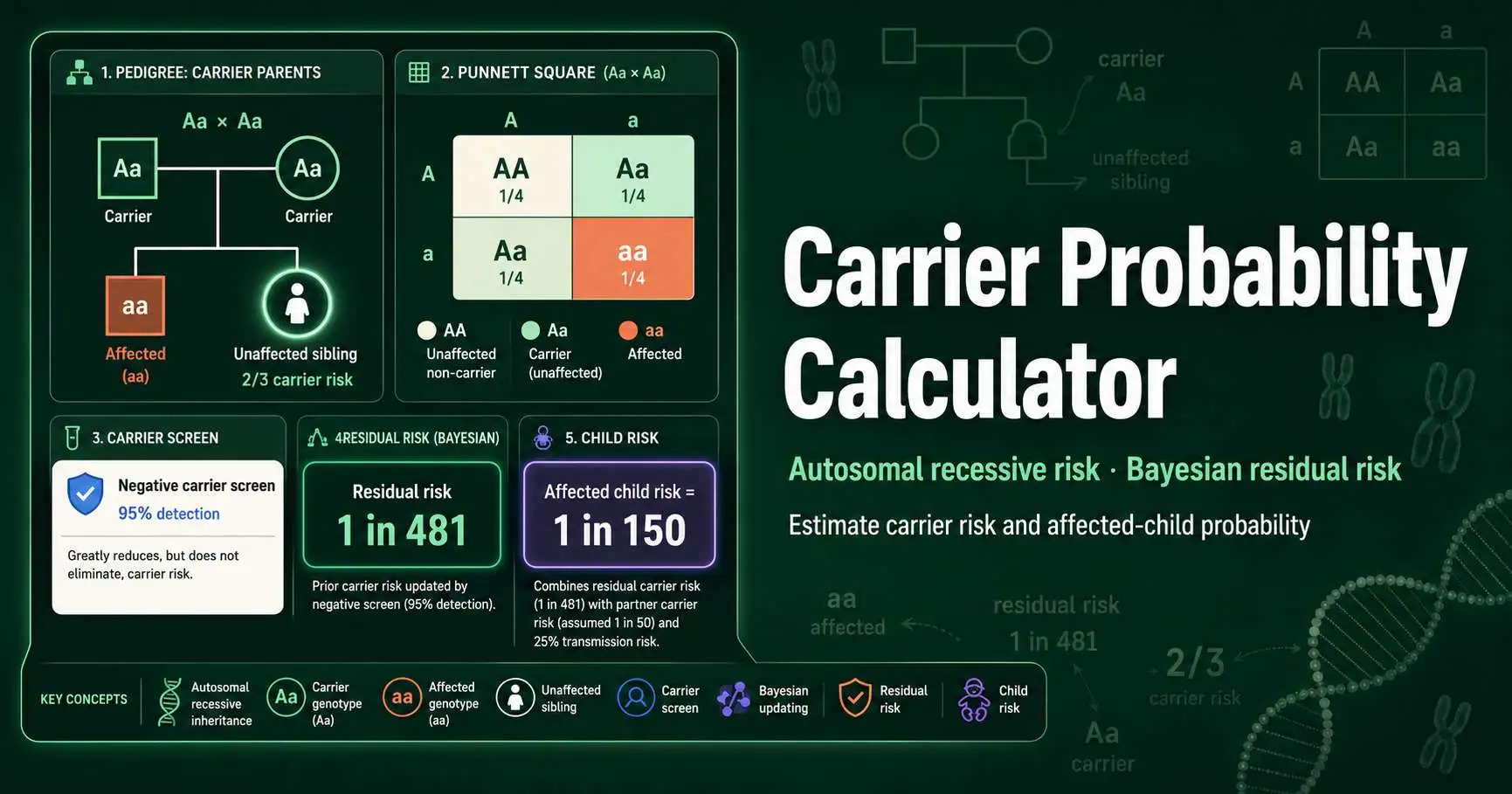
Autosomal recessive carrier probability diagram showing an unaffected sibling, carrier parents, negative screening residual risk, and affected-child probability
Figure 1. An autosomal recessive carrier-risk model connects pedigree structure, Aa carrier genotypes, aa affected offspring, and residual risk after screening. The diagram demonstrates how family-history information changes prior probability before Bayesian updating adjusts risk after a negative carrier test.

What is Carrier Probability Calculator?

A carrier probability calculator estimates the chance that an unaffected person carries one altered allele for an autosomal recessive condition. It answers questions like “What is my carrier risk if my sibling is affected?” and “How much does a negative carrier screen reduce my risk?”

Autosomal recessive inheritance requires two altered gene copies for the affected phenotype. A person with one altered copy usually acts as a carrier and can pass that allele to a child. MedlinePlus explains that carriers often show no signs of the condition but can transmit the variant.

This tool uses simple Mendelian probability plus Bayesian updating. It does not name a specific gene, because genes such as CFTR, HBB, SMN1, and HEXA need different carrier frequencies, detection rates, and test panels.

What each part of Carrier Probability Calculator does

Carrier probability presets

Presets load common classroom cases. They include an unaffected sibling of an affected person, one known carrier parent, two population-frequency partners, and a negative-screen example.

Person and partner cards

These cards store the prior carrier probabilities before child-risk calculation. You can enter 1/25, 0.04, or 4, and the tool reads each format as a probability.

Negative carrier screen switches

The switches apply residual-risk logic. A negative result lowers risk according to the detection rate, but it leaves risk from variants outside the test’s detection range.

Child-risk result cards

The result cards combine both partner probabilities. Affected-child risk equals person carrier risk × partner carrier risk × 25% for an autosomal recessive condition.

How to use Carrier Probability Calculator

  1. 1

    Choose a carrier-risk scenario

    Select a family-history or population-frequency preset for person 1 and the reproductive partner.

  2. 2

    Edit carrier probability values

    Enter probabilities as fractions such as 1/25, decimals such as 0.04, or percentages such as 4.

  3. 3

    Add negative carrier screen results

    Turn on negative screening and set the detection rate when a carrier test failed to detect a variant.

  4. 4

    Read residual and child risks

    Review posterior carrier probability, affected-child risk, carrier-child chance, and non-carrier chance.

Carrier probability formulas used by the calculator

For a known Aa × Aa carrier couple, the Punnett square gives AA, Aa, Aa, and aa. That means 25% non-carrier, 50% carrier, and 25% affected for each pregnancy. MedlinePlus gives the same 25%, 50%, and 25% breakdown for autosomal recessive carrier parents.

For an unaffected sibling of an affected child, the calculator uses conditional probability. The unaffected sibling cannot be aa. Among the remaining AA, Aa, and Aa possibilities, two are carriers. That gives a 2/3 carrier probability.

After a negative carrier screen, the tool applies this residual-risk formula: prior × missed-detection probability divided by total negative-test probability. If the prior is 1/25 and the detection rate is 95%, residual carrier risk becomes about 0.208%, or roughly 1 in 481.

Carrier probability worked examples

Example 1: unaffected sibling of an affected person

Two carrier parents have an affected child. Another sibling is unaffected. That unaffected sibling has three possible genotypes left: AA, Aa, and Aa.

Two of the three possibilities carry the recessive allele. The sibling’s carrier probability equals 2/3, or 66.67%. If their partner has a 1/25 carrier probability, affected-child risk equals 2/3 × 1/25 × 1/4 = 1/150.

Example 2: negative screen after a 1 in 25 prior

A person starts with a 1/25 carrier estimate. Their carrier screen reports negative, and the panel detects 95% of carriers for the modelled condition.

Residual risk equals 0.04 × 0.05 divided by 0.04 × 0.05 + 0.96. That gives 0.00208, or about 1 in 481. The test lowers risk sharply, but it does not remove all risk.

Where carrier probability matters in genetics

Carrier probability supports genetic counselling, reproductive planning, and medical genetics education. It helps students connect a pedigree diagram to a numerical risk estimate. It also shows why a partner’s probability matters for autosomal recessive child risk.

Clinical examples include cystic fibrosis involving CFTR, sickle cell disease involving HBB, spinal muscular atrophy involving SMN1, and Tay-Sachs disease involving HEXA. Each condition needs its own carrier frequency and test sensitivity. For that reason, a classroom calculation should not replace a genetics professional’s risk assessment.

You can review autosomal recessive inheritance patterns through MedlinePlus and a broader inheritance overview through OpenStax. MedlinePlus explains autosomal recessive inheritance and OpenStax summarizes carrier inheritance patterns.

What this autosomal recessive carrier calculator cannot tell you

This calculator does not diagnose carrier status. It models probability from the values you enter. Real carrier screening depends on gene coverage, variant type, ancestry, family variant information, laboratory method, and residual-risk tables.

The tool also assumes one autosomal recessive locus with complete penetrance. It does not model compound heterozygosity, de novo variants, consanguinity coefficients, pseudodeficiency alleles, copy-number assay limits, or X-linked inheritance.

Use this page for education and preliminary risk practice. Discuss personal carrier screening, pregnancy risk, or family-history interpretation with a qualified genetics professional.

Carrier Probability Calculator FAQs

What does a carrier probability calculator estimate?
A carrier probability calculator estimates the chance that a person carries one pathogenic recessive allele. It combines family-history information, population carrier frequency, and negative carrier screening results. For an autosomal recessive condition, a carrier usually has one working allele and one altered allele. The tool also estimates affected-child risk when both reproductive partners have carrier probabilities.
Why is an unaffected sibling of an affected person often given a 2 in 3 carrier risk?
Two carrier parents can have AA, Aa, Aa, or aa children. If a sibling is known to be unaffected, the aa category no longer applies. Three unaffected genotype possibilities remain: AA, Aa, and Aa. Two of those three are carriers, so the conditional carrier probability equals 2/3.
How does a negative carrier screen change carrier probability?
A negative carrier screen lowers carrier probability, but it rarely makes risk zero. The calculator uses detection rate to estimate residual risk. For example, a 1 in 25 prior probability with a 95% detection rate drops to about 1 in 481 after a negative result. The remaining risk comes from variants that the test did not detect.
How do you calculate affected-child risk for an autosomal recessive condition?
Affected-child risk equals the first partner carrier probability multiplied by the second partner carrier probability multiplied by 1/4. The 1/4 factor comes from the Aa × Aa Punnett square. When both parents are confirmed carriers, each pregnancy has a 25% affected risk, 50% carrier chance, and 25% non-carrier chance. When one partner has uncertain carrier status, the calculator weights that 25% risk by probability.
Can this calculator use population carrier frequencies?
Yes. You can enter population estimates such as 1/25, 1/50, or 1/100. Use a carrier frequency that matches the specific condition, test panel, and population in your worksheet or counselling note. Carrier frequencies vary by gene, ancestry, founder history, and screening method. This tool treats the value you enter as the prior probability before testing or partner information changes the risk.
Does this carrier calculator work for X-linked inheritance?
No. This page models autosomal recessive inheritance, where the gene lies on one of the numbered chromosomes. X-linked conditions need sex-specific transmission rules because sons inherit a Y chromosome from their father and an X chromosome from their mother. A carrier mother can pass an X-linked recessive allele to sons and daughters in different ways. Use a sex-linked inheritance calculator for X-linked recessive, X-linked dominant, or Y-linked problems.
Can a carrier have symptoms of an autosomal recessive condition?
Most carriers for classic autosomal recessive conditions do not show the affected phenotype. One normal allele usually produces enough functional gene product for health. Some genes show carrier effects, variable penetrance, or biochemical findings, but those cases require condition-specific interpretation. This calculator uses the standard classroom model: AA is non-carrier, Aa is carrier, and aa is affected.

Use these tools to compare autosomal recessive carrier risk with direct Punnett square inheritance and sex-linked transmission.