Dilution Factor Calculator

Calculate fold dilution from volumes, concentrations, target factors, or serial dilution steps. Use the result to prepare accurate stock, diluent, and final-solution volumes for lab workflows.

Calculate fold dilution from volumes or concentrations

Enter the values you already know. The calculator reports dilution factor, final concentration, stock volume, diluent volume, log10 dilution, and batch totals.

Start with a dilution factor example

Choose a common setup, then change the volumes, concentrations, or serial-dilution steps.

Calculation mode

Pick the input style that matches your protocol. Results update as soon as you change a value.

Live dilution factor result

Dilution factor

10×

The final solution is 10 times less concentrated than the stock.

Diluent

Stock per sample

10 µL

Diluent per sample

90 µL

Final concentration

10 µM

Log10 dilution

1

Total stock volume

11 µL

Total diluent volume

99 µL

Concentration reduction

90%

A 10× dilution reduces concentration by 90%. A 100× dilution reduces concentration by 99%.

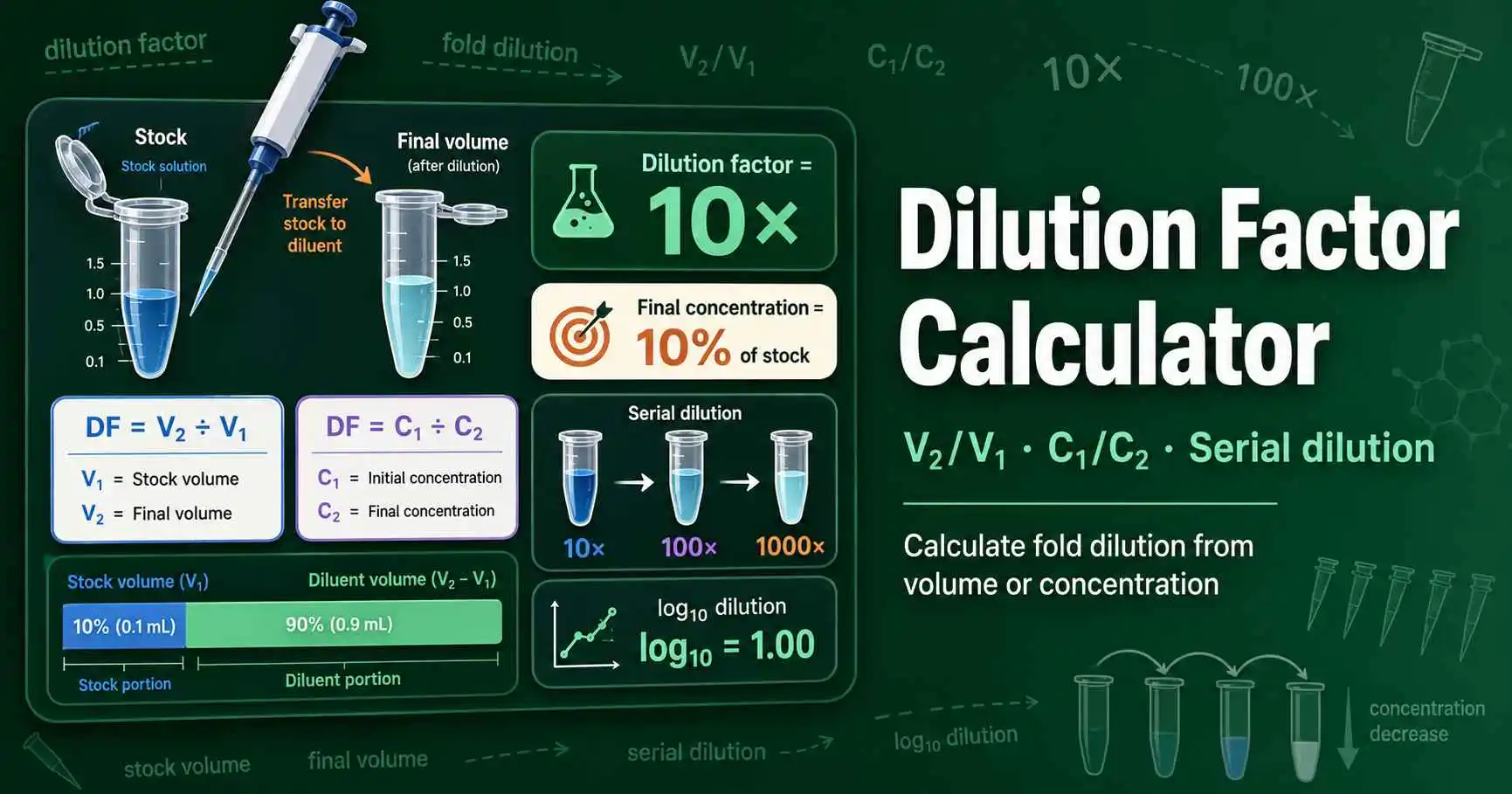
Diagram showing dilution factor calculation from stock volume, final volume, concentration decrease, and serial dilution steps.
Figure 1. Dilution factor links the stock solution to the final mixture. The same fold dilution can come from volume ratios, concentration ratios, or multiplied serial dilution steps.

What dilution factor means

Dilution factor is the fold decrease from stock concentration to final concentration. A 10× dilution gives one tenth of the original concentration. A 100× dilution gives one hundredth of the stock concentration.

Most lab problems use one of two routes. Volume problems use final volume divided by stock volume. Concentration problems use stock concentration divided by final concentration.

Use the dilution ratio calculator when your protocol says 1:10 or 1 part stock plus 9 parts diluent. Use this page when you need the fold dilution itself.

Core equations used here

From volumes

Dilution factor = final volume ÷ stock volume

10 µL stock in 100 µL total gives a 10× dilution.

From concentrations

Dilution factor = stock concentration ÷ final concentration

100 µM diluted to 10 µM also gives a 10× dilution.

What each input tells you

Choose the mode that matches your starting information. This keeps the calculation transparent and prevents common ratio mistakes.

V₂/V₁ mode

Calculates fold dilution directly from final volume and stock volume.

C₁/C₂ mode

Calculates fold dilution from stock concentration and desired final concentration.

Target factor mode

Solves the stock and diluent volumes needed to make a known fold dilution.

Serial mode

Multiplies step factors across a dilution series such as 10 × 10 × 10.

Log10 dilution

Shows the dilution on a power-of-ten scale for standard curves and microbiology work.

Pipetting warning

Flags volumes that can create high relative error on common micropipettes.

Worked dilution factor examples

Find the factor from pipetted volumes

You add 20 µL of stock DNA and bring the tube to 200 µL final volume. Divide 200 by 20. The dilution factor equals 10×.

If the starting DNA concentration was 50 ng/µL, the final concentration equals 5 ng/µL. For DNA-specific copy-number work, transfer that value into the DNA copy number calculator.

Calculate a serial dilution total factor

A qPCR standard curve often uses seven 10-fold dilution steps. Multiply the step factors: 10 × 10 × 10 × 10 × 10 × 10 × 10 = 10,000,000×.

Use the serial dilution calculator when you need every tube volume in the series, not just the total factor.

How to interpret common fold dilutions

Dilution factorFinal concentrationTypical meaning
50% of stockOne part stock plus one part diluent
10×10% of stockCommon first dilution for DNA or standards
100×1% of stockOften safer as two 10× steps
10⁶×0.0001% of stockSerial dilution for qPCR or colony counts

Accuracy checks before preparing a dilution

A large single-step dilution can force you to pipette less than 1 µL. Use an intermediate dilution when the stock transfer volume becomes too small. This improves precision and reduces tube-to-tube variation.

Dilution follows conservation of solute: adding solvent changes concentration but not the amount of solute transferred. Chemistry LibreTexts explains this same principle in its dilution overview. Review the dilution concept.

Related dilution tools

Dilution factor questions

What is a dilution factor?

A dilution factor tells how many times the stock solution was diluted. A 10× dilution means the final solution contains one tenth of the original concentration. You can calculate it from volumes with final volume divided by stock volume, or from concentrations with stock concentration divided by final concentration.

How do I calculate dilution factor from volume?

Divide the final volume by the stock volume. If you add 10 µL stock and bring the final volume to 100 µL, the dilution factor equals 100 ÷ 10 = 10×. The final concentration becomes one tenth of the stock concentration.

How do I calculate dilution factor from concentration?

Divide the stock concentration by the final concentration. A 100 µM stock diluted to 10 µM gives a 10× dilution factor. The same logic works for mg/mL, ng/µL, %, and X buffer strength when both concentrations use the same unit.

Is a 1:10 dilution the same as a 10× dilution?

Yes, when 1:10 means one part stock in ten total parts. A 10× dilution reduces concentration to 1/10 of the original stock. A phrase like “1 part stock plus 10 parts diluent” is different because it creates eleven total parts and therefore an 11× dilution.

How do serial dilution factors combine?

Serial dilution factors multiply. Six 10-fold steps create a total dilution factor of 10⁶, or 1,000,000×. Four 2-fold steps create a 16× dilution. This tool calculates the total factor and the per-step tube setup.

What does log10 dilution mean?

Log10 dilution tells how many powers of ten separate stock and final concentration. A 100× dilution has log10 dilution of 2 because 10² equals 100. Microbiology, qPCR, and standard-curve workflows often describe dilution series using log10 spacing.

When should I make an intermediate dilution?

Make an intermediate dilution when the required stock volume falls below your reliable pipetting range. For example, 0.2 µL stock into 99.8 µL diluent produces high relative error. A two-step dilution usually improves accuracy and reproducibility.