Serial Dilution Calculator

Plan a stepwise dilution series with transfer volume, diluent volume, cumulative dilution factor, concentration at each tube, and CFU/mL estimates from colony counts.

Build a tube-by-tube dilution series

Enter a step factor, final tube volume, and starting concentration. The table shows each transfer, each diluent addition, and the concentration after every dilution step.

Start with a serial dilution preset

Pick a common series, then adjust the step factor, concentration, volumes, and number of tubes.

Series setup

Use constant mode for 10-fold or 2-fold series. Use custom mode when different steps need different factors.

Series result

Total dilution factor

1.000e+7×

Final concentration

0.1 copies/µL

Log10 dilution

7

Smallest transfer

10 µL

Batch totals

Total transfer volume

77 µL

Total diluent volume

693 µL

CFU/mL helper

Use this only when you plate a known volume from one dilution step.

8.600e+7 CFU/mL

Tube-by-tube dilution table

Each row uses the previous tube as the stock for the next dilution step.

Step 1

10×

Transfer
10 µL
Diluent
90 µL
Concentration
100000 copies/µL

Step 2

100×

Transfer
10 µL
Diluent
90 µL
Concentration
10000 copies/µL

Step 3

1000×

Transfer
10 µL
Diluent
90 µL
Concentration
1000 copies/µL

Step 4

10000×

Transfer
10 µL
Diluent
90 µL
Concentration
100 copies/µL

Step 5

100000×

Transfer
10 µL
Diluent
90 µL
Concentration
10 copies/µL

Step 6

1.000e+6×

Transfer
10 µL
Diluent
90 µL
Concentration
1 copies/µL

Step 7

1.000e+7×

Transfer
10 µL
Diluent
90 µL
Concentration
0.1 copies/µL
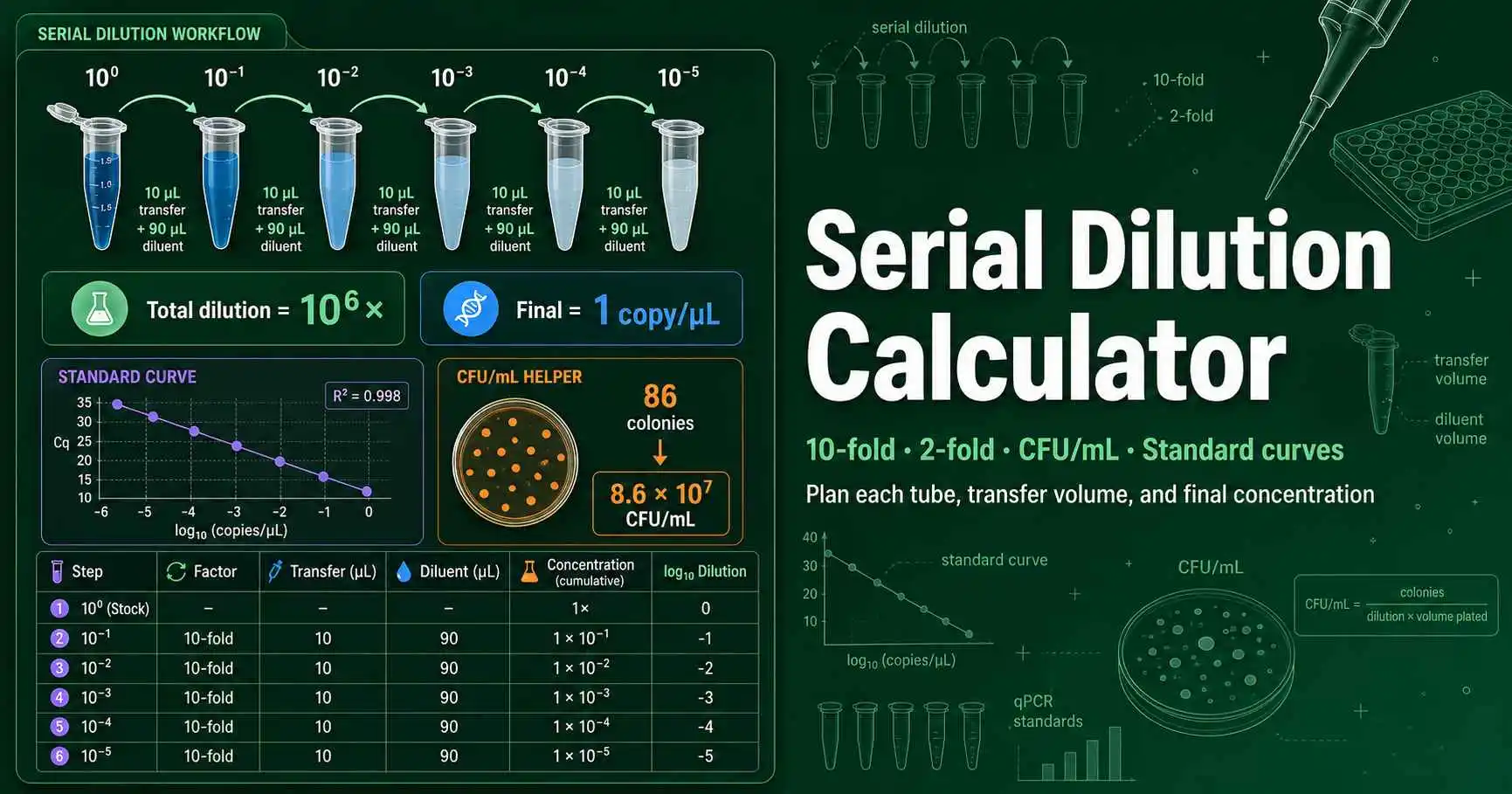
Diagram showing serial dilution tubes with transfer arrows, diluent volumes, cumulative dilution factors, and final concentration values.
Figure 1. A serial dilution uses the previous tube as the source for the next tube. Each step multiplies the cumulative dilution factor and lowers the concentration by a predictable amount.

What serial dilution does

A serial dilution reduces concentration in controlled steps. Each tube receives a transfer from the previous tube plus fresh diluent. This makes very large dilutions practical and reproducible.

A 10-fold series creates concentrations of 10⁻¹, 10⁻², 10⁻³, and onward. A 2-fold series creates closer spacing and works well for dose-response experiments. Mixed factors let you spread wide first, then refine the range.

Use the dilution factor calculator when you need one fold dilution. Use this page when your protocol needs several connected tubes or wells.

Equations used for each step

Transfer volume

Transfer = final tube volume ÷ step factor

For a 10-fold step in 100 µL total, transfer 10 µL.

Cumulative factor

Total factor = factor₁ × factor₂ × factor₃...

Seven 10-fold steps create a 10⁷ total dilution factor.

What each input controls

Each setting changes either the concentration spacing, the pipetting plan, or the final estimate. Use the table as a checklist before you label tubes.

Step factor

Sets how much each tube dilutes the previous tube. Common values include 2, 5, and 10.

Number of steps

Controls how far the series extends from the starting sample.

Final tube volume

Sets the total volume in every dilution tube or well.

Starting concentration

Lets the table report actual concentration after each dilution step.

Custom factors

Handles mixed series such as 10,10,2,2 when equal spacing is not enough.

CFU/mL helper

Back-calculates original microbial concentration from colonies and plated volume.

Worked serial dilution examples

Prepare a 10-fold qPCR standard curve

Start with 1,000,000 copies/µL and prepare seven 10-fold dilutions. The final standard contains 0.1 copies/µL because 1,000,000 ÷ 10⁷ = 0.1. Each 100 µL tube uses 10 µL transfer and 90 µL diluent.

After the run, analyze the standard-curve slope with the qPCR efficiency calculator.

Estimate CFU/mL from a dilution plate

A plate from the 10⁻⁵ tube gives 86 colonies, and you plated 0.1 mL. The original concentration equals 86 × 100,000 ÷ 0.1 = 86,000,000 CFU/mL.

Pick a plate with a countable colony range. Many teaching labs use about 30 to 300 colonies as a practical counting window.

Common step factors and use cases

Step factorTypical setupBest use
2-fold50 µL transfer + 50 µL diluentDose-response curves and titrations
5-fold20 µL transfer + 80 µL diluentModerate spacing across a wider range
10-fold10 µL transfer + 90 µL diluentqPCR standards, microbial counts, large dilution ranges

Accuracy checks before making the series

Mix each tube thoroughly before transferring to the next tube. Incomplete mixing carries the error forward and affects every later dilution. Use a fresh tip between steps to avoid carryover from the previous concentration.

Serial dilution reduces concentration through repeated dilution factors. LibreTexts describes serial dilution as a series where the dilution factor usually stays the same at each step and gives a 1:10 example with one part sample plus nine parts solvent. Review the serial dilution method.

Use the solution dilution calculator when you only need one final target concentration from a stock solution.

Related dilution and qPCR tools

Serial dilution questions

What is a serial dilution?

A serial dilution is a sequence of stepwise dilutions. Each tube usually uses the previous tube as its stock. A seven-step 10-fold series creates cumulative factors of 10×, 100×, 1000×, and so on. This method avoids one tiny transfer when the final dilution needs to be very large.

How do I calculate the total dilution factor in a series?

Multiply every step factor together. Three 10-fold steps give 10 × 10 × 10 = 1000×. A mixed series such as 10, 10, 2, and 2 gives 400×. The calculator applies this multiplication to each row and reports the cumulative factor.

How much transfer volume do I need for a 10-fold dilution?

Divide the final tube volume by 10. For a 100 µL final tube, transfer 10 µL from the previous tube and add 90 µL diluent. For a 1 mL final tube, transfer 100 µL and add 900 µL diluent. The same rule works for any fixed step factor.

Why should I use serial dilution instead of one large dilution?

Serial dilution improves pipetting accuracy when one large dilution would require a very small stock volume. For example, a 1:1,000,000 dilution works better as six 10-fold steps than as 0.001 µL stock into 999.999 µL diluent. Each step keeps the transfer volume in a practical pipette range.

How do I calculate CFU/mL from a serial dilution plate?

Use colonies multiplied by the cumulative dilution factor, then divide by plated volume in mL. If 86 colonies grow from the 10⁻⁵ dilution and you plated 0.1 mL, the original concentration equals 86 × 100,000 ÷ 0.1 = 86,000,000 CFU/mL. The calculator includes this helper for microbiology plates.

What colony count range should I trust?

Many teaching labs prefer plates with about 30 to 300 colonies. Fewer colonies create large counting noise. Too many colonies can merge and undercount the true number. The calculator warns when the entered colony count sits outside that common range.

Can I use this for qPCR standard curves?

Yes. Enter the starting copy number, choose a 10-fold or 5-fold step factor, and set the number of standards. The output table gives the concentration at each standard point. You can then use those standards with a qPCR efficiency calculation after the run.