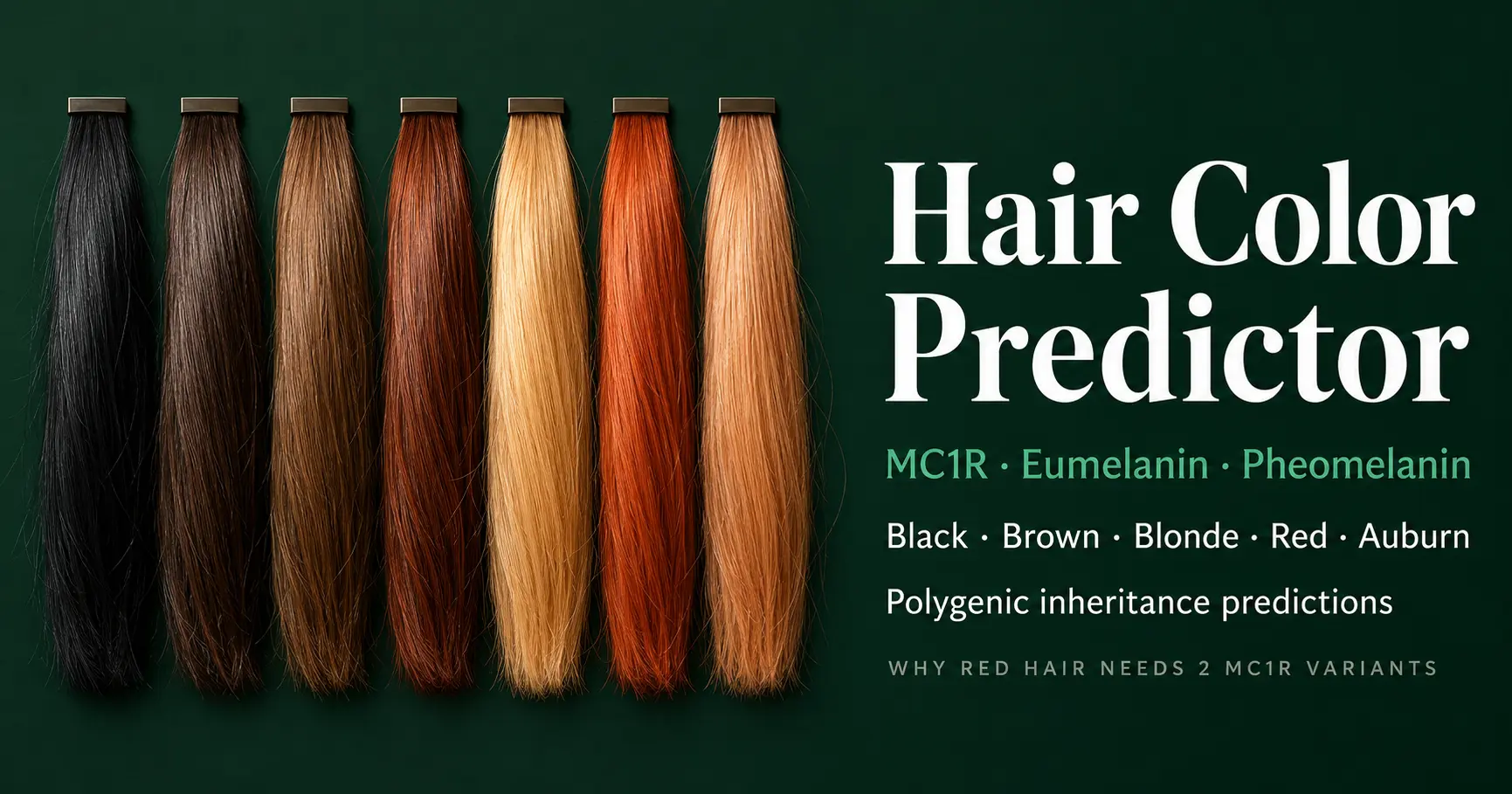
The Genetics of Hair Colour — Two Pigments, Many Genes
Human hair colour is determined by the ratio and total quantity of two melanin types produced in specialised cells called melanocytes located in the hair follicle bulb. Eumelanin produces brown and black shades. Pheomelanin produces red and yellow shades. The interplay between these two pigments — regulated by a network of at least a dozen genes — generates the full spectrum from jet black to strawberry blonde to vivid red.
Unlike eye colour, which has one dominant locus (HERC2/OCA2), hair colour has no single predominant gene. The most influential gene is MC1R — but it primarily controls the red hair extreme. The genetic architecture of the full black-to-blonde spectrum involves many loci, which is why hair colour prediction from parental phenotypes alone carries more uncertainty than blood type inheritance.
A landmark 2021 genome-wide association study by Hysi et al. in Nature Genetics — using 350,000 individuals from the UK Biobank — identified 123 independent genetic loci associated with hair colour, together explaining about 40% of the total variation. This confirms that hair colour is genuinely complex, driven by many small-effect variants rather than a handful of large-effect genes.
MC1R — The Molecular Switch Between Eumelanin and Pheomelanin
The melanocortin 1 receptor (MC1R) gene on chromosome 16q24.3 encodes a G-protein-coupled receptor on the melanocyte plasma membrane. It acts as the master switch controlling pigment type. When alpha-melanocyte-stimulating hormone (α-MSH) binds MC1R, it activates adenylyl cyclase via G-alpha-s, elevating intracellular cyclic AMP (cAMP). High cAMP activates protein kinase A, which phosphorylates CREB and ultimately upregulates MITF (melanocyte inducing transcription factor). MITF activates transcription of TYR, TYRP1, and DCT — the enzymes of the eumelanin synthesis pathway.
When MC1R signalling is reduced — due to loss-of-function variants — cAMP levels remain low, MITF activation is reduced, and the melanocyte defaults to pheomelanin synthesis via a separate pathway. Agouti Signalling Protein (ASIP), encoded by the ASIP gene, is an endogenous MC1R antagonist that competes with α-MSH — further shifting melanocytes toward pheomelanin when expressed.
No MC1R variants
Typical outcome: Black or dark brown
Eumelanin: Maximum
Pheomelanin: Minimal
~80% of individuals
1 MC1R variant (heterozygous)
Typical outcome: Brown, auburn, or dark red tints
Eumelanin: Moderate–high
Pheomelanin: Low–moderate
Carrier — often subtle effect
2 MC1R variants (homozygous/compound)
Typical outcome: Red or strawberry blonde
Eumelanin: Very low to none
Pheomelanin: Maximum
~1–2% of global population
Other Major Hair Colour Genes Beyond MC1R
While MC1R is the most studied hair colour gene, the genetics of black, brown, and blonde hair are primarily controlled by other loci that regulate total melanin production, melanosome development, and melanocyte activity.
OCA2 / HERC2 (Chromosome 15)
Regulates melanosomal pH through the P protein, affecting tyrosinase activity and eumelanin synthesis rate. OCA2 variants are the second most important locus after MC1R for dark-to-light hair variation. The same HERC2 rs12913832 SNP important for eye colour also contributes to hair colour.
TYRP1 (Chromosome 9)
Tyrosinase-related protein 1 catalyses a key step in eumelanin polymerisation. Variants in TYRP1 influence brown versus black hair shade — individuals with two non-functional TYRP1 alleles may have lighter, browner eumelanin (tyrosine is oxidised differently). Associated with brown hair in GWAS studies.
KITLG (Chromosome 12)
KIT Ligand (stem cell factor) promotes melanocyte proliferation and survival in hair follicles. A regulatory SNP near KITLG (rs12821256) is strongly associated with European blonde hair. This variant reduces melanocyte density in follicles during postnatal development, explaining the common darkening of blonde hair in children.
SLC45A2 / MATP (Chromosome 5)
Membrane-associated transporter protein affects melanosome acidification — the same mechanism as OCA2. Associated with lighter hair in Europeans and oculocutaneous albinism type 4 when non-functional. Loss-of-function variants reduce both hair and skin pigmentation.
ASIP (Chromosome 20)
Agouti Signalling Protein is the endogenous antagonist of MC1R. ASIP competes with α-MSH for MC1R binding and, when expressed, shifts melanocytes toward pheomelanin production. Variants near ASIP associate with lighter hair colour and freckling in GWAS datasets.
IRF4 (Chromosome 6)
Interferon Regulatory Factor 4 is a transcription factor expressed in melanocytes. A variant at rs12203592 is associated with lighter hair, freckling, and moles. IRF4 regulates MITF expression and therefore affects the overall level of melanocyte pigmentation activity.
MC1R Variants, Red Hair, and Medical Significance
MC1R loss-of-function variants have medical implications beyond hair colour. Because pheomelanin is a less efficient photoprotectant than eumelanin and generates reactive oxygen species under UV exposure, red-haired individuals (two MC1R variants) face significantly elevated melanoma risk — approximately 3-to-4-fold higher than individuals without MC1R variants. This risk is independent of sun exposure habits, suggesting intrinsic pheomelanin oxidative damage contributes to melanocyte DNA damage.
MC1R variants also associate with increased pain sensitivity. MC1R receptors are expressed in peripheral sensory neurons, and loss-of-function variants alter opioid receptor coupling in neural tissue. Clinical studies have found that red-haired patients require higher doses of volatile anaesthetic agents and show altered analgesic responses — a genuine pharmacogenomic consideration in surgical planning.
Understanding hair colour genetics therefore extends beyond curiosity about offspring appearance — it provides insight into individual skin cancer risk and pharmacogenomic differences that matter clinically.
Hair Colour Inheritance Patterns — What to Expect
| Parent 1 | Parent 2 | Most likely offspring outcomes |
|---|---|---|
| Black | Black | Black (85%), Dark Brown (10%), other (5%) |
| Brown | Brown | Brown (45%), Dark Brown (15%), Blonde (15%), Auburn (12%), other |
| Blonde | Blonde | Blonde (65%), Brown (10%), Strawberry Blonde (10%), Red (5%) |
| Red | Red | Red (65%), Auburn (18%), Strawberry Blonde (10%), Blonde (5%) |
| Brown | Red | Brown (25%), Auburn (30%), Strawberry Blonde (20%), Red (20%) |
| Black | Blonde | Dark Brown (35%), Brown (40%), Black (10%), other (15%) |
Approximate population-level probabilities. Specific outcomes depend on each parent's MC1R genotype, ASIP, KITLG, and multiple other loci.
Frequently Asked Questions — Hair Colour Genetics
What genes determine hair colour?
Why is red hair rare and genetically recessive?
Can two dark-haired parents have a blonde or red-haired child?
What is eumelanin and how does it produce black and brown hair?
What is the MC1R gene and why is it the red hair gene?
Why does hair colour often darken during childhood and adolescence?
Is auburn hair the same as red hair genetically?
What causes blonde hair to exist genetically?
Related Tools
Eye Color Calculator
HERC2/OCA2 polygenic eye colour prediction with SVG iris illustrations.
Open CalculatorBaby Genetics Calculator
Hair colour, eye colour, and blood type probabilities in one tool.
Open CalculatorBlood Type Calculator
ABO and Rh factor inheritance with transfusion compatibility.
Open CalculatorPunnett Square Calculator
Mendelian genetics crosses — monohybrid to pentahybrid with ratios.
Open Calculator