Oligo Dilution Calculator for PCR Primers and Probes
Compute exact stock and diluent volumes to prepare any working concentration from a concentrated oligonucleotide stock. Built on the C₁V₁ = C₂V₂ relationship with automatic µM, nM, and pM unit handling.
Calculate your dilution
Enter your stock concentration, target working concentration, and final volume. The recipe updates instantly — no Calculate button.
Stock (C₁)
Concentration of the lyophilised oligo after resuspension.
Working (C₂)
Concentration needed for PCR, qPCR, sequencing, or transfection.
Final volume (V₂)
Total volume of working solution to prepare.
Volume composition
Calculation
Pipetting check
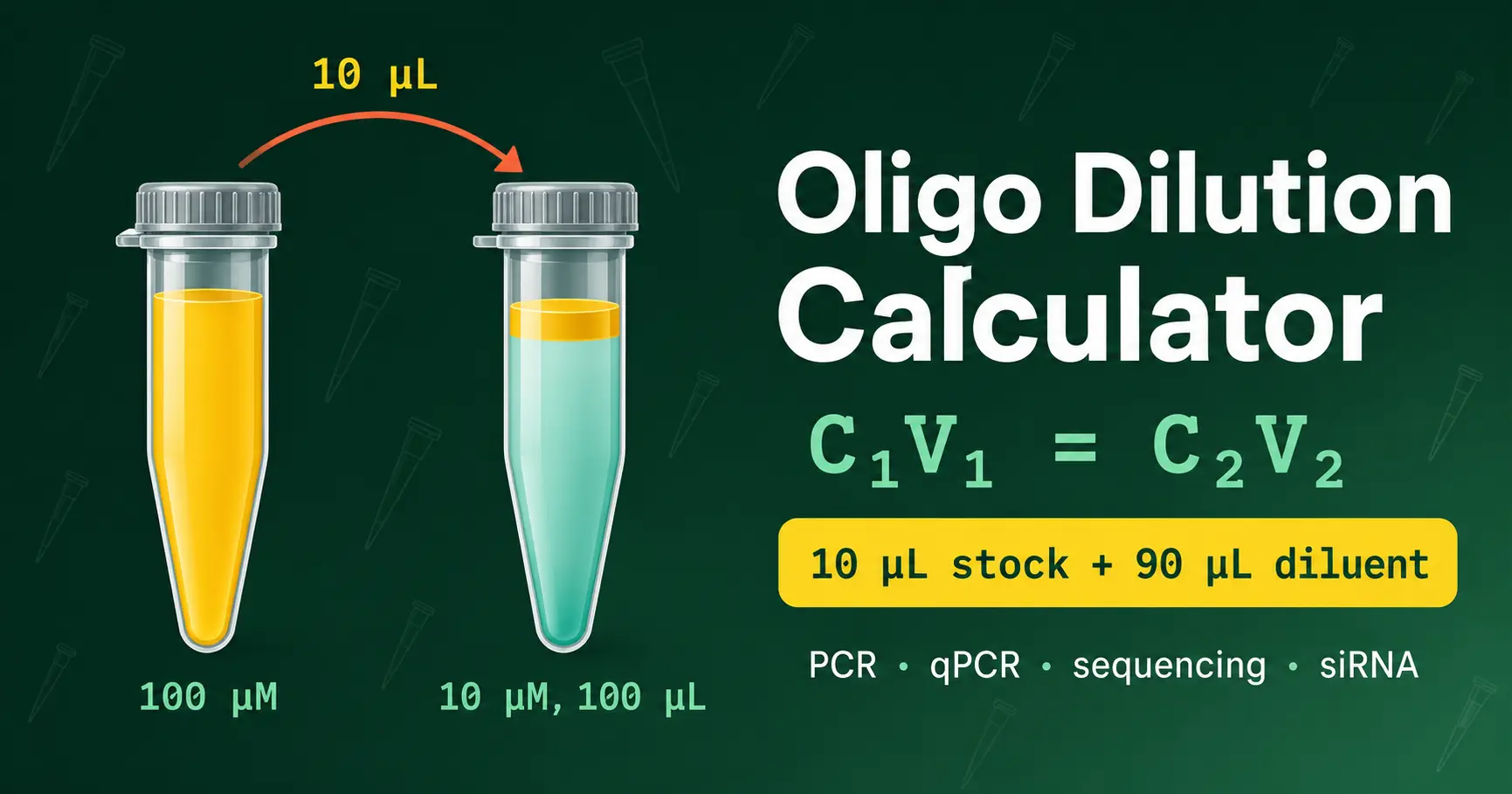
What is the C₁V₁ = C₂V₂ equation?
The dilution equation says that the moles of solute drawn from a stock equal the moles delivered to the final solution. Stock concentration C₁ multiplied by aliquot volume V₁ gives moles transferred. Final concentration C₂ multiplied by final volume V₂ gives moles in the diluted solution. Setting them equal is just stoichiometric bookkeeping — no oligo appears or disappears during dilution.
The equation works for any units, as long as C₁ and C₂ share units and V₁ and V₂ share units. Mixing µM with nM requires conversion (1 µM = 1000 nM); this calculator handles the conversion internally so you can pick any combination of units. The same equation applies to enzyme stocks, BSA solutions, sodium chloride buffers, and any other solute — it is not specific to oligonucleotides.
A non-obvious detail: at very low concentrations (below 10 nM), adsorption to polypropylene tube walls becomes proportionally significant. A nominal 1 nM solution prepared by serial dilution into standard microfuge tubes can lose 30–50% of the oligo to surface binding within hours. Low-binding tubes (silanised or coated) and carrier nucleic acid (10 ng/µL tRNA) mitigate this loss when working with sub-nM concentrations.
Standard oligo dilution workflow
Oligonucleotides ship lyophilised in known nmol amounts. A typical 25-nmol synthesis arrives in a 1.5 mL screw-cap tube with the exact yield printed on the label. The first dilution — resuspension — converts the dry pellet into a stock at a chosen concentration (usually 100 µM). The second dilution — the subject of this calculator — converts the concentrated stock into a working solution at 10 µM or below.
Most labs maintain three concentration tiers per oligo. The 100 µM concentrated stock sits at −80 °C in single-use aliquots and is never freeze-thawed. A 10 µM working stock sits at −20 °C in 50–200 µL aliquots and tolerates 10–20 freeze-thaw cycles. The reaction-ready dilution — typically 1 µM or lower — is prepared fresh weekly and kept at 4 °C. This tiered system limits exposure of the concentrated stock to handling and freeze-thaw stress.
For high-throughput work, robotic liquid handlers prepare 96-well plates of pre-diluted primer pairs at 5 µM each, ready to be added in a single transfer step to qPCR master mixes. The dilution equation determines the volumes per well; the calculator output here is identical to what those systems compute.
Worked examples
Example 1: 100 µM stock to 10 µM working
Goal: prepare 100 µL of 10 µM working stock from a 100 µM resuspended primer.
V₁ = (C₂ × V₂) / C₁ = (10 µM × 100 µL) / 100 µM = 10 µL stock
Diluent = V₂ − V₁ = 100 − 10 = 90 µL TE buffer
Result: 1:10 dilution. P20 pipette handles both transfers comfortably.
Example 2: 100 µM to 250 nM (high dilution factor)
Goal: prepare 50 µL of 250 nM TaqMan probe from 100 µM stock.
Convert: 250 nM = 0.25 µM. V₁ = (0.25 µM × 50 µL) / 100 µM = 0.125 µL stock
Pipetting 0.125 µL is below the accurate range of any pipette. Use a two-step dilution: first dilute 100 µM to 10 µM (5 µL into 45 µL), then dilute 10 µM to 250 nM (1.25 µL into 48.75 µL).
Final dilution factor is 400×, distributed across two 20× and 40× steps.
Practical applications
Standard PCR setup. A 50 µL reaction typically uses 200 nM each of forward and reverse primer, delivered as 1 µL of a 10 µM working stock. The 10 µM dilution prepared with this calculator gives you enough primer for 50–100 reactions per 50 µL of working stock.
qPCR primer-probe mixes. Multiplex qPCR assays combine forward primer, reverse primer, and probe in a single tube. Each component is diluted separately to a working stock (10 µM primers, 5 µM probe), then mixed in defined ratios for the assay format. The dilution calculator runs once per oligo.
siRNA transfection. Knockdown experiments use siRNA at 10–100 nM final concentration in the cell culture well. A standard workflow dilutes 50 µM siRNA stock to 10 µM working concentration, then further dilutes into Opti-MEM for the transfection complex with Lipofectamine.
Hybridisation probes. Northern blots, in situ hybridisation, and FISH all use labelled oligo probes at defined concentrations (typically 100 ng/mL for FISH, 1–10 ng/µL for Northern). Mass-based concentrations require knowing the molecular weight — use the Oligo Concentration Calculator alongside this tool for mass-to-molar conversions.
Limitations and caveats
The C₁V₁ = C₂V₂ equation assumes ideal mixing and no loss of solute. In practice, oligonucleotides adsorb to plastic tube walls — especially at concentrations below 10 nM in standard polypropylene. Dilutions made into low-binding tubes or with carrier nucleic acid (10 ng/µL tRNA or salmon sperm DNA) retain closer to nominal concentration.
Single-step dilutions above 100× compound pipetting error and amplify any concentration drift in the stock. For dilutions exceeding 50×, prefer a two-step serial approach. The calculator flags problematic dilution factors but does not enforce a redesign — the choice depends on your accuracy requirements.
This calculator is educational. For GMP, GLP, or clinical assay preparation, follow the SOP for your facility and validate dilutions empirically by spectrophotometric or fluorometric measurement of the final solution. Reference: IDT oligonucleotide handling guidelines.
Frequently asked questions
What is the standard working concentration for PCR primers?
What is the C1V1 = C2V2 formula?
Should I dilute oligos in water or TE buffer?
How accurate are micropipette dilutions?
Why does the calculator warn about high dilution factors?
How long do diluted oligos last in storage?
Can I dilute multiple oligos in the same tube to make a primer mix?
What is the difference between this calculator and the oligo resuspension calculator?
Educational note. This calculator is built for teaching, coursework, and routine lab planning. For regulated diagnostic or pharmaceutical work, follow facility SOPs and validate empirically. References: IDT oligo handling guidelines, NCBI.
Related Tools
Oligo Resuspension Calculator
Find the diluent volume to resuspend lyophilised oligos at target concentration.
Open CalculatorOligo Concentration Calculator
Convert OD₂₆₀ absorbance to oligonucleotide molar concentration.
Open CalculatorSerial Dilution Calculator
Generate a serial dilution series with custom fold-dilutions and step counts.
Open CalculatorOligo Analyzer
Full primer analysis: Tm, hairpin, self-dimer, ΔG, and molecular weight.
Open Calculator