What Is a Codominance Punnett Square?
A codominance Punnett square is a prediction grid for a trait where both alleles are visible in the heterozygote. The grid still follows Mendel's law of segregation. Each parent passes one allele into each gamete. The difference is the phenotype assigned to the heterozygous box.
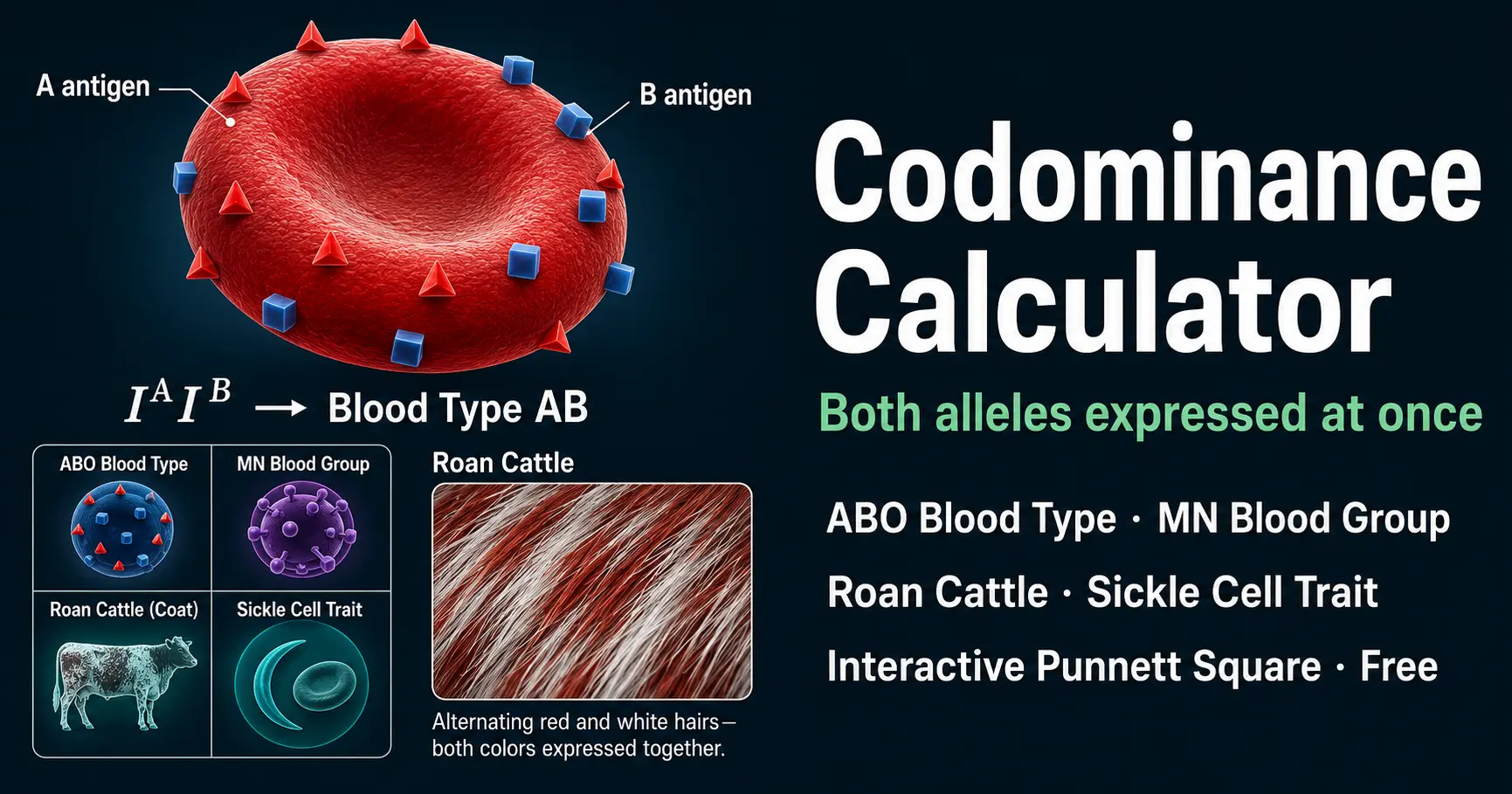
In complete dominance, a heterozygote often looks like the dominant homozygote. In codominance, the heterozygote gets its own phenotype because both alleles are expressed. Roan cattle show red and white hairs. Type AB blood shows A and B antigens. MN blood group heterozygotes show M and N antigens.
RR
First homozygote
One visible phenotype
RW
Heterozygote
Both phenotypes together
WW
Second homozygote
The other visible phenotype
How to Solve a Codominance Punnett Square
- 1Write the parent genotypes: Use two allele symbols for the same gene. For roan cattle, red can be R and white can be W, so a roan animal is RW.
- 2Split each parent into gametes: A parent with genotype RW can make R gametes and W gametes. Put one parent across the top and the other down the side.
- 3Fill each box in the grid: Combine the top allele with the side allele in every cell. For RW by RW, the boxes are RR, RW, WR, and WW.
- 4Label the heterozygote correctly: RW and WR are codominant heterozygotes. They show both traits. Do not label them as red, white, or a blended colour.
- 5Count the ratio: A heterozygote by heterozygote codominance cross usually gives 1 RR, 2 RW, and 1 WW. The phenotype ratio is 1:2:1.
What Does a Codominance Punnett Square Look Like?
Most classroom codominance problems use a 2 by 2 grid. A roan by roan cattle cross is the clearest example because the two alleles stay easy to track.
| Gametes | R | W |
|---|---|---|
| R | RR, red | RW, roan |
| W | WR, roan | WW, white |
This grid shows how to make a Punnett square for codominance. The heterozygote has its own label. That label is the key feature students must show in their answer.
Codominance Punnett Square Examples
Example 1: Roan Cattle Cross
Cross two roan cattle. Use R for red coat and W for white coat. Roan is RW because both red and white hairs are visible.
Example 2: AB Blood Type as Codominance
In the ABO system, IA and IB are codominant. A person with genotype IAIB has type AB blood because both antigens are present.
Example 3: MN Blood Group
The MN blood group is controlled by codominant M and N alleles. A heterozygote has both M and N antigens on red blood cells.
Codominance Practice Worksheet with Answers
Use these short problems as classroom practice. Students should write the gametes, complete the grid, and then list genotype and phenotype percentages.
| Question | Cross | Answer | Phenotype result |
|---|---|---|---|
| 1 | RW by RW | 25% RR, 50% RW or WR, 25% WW | 1 red : 2 roan : 1 white |
| 2 | RR by WW | 100% RW | All roan |
| 3 | MN by NN | 50% MN, 50% NN | 1 MN blood group : 1 N blood group |
| 4 | AB by AA | 50% AA, 50% AB | 1 A phenotype : 1 AB phenotype in the simplified model |
| 5 | HS by HS | 25% HH, 50% HS, 25% SS | 1 normal haemoglobin : 2 carrier : 1 sickle haemoglobin class |
Dihybrid Codominance Punnett Square
A dihybrid codominance Punnett square tracks two genes at the same time. The grid usually becomes 4 by 4 when both parents are heterozygous at both genes. The setup is the same as any dihybrid cross: make all possible gametes from each parent, place one parent on the top, place the other on the side, and combine alleles in each box.
The special part is phenotype scoring. For any codominant gene, the heterozygote must show both traits. For example, if gene one is coat colour with RW as roan and gene two is blood antigen with MN as M plus N, an offspring with genotype RWMN expresses both codominant pairs. For larger grids, a forked-line method can be easier than drawing every box.
Codominance vs Incomplete Dominance
Students often confuse these two inheritance patterns because both can produce a 1:2:1 phenotype ratio. The correct answer depends on the heterozygote.
| Feature | Codominance | Incomplete dominance |
|---|---|---|
| Heterozygote | Shows both phenotypes | Shows one blended phenotype |
| Example | AB blood type or roan coat | Pink snapdragon flower |
| Middle phenotype | Two traits together | Intermediate trait |
| Ratio for RW by RW | 1:2:1 | 1:2:1 |
| Main scoring rule | Label heterozygote as both | Label heterozygote as blended |
For blended heterozygotes, use the incomplete dominance Punnett square. For a molecular reference on ABO antigens, see the NCBI Blood Groups and Red Cell Antigens resource.
Related Tools
Incomplete Dominance Punnett Square
Compare codominance with crosses where heterozygotes show a blended phenotype.
Open CalculatorBlood Type Calculator
Model ABO and Rh inheritance with parent blood types and probability results.
Open CalculatorPunnett Square Calculator
Build standard monohybrid, dihybrid, and multihybrid Punnett squares.
Open Calculator