What Is a Baby Eye Color Calculator?
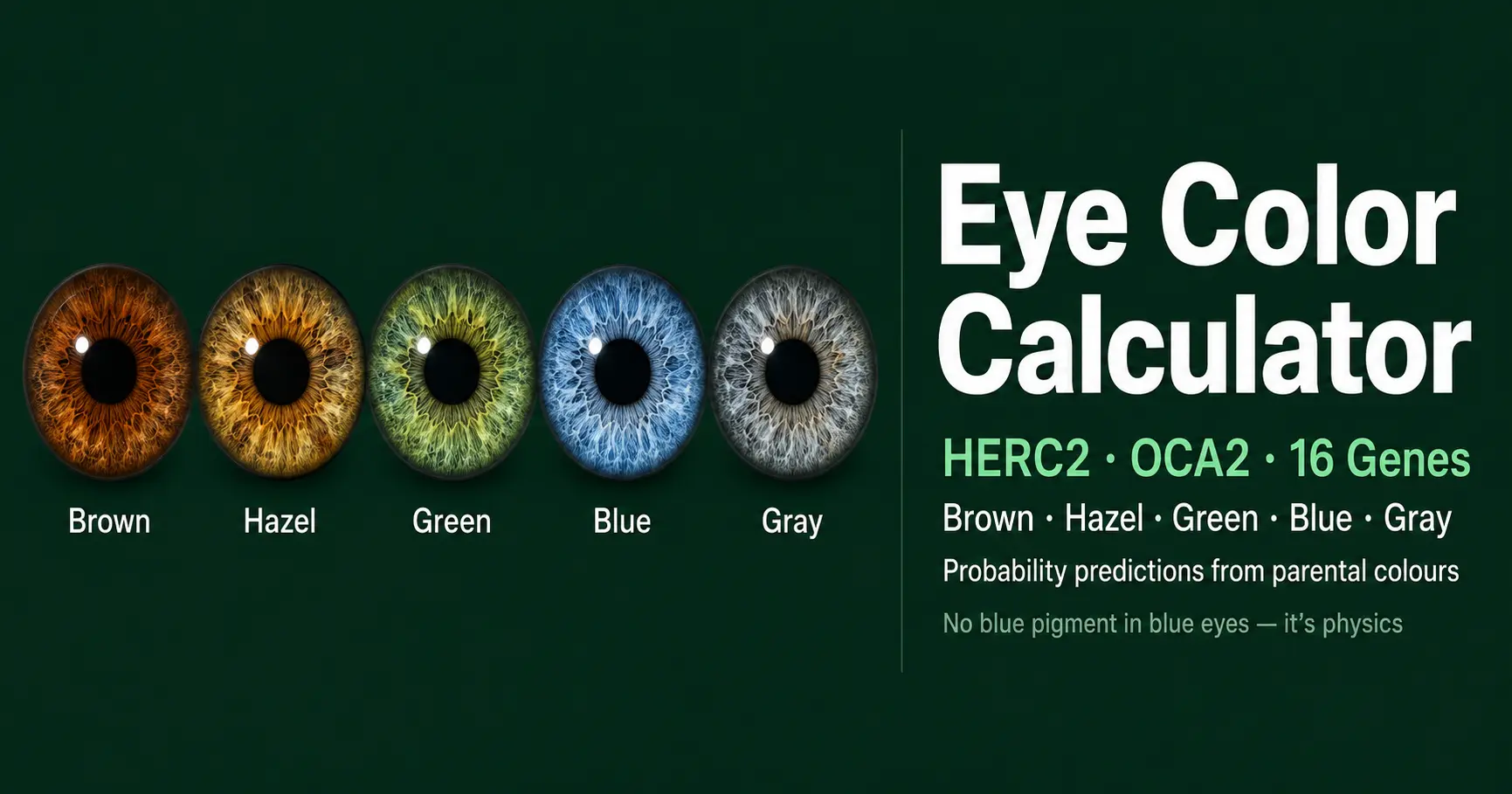
A baby eye color calculator estimates the probability of each possible iris color in a child. It compares the visible eye colors of both parents and maps them to common genetic patterns linked with melanin production. The output is a chance estimate, not a promise, because eye color is a polygenic trait.
Older school diagrams often treat eye color as one gene where brown is dominant and blue is recessive. That model is useful for a basic Punnett square, but it is too simple for real families. More than 16 genes can influence iris color. The most important region is the HERC2/OCA2 locus on chromosome 15, which controls how much melanin accumulates in the iris.
Use the calculator as a genetics guide. It can answer questions such as “What are the chances of my baby having blue eyes?” or “Can two brown-eyed parents have a green-eyed child?” It cannot replace DNA testing because parent eye color is only a visible clue, not the full genotype.
How Baby Eye Color Is Inherited
Eye color comes from both the mother and the father. A baby inherits one copy of each autosomal gene from each parent. The final iris color depends on which variants are inherited and how those variants affect melanin, melanosomes, and light scattering inside the iris.
The HERC2 gene contains a regulatory variant that affects OCA2 expression. OCA2 helps control the P protein in melanosomes, where melanin is produced. Higher OCA2 activity usually means more eumelanin and darker eyes. Lower OCA2 activity usually means lighter eyes. Secondary genes such as SLC24A4, IRF4, TYR, TYRP1, SLC45A2, MITF, and KITLG can shift the result toward hazel, green, blue, or gray.
Visible phenotype
Parent eye color
Brown, hazel, green, blue, or gray
Useful for probability estimates, but it does not show every hidden variant.
Primary genetic regulator
HERC2/OCA2
Controls iris melanin level
Strongly influences the brown vs blue pattern in many populations.
Probability output
Baby result
Multiple possible eye colors
The most likely color is not always the final outcome.
Can You Use a Punnett Square for Eye Color?
You can use a Punnett square for a simplified eye color lesson, but real baby eye color needs a polygenic model. A basic Punnett square might label brown as B and blue as b, then show BB, Bb, and bb combinations. That explains why two brown-eyed parents can have a blue-eyed baby if both carry a lighter-eye variant.
The limitation is that human iris color is not controlled by only B and b. Brown, hazel, green, blue, and gray reflect different melanin levels and different combinations of variants across several loci. That is why a baby eye color calculator gives percentages rather than one fixed Punnett square answer.
| Model | Best use | Limitation |
|---|---|---|
| Simple Punnett square | Teaching dominant and recessive inheritance | Cannot explain hazel, green, gray, or many real family outcomes |
| Parent phenotype calculator | Estimating baby eye color chances from visible traits | Cannot see hidden variants without family history or DNA data |
| DNA based polygenic model | Research-grade prediction using SNPs | Requires genetic testing and population calibration |
Baby Eye Color Calculator with Grandparents
Grandparents can improve an eye color estimate because they reveal hidden family variants. A brown-eyed parent may carry lighter-eye alleles if one of their parents has blue, green, or gray eyes. Those variants can pass silently through one generation and appear in the next.
Grandparents do not send genes directly to the baby. Their value is indirect. They help you infer what each parent may carry. If both sides of the family include blue or green eyes, the chance of a lighter-eyed baby may be higher than parent eye color alone suggests.
Practical rule for family history
Parent eye color gives the first estimate. Grandparent eye color adds context. DNA data gives the strongest prediction. For most users, the best practical approach is to calculate the parent-based estimate first, then interpret it alongside the visible traits in close relatives.
When Does a Baby's Eye Color Become Permanent?
Many babies are born with blue or gray eyes because the iris has little melanin at birth. During the first months of life, melanocytes become more active and melanin accumulates in the anterior iris stroma. If the baby carries variants linked with higher melanin, the eyes may darken toward hazel or brown.
Most visible change happens during the first 6 to 18 months. Many children have a stable eye color by age 3, although subtle shifts in shade can continue later. Darkening is more common than lightening because melanin tends to increase after birth.
Brown, Hazel, Green, Blue, and Gray Eye Color Chances
Brown is the most common eye color worldwide because it reflects high eumelanin in the iris. Blue is common in some European populations but less common globally. Green and gray are often listed among the rarest common eye colors, though exact rankings change by ancestry and how researchers classify mixed shades.
| Eye color | Main iris attribute | Genetic interpretation |
|---|---|---|
| Brown | High eumelanin | Often linked with stronger OCA2 expression and darker pigmentation variants |
| Hazel | Moderate melanin with mixed tones | Usually reflects several interacting pigmentation variants |
| Green | Low to moderate melanin | Often influenced by HERC2/OCA2 plus SLC24A4, IRF4, and related loci |
| Blue | Very low melanin | Usually linked with reduced OCA2 expression and Rayleigh scattering |
| Gray | Very low melanin with denser scattering | May reflect iris stromal structure as well as pigmentation variants |
Does the Mother or Father Decide Baby Eye Color?
Neither parent decides eye color alone. Dominance belongs to alleles, not to mothers or fathers. A father can pass a lighter-eye variant or a darker-eye variant. A mother can do the same. The baby's eye color depends on the combination inherited from both sides.
Some traits are sex-linked or father-specific in special cases. For example, a biological son receives a Y chromosome from his father. Eye color is different. The major eye color genes are autosomal, so both parents contribute.
Facial features such as nose shape, jaw shape, cheek structure, and eye shape are also influenced by many genes from both parents. A child may look more like one parent, but that does not mean all facial traits or eye color came from that parent only.
The Science Behind the Prediction
The strongest known eye color signal is a regulatory variant near HERC2 that affects OCA2. OCA2 helps control melanosome function in iris melanocytes. When OCA2 expression is high, the iris usually stores more eumelanin and appears brown. When OCA2 expression is low, the iris stores less melanin and appears blue or gray because of light scattering.
The landmark Sturm et al. study on HERC2/OCA2 helped explain why one region accounts for much of the blue-versus-brown difference in European populations. Later genome-wide studies found many more associated loci, including results reported in a large 2021 eye color GWAS.
That is why this calculator avoids a single-gene answer. It uses the parent eye colors as practical inputs, then returns a probability distribution across common baby eye color outcomes.
Related Tools
Baby Genetics Calculator
Estimate eye color, hair color, and blood type probabilities in one baby genetics tool.
Open CalculatorHair Color Predictor
Explore baby hair color chances using melanin and MC1R-related inheritance.
Open CalculatorBlood Type Calculator
Calculate ABO and Rh inheritance patterns from both parents.
Open Calculator