Codon Usage & Translation Tool for DNA to Protein

Translate DNA or RNA into a protein sequence, inspect each codon, and count codon usage in real time. The tool helps students, teachers, and lab users check reading frames, start codons, stop codons, GC content, and amino acid properties from one sequence input.

Live Codon Usage & Translation Tool

Paste a nucleotide sequence, select a reading frame, and get codon-by-codon translation without pressing a calculate button.

Try a coding sequence preset

Load an example, then edit the sequence, reading frame, and translation options.

DNA or RNA sequence input

Paste a coding sequence in 5′ to 3′ orientation. RNA U bases convert to DNA T bases before translation.

Translation settings

Choose whether the tool starts at the first in-frame ATG and whether it stops at the first termination codon.

A

9

T

8

G

14

C

8

Live translation result

Complete start-to-stop coding sequence detected

Protein length: 11 amino acids. Coding GC: 56.4%. Estimated peptide mass: 1.19 kDa.

Codons

13

ATG

2

Stops

2

Protein sequence

Stop codons appear as *. Ambiguous codons appear as X.

One-letter amino acid sequence

MAIVMGR*KGAR*

Codon translation preview from DNA triplets to amino acidsDNA codons → mRNA codons → amino acidsATGMSTARTGCCAATTIGTAVATGMSTARTGGCGCGCRTGA*STOPAAGKGGTG+3

Codon-by-codon translation table

Each row shows the DNA triplet, mRNA triplet, encoded amino acid, and biological flag.

#Base positionDNA codonmRNA codonAmino acidFlag
11ATGAUGM · MethionineStart
24GCCGCCA · Alanine
37ATTAUUI · Isoleucine
410GTAGUAV · Valine
513ATGAUGM · MethionineStart
616GGCGGCG · Glycine
719CGCCGCR · Arginine
822TGAUGA* · Stop codonStop
925AAGAAGK · Lysine
1028GGTGGUG · Glycine
1131GCCGCCA · Alanine
1234CGACGAR · Arginine
1337TAGUAG* · Stop codonStop

Codon usage in this sequence

This summary counts codons inside your submitted sequence. It does not apply a species-specific codon bias table.

ATGM2 · 15.4%
GCCA2 · 15.4%
AAGK1 · 7.7%
ATTI1 · 7.7%
CGAR1 · 7.7%
CGCR1 · 7.7%
GGCG1 · 7.7%
GGTG1 · 7.7%
GTAV1 · 7.7%
TAG*1 · 7.7%
Most frequent codon: ATG, encoding Methionine.

Amino acid property profile

hydrophobic

6

46.2% of translated codons

polar

0

0.0% of translated codons

positive

3

23.1% of translated codons

negative

0

0.0% of translated codons

special

2

15.4% of translated codons

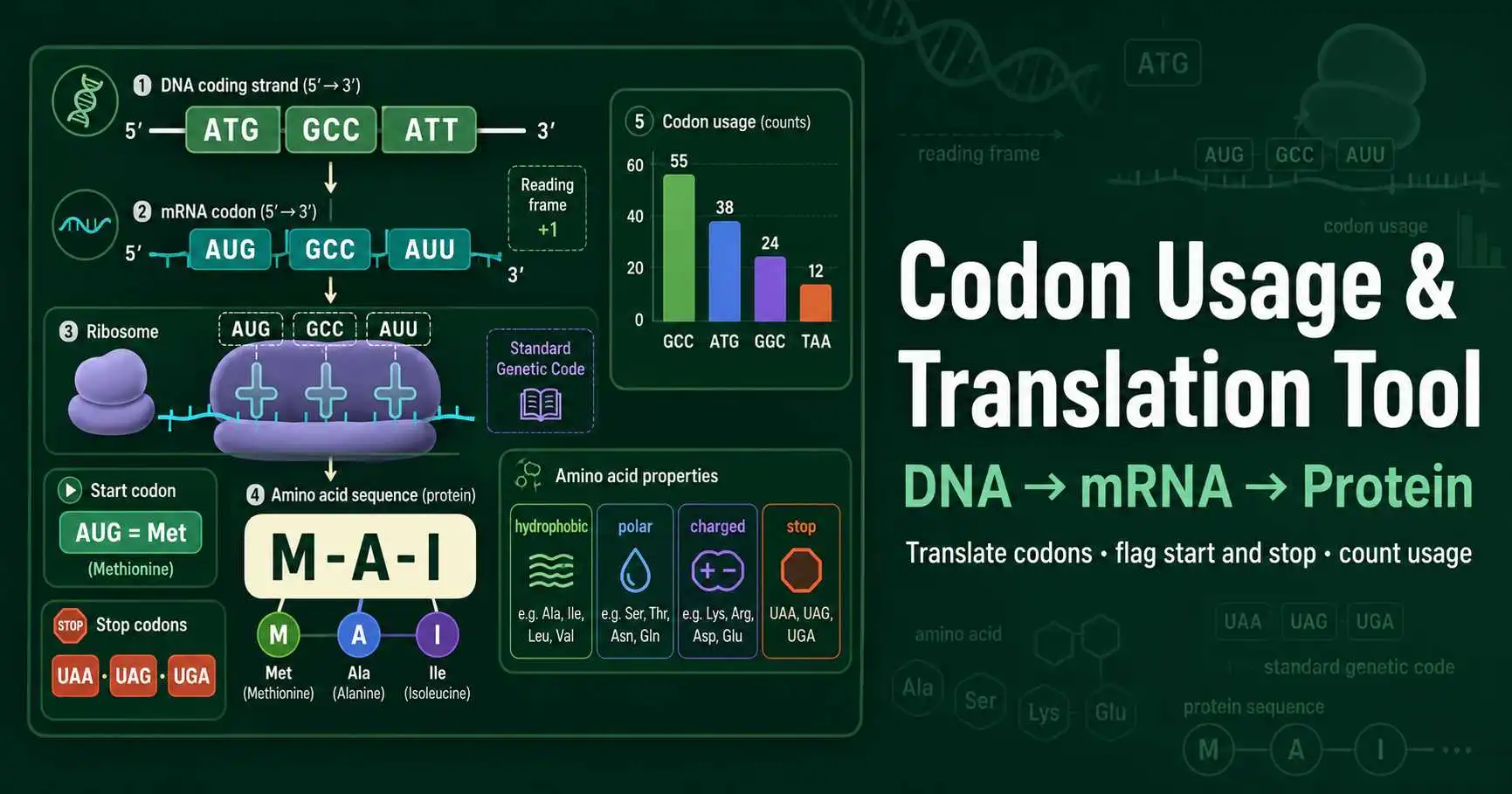
Codon usage and DNA translation diagram showing DNA triplets, mRNA codons, ribosome reading frame, start codon, stop codons, and amino acid output
Figure 1. A coding DNA strand converts into mRNA codons before the ribosome reads triplets through the standard genetic code. AUG marks the methionine start codon, while UAA, UAG, and UGA act as termination signals that recruit release factors instead of tRNAs.

What is a Codon Usage & Translation Tool?

A codon translation tool reads a nucleotide sequence in groups of three bases and converts each triplet into an amino acid. DNA coding-strand codons use T, while mRNA codons use U. ATG in DNA therefore corresponds to AUG in mRNA and usually encodes methionine at the beginning of a protein.

The standard genetic code contains 64 codons. Sixty-one codons encode amino acids, and three codons signal termination. NCBI lists the standard code as translation table 1, while mitochondrial and some microbial systems use alternative tables. View NCBI genetic-code tables.

Codon usage adds another layer. Two codons can encode the same amino acid, but organisms often use synonymous codons at different frequencies. This calculator counts codons in your submitted sequence, so it gives a clear sequence-level summary before any species-specific bias analysis.

How to use Codon Usage & Translation Tool

  1. 1

    Paste the DNA or RNA coding sequence

    Enter a 5′ to 3′ coding strand sequence using A, C, G, T, or U bases.

  2. 2

    Select the reading frame

    Choose frame 1, 2, or 3 so the codons start at the correct base position.

  3. 3

    Choose translation settings

    Start at the first in-frame ATG or stop at the first termination codon when your sequence contains an ORF.

  4. 4

    Review the protein and codon usage output

    Check the translated amino acid sequence, codon table, start/stop flags, GC percentage, and codon counts.

Use the coding strand when possible. If you paste the template strand, first convert it with a reverse complement tool, then translate the corrected 5′ to 3′ coding sequence.

What each part of Codon Usage & Translation Tool does

Preset coding sequences

Presets load common translation scenarios. One example includes a complete coding sequence, while another starts after upstream bases. These examples help users learn how reading frame and start position change the protein result.

Sequence input box

The input accepts DNA or RNA and removes spaces, numbers, and formatting. RNA U bases convert to T internally, then the output table displays the matching mRNA codon with U again.

Reading-frame selector

Frame 1 starts at base 1, frame 2 starts at base 2, and frame 3 starts at base 3. This control explains why the same DNA sequence can encode different amino acid chains when read from a different offset.

Start and stop switches

The first switch begins translation at the first in-frame ATG. The second switch ends output at TAA, TAG, or TGA. Together, they model a simple open reading frame from start to termination.

Protein and codon table

The result panel shows the one-letter protein sequence, codon positions, amino acid names, and biological flags. It helps users spot internal stop codons, missing start codons, and frame errors.

Codon usage bars

The usage chart counts how often each codon appears in the translated region. It answers practical questions such as which codon appears most often and whether a short sequence looks GC rich.

DNA codons, mRNA codons, and amino acid output

Translation uses mRNA, not DNA, as the direct ribosome template. A coding DNA triplet such as ATG becomes AUG in mRNA after transcription. The ribosome reads AUG as methionine and then advances one codon at a time along the same reading frame.

OpenStax explains that the reading frame starts at AUG near the 5′ end of the mRNA and continues in groups of three until a stop codon appears. Read the OpenStax genetic-code chapter. That same rule explains why a one-base insertion can cause a frameshift mutation.

Amino acid properties help interpret the translated sequence. Hydrophobic residues such as leucine, isoleucine, valine, and phenylalanine often enrich protein cores or membrane-spanning regions. Charged residues such as lysine, arginine, glutamate, and aspartate often shape protein surfaces and binding interfaces.

Codon translation worked examples

Example 1: translate a short coding sequence

DNA sequence ATGGCCATT starts at ATG. The codons read as ATG-GCC-ATT. The mRNA version reads AUG-GCC-AUU.

AUG encodes methionine, GCC encodes alanine, and AUU encodes isoleucine. The one-letter protein sequence becomes MAI. The three-letter sequence becomes Met-Ala-Ile.

Example 2: detect a stop codon

DNA sequence ATGAAATAA contains three complete codons. ATG encodes methionine, AAA encodes lysine, and TAA acts as a stop codon.

The one-letter output appears as MK*. If stop-at-first-stop is active, translation ends at the asterisk and ignores any downstream codons in that simple ORF view.

Why codon translation matters in genetics and molecular biology

DNA-to-protein translation connects genotype with protein sequence. A single nucleotide change can create a synonymous codon, replace one amino acid, or introduce a premature stop codon. That is why variant annotation starts by locating codons and reading frames.

In cloning and expression work, translation checks catch practical errors before ordering DNA. A missing ATG, a frameshift, or an internal stop codon can prevent protein expression even when the DNA sequence looks long enough. Codon counts also help users notice GC-rich regions that may complicate synthesis or PCR.

In teaching labs, this tool links transcription, translation, and mutation effects. Students can paste the same sequence in three frames and immediately see how codon grouping changes the predicted polypeptide.
Codon Usage & Translation Tool accuracy limits

This tool uses the standard genetic code. It does not translate mitochondrial, plastid, ciliate, mycoplasma, or other alternative genetic codes. Check the organism and genome compartment before translating non-nuclear genes.

The codon usage output describes only the submitted sequence. It does not calculate codon adaptation index, tRNA adaptation index, or expression host optimization. Those analyses need organism-specific reference tables and experimental context.

This page supports education and sequence review. It does not replace clinical variant interpretation, regulated diagnostic annotation, or laboratory quality-control software.

Codon Usage & Translation Tool FAQs

What does the Codon Usage & Translation Tool do?

The Codon Usage & Translation Tool converts a DNA or RNA sequence into amino acids using the standard genetic code. It reads the sequence in triplets called codons, then reports the encoded one-letter protein sequence. The table also shows mRNA codons, amino acid names, start codons, stop codons, and codon counts. This helps students check reading frames, coding sequences, and basic protein output from a nucleotide sequence.

Which codon starts translation in the standard genetic code?

AUG starts translation in mRNA and corresponds to ATG in the DNA coding strand. AUG encodes methionine, so most complete protein sequences begin with M in the one-letter amino acid code. Some organisms and organelles use alternative start codons, but this tool focuses on the standard genetic code. Use the first-ATG option when your pasted sequence contains extra upstream bases before the coding region.

Which codons stop protein translation?

The standard stop codons are UAA, UAG, and UGA in mRNA. In a DNA coding sequence, those appear as TAA, TAG, and TGA. Stop codons do not encode an amino acid, so the tool marks them with an asterisk in the protein sequence. Turn on the stop-at-first-stop setting when you want the output to mimic a single open reading frame.

Why does the reading frame change the protein sequence?

A ribosome reads mRNA three bases at a time. Moving the starting position by one base changes every downstream codon, so the amino acid sequence changes completely. For example, ATGGCC reads as ATG-GCC in frame 1, but TGG-CC... in frame 2. That is why coding-sequence analysis always needs a defined 5′ to 3′ reading frame.

Does this tool measure species-specific codon bias?

This version counts codons within your submitted sequence. It does not compare those codons with an organism-specific codon usage table. Species-specific codon bias requires a reference genome or expression-weighted codon table, such as tables built for Escherichia coli, Saccharomyces cerevisiae, or Homo sapiens. The current output still helps you spot repeated codons, GC-rich triplets, rare stop positions, and the amino acid composition of your sequence.

Can I paste RNA instead of DNA?

Yes. The tool accepts RNA bases and converts U to T internally before applying the standard DNA codon table. It still displays the corresponding mRNA codon in the output table, so ATG appears as AUG. Mixed DNA/RNA input is cleaned before translation. Unsupported symbols get ignored and reported in the sequence checks box.

What does X mean in the translated protein sequence?

X means the tool cannot assign a specific amino acid to that codon. This usually happens when the codon contains N, which represents an unknown nucleotide. A codon such as ATN could encode different amino acids depending on the real third base. Replace ambiguous bases with A, C, G, or T when you need an exact protein translation.

Can this calculator translate mitochondrial genes?

This calculator uses the standard nuclear genetic code. Mitochondria use alternative codon assignments in many lineages, so a vertebrate mitochondrial gene can translate differently from a nuclear coding sequence. For example, some mitochondrial tables assign TGA to tryptophan instead of stop. Use a dedicated alternative genetic-code translator when your sequence comes from mitochondria, plastids, or an organism with a known nonstandard code.

Use these calculators to prepare coding-strand sequences and identify open reading frames before translation.