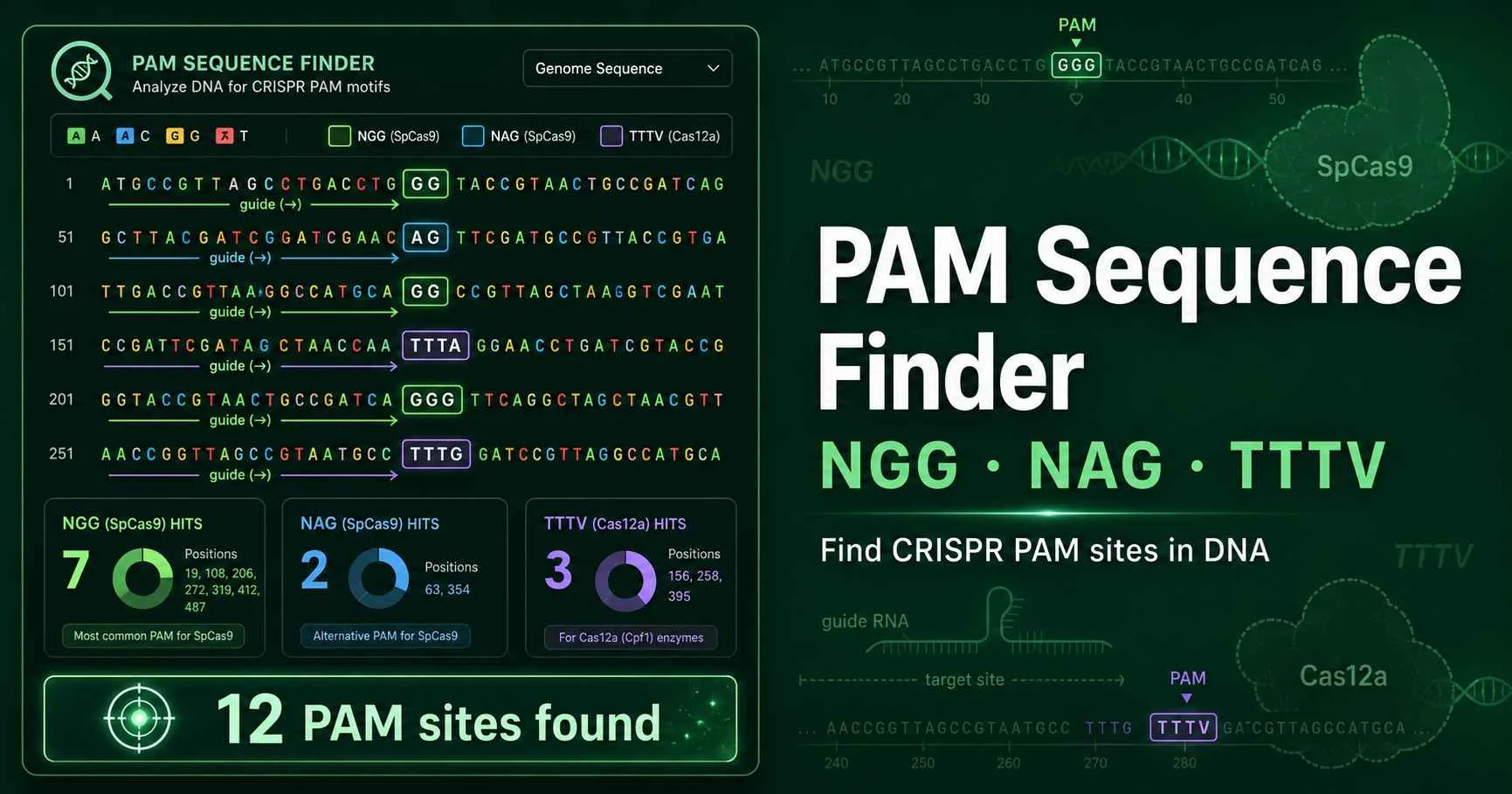
What a PAM site means in CRISPR design
A PAM, or protospacer adjacent motif, is the short DNA motif that lets a CRISPR nuclease bind a candidate target. A guide RNA can match the nearby DNA sequence, but the nuclease still needs the correct PAM. That rule makes PAM discovery the first filter in many CRISPR design workflows.
SpCas9 commonly uses NGG, where N means any base and G means guanine. Cas12a uses a different architecture and often recognizes TTTV, where V means A, C, or G. Addgene explains that the PAM sequence depends on the Cas protein you choose, and the guide must sit in the correct orientation relative to that PAM. Read Addgene’s CRISPR guide.
This page answers a practical question: “Where can my selected CRISPR nuclease cut near this DNA region?” It finds local candidates inside the sequence you provide. It does not perform genome-wide off-target search, repair-outcome prediction, or clinical interpretation.
What each part of the PAM finder does
Each control changes a real CRISPR design decision. The table below shows when to use each part of the tool.
DNA sequence box
Paste the genomic, plasmid, or amplicon region that should be scanned for PAM motifs.
Nuclease selector
Choose the PAM rule and guide length for SpCas9, Cas12a, SaCas9, SpG, or a custom system.
Strand control
Scan plus strand, reverse-complement strand, or both strands when orientation remains open.
Basic mode
Find common PAMs quickly for teaching, first-pass screening, or short sequence checks.
Advanced mode
Set custom PAM patterns, filter by score, flag poly-T runs, and control result count.
Candidate table
Compare guide sequence, PAM, coordinates, cut estimate, GC%, score, and warnings.
Guide orientation rules for NGG, NAG, TTTV, and custom PAMs
The same DNA sequence can produce different candidate guides when the PAM sits 3′ or 5′ of the protospacer. Use the orientation table before you interpret coordinates.
| System | PAM pattern | Guide layout | Best use in this tool |
|---|---|---|---|
| SpCas9 | NGG | 5′-N20-NGG-3′ | Standard educational and experimental candidate discovery. |
| SpCas9 relaxed | NAG | 5′-N20-NAG-3′ | Secondary scan when few NGG sites exist. |
| Cas12a | TTTV | 5′-TTTV-N23-3′ | Find 5′ PAM targets for Cas12a-family workflows. |
| SaCas9 | NNGRRT | 5′-N21-NNGRRT-3′ | Screen compact Cas9 target sites. |
Practical examples for CRISPR target screening
Find SpCas9 NGG sites in an exon
Paste a coding exon and choose SpCas9 NGG. The tool searches both strands and extracts each 20 nucleotide protospacer next to NGG. A candidate with 45% to 55% GC, no long homopolymer, and no TTTT run usually deserves closer review.
Use the coordinates to see whether the candidate lies near the intended exon region. Then open the DNA to Protein Translation Tool if you need to check the reading frame and amino-acid context.
Screen an AT-rich sequence with Cas12a
Select Cas12a TTTV when your target region lacks convenient NGG sites. Cas12a places the PAM 5′ of the guide, so the extracted guide appears after TTTV on the scanned strand. This orientation matters when you report guide coordinates.
AT-rich regions can produce many TTTV motifs. Use Advanced mode to filter low-scoring guides, then export the CSV report for review in your design notes.
What this local PAM scan can and cannot decide
A local PAM scan gives you candidate sites, not final guides. It cannot know whether the same 20 nucleotide guide appears elsewhere in a genome unless you provide that comparison database. Genome-wide off-target analysis remains a separate step.
MedlinePlus explains that CRISPR-Cas9 uses a guide RNA to recognize a DNA target and Cas9 to cut at the targeted location. That mechanism needs sequence pairing, PAM recognition, and cell-specific repair. A browser calculator can screen the first two local sequence features, but it cannot predict every cellular outcome. Read the MedlinePlus genome editing overview.
Related CRISPR and sequence tools
Use these pages before or after PAM scanning to build a more complete sequence-analysis workflow.
CRISPR Guide RNA Design Tool
Move from PAM discovery to ranked guide candidates with scoring and design checks.
DNA Sequence Analyzer
Check length, GC%, reverse complement, ORFs, and sequence composition before scanning for PAMs.
DNA to Protein Translation Tool
Translate coding regions and confirm whether a target sits inside a protein-coding reading frame.
PAM Sequence Finder FAQs
What does a PAM Sequence Finder do?
A PAM Sequence Finder scans a DNA sequence for protospacer adjacent motifs such as NGG for SpCas9 or TTTV for Cas12a. It extracts the nearby guide-sized sequence, reports the strand, maps the coordinates, and gives a basic quality score. The result helps you locate possible CRISPR target regions before you use a full guide RNA design pipeline. It does not prove editing efficiency or genome-wide specificity.
Where is the guide sequence relative to the PAM?
For SpCas9-style NGG sites, the 20 nucleotide guide sequence sits directly upstream of the PAM on the target DNA strand. A typical layout is 5′-N20-NGG-3′. Cas12a uses a different orientation, so TTTV sits 5′ of the guide region. The tool handles both orientations and reports coordinates on the original sequence.
Why should I scan both DNA strands?
CRISPR target sites can occur on either strand of a double-stranded DNA fragment. A plus-strand NGG site yields one guide orientation, while a reverse-complement site yields the opposite guide orientation. Scanning both strands gives a fuller target list. You can restrict the scan when you only want guides in one direction for a specific assay design.
What GC percentage should a CRISPR guide have?
Many screening workflows treat 40% to 60% GC as a useful first-pass range for 20 nucleotide SpCas9 guides. Lower GC can weaken guide-target pairing, while very high GC can increase secondary-structure or off-target concern. This tool scores GC% as a basic filter only. You should still check organism-specific efficiency scores and off-target matches before ordering a guide.
Can this page replace a full CRISPR guide design tool?
No. This page finds PAM-adjacent candidate regions inside the sequence you paste. It does not search the whole genome, score chromatin accessibility, predict repair outcome, or validate off-target risk. Use it as a fast teaching and screening tool. Use a full guide RNA design tool for experimental guide selection.
Why does the tool flag TTTT inside a guide?
A run of four thymidines can act as a termination signal for U6-driven sgRNA expression in some plasmid systems. That risk matters when a guide RNA uses a Pol III promoter. The sequence may still work in other delivery formats, such as synthetic sgRNA or RNP delivery. The warning tells you to check the expression system before choosing the guide.
Does the score include off-target analysis?
The score does not include genome-wide off-target analysis. It checks local guide features such as GC%, long base runs, poly-T sequence, and 5′ G context. A guide can score well here and still match other genomic sites. Run a genome-aware off-target search before laboratory use.