Blood Type Calculator: What Will My Baby's Type Be?
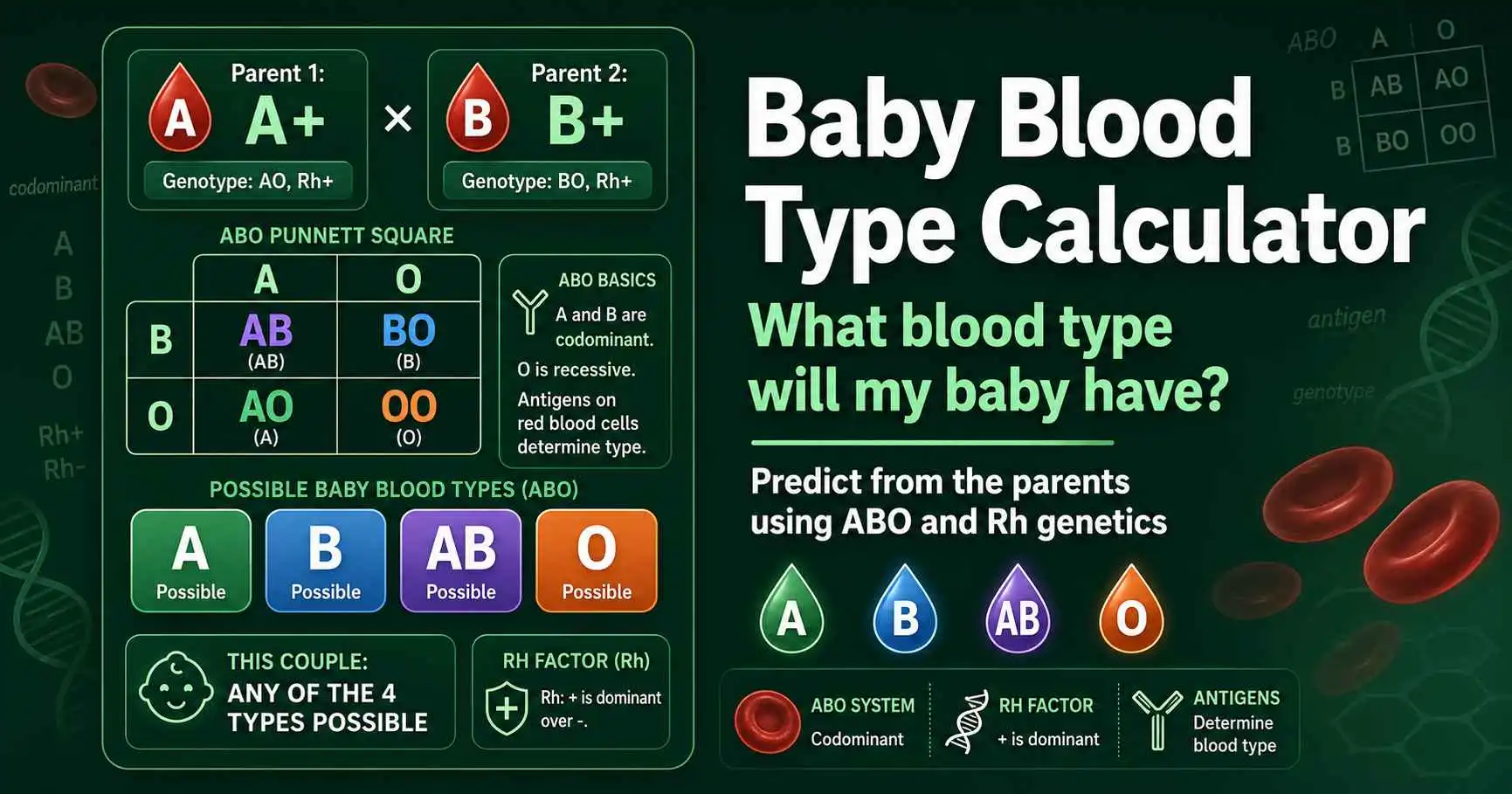
A baby's blood type is set by the alleles it inherits from both parents, one for the ABO system and one for the Rh factor. Each parent passes one ABO allele (A, B, or O) and one Rh allele (positive or negative), and the combination decides the child's full blood type, such as A+, O-, or AB+. Knowing both parents' types lets you predict every blood type a child could have, and the odds of each.
This is one of the most common questions expectant parents ask, and the genetics behind it is satisfyingly clear once you see it. Blood type follows well-understood inheritance rules, which makes it far more predictable than traits like eye color. This guide explains how ABO and Rh are inherited, gives you complete parent-combination charts, and covers the medical reason the prediction actually matters during pregnancy. If you want the deeper genetics of the three ABO alleles first, our explainer on multiple alleles and ABO blood type lays out the foundation this builds on.
How Blood Type Is Inherited
Your blood type comes from two separate genetic systems working together: the ABO system and the Rh system. The ABO system, controlled by a gene on chromosome 9, determines whether you are type A, B, AB, or O. The Rh system, controlled by a gene on chromosome 1, determines whether you are positive or negative. Combined, they give the eight common blood types from A+ down to O-.
Each parent contributes one allele from each system. For ABO, a parent passes one of their two ABO alleles to the child. For Rh, a parent passes one of their two Rh alleles. The child's blood type is then read from the pair it receives, exactly as in any genetic cross. Because each parent has two alleles but passes only one, a parent's visible blood type does not always reveal what they can pass on, which is the source of most surprises.
The two systems are inherited independently, since they sit on different chromosomes. This means you can work out the ABO outcome and the Rh outcome separately, then combine them. That independence is what makes blood type prediction manageable: you solve two simple problems instead of one complicated one, then put the answers together to get the full type. We will handle ABO first, then Rh, then combine them.
The ABO System: A, B, AB, and O
The ABO system involves three alleles, but each person carries only two of them. The three alleles are A, B, and O. The A and B alleles are codominant, meaning when both are present, both show up. The O allele is recessive, so it is masked whenever an A or B is present. This mix of relationships produces four blood types from six possible genotypes.
Here is how the genotypes map to blood types. Type A comes from AA or AO, type B from BB or BO, type AB from the AB genotype, and type O only from OO. The two dominant alleles, A and B, can each hide a recessive O. So a type A person might be AA or secretly AO, carrying a hidden O allele they can pass to a child. This hidden O is why two type A parents can sometimes have a type O child.
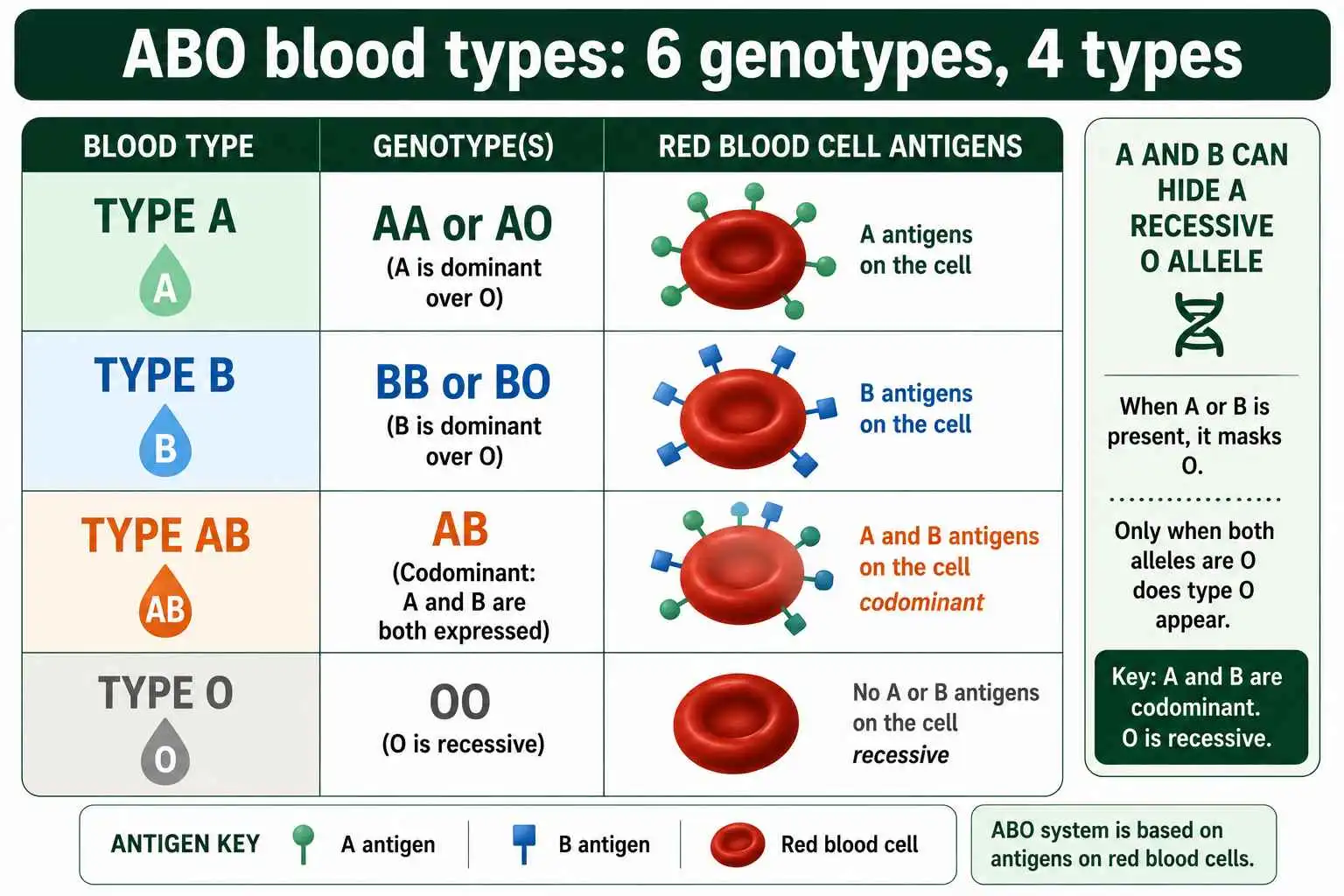
The codominance of A and B explains type AB blood. A person who inherits an A allele from one parent and a B allele from the other expresses both antigens at once, producing type AB. There is no blending into an intermediate; both markers appear fully and separately on the red blood cells, a textbook case of codominance in action. Type O, at the other extreme, has neither A nor B antigens, which only happens when a person inherits two recessive O alleles. Understanding which genotypes hide an O allele is the key to predicting the trickier blood type combinations.
The Rh Factor: Positive and Negative
The Rh factor is the second part of your blood type, the plus or minus sign after the letter. It refers to the presence or absence of the Rh antigen, also called the D antigen, on your red blood cells. If the antigen is present, you are Rh-positive. If it is absent, you are Rh-negative. About 85 percent of people are Rh-positive.
The Rh factor follows simple dominant-recessive inheritance, which makes it easier than ABO. The Rh-positive allele, often written with a plus, is dominant. The Rh-negative allele is recessive. So a person is Rh-negative only if they inherit two negative alleles, one from each parent. A single positive allele makes the person Rh-positive, whether paired with another positive or with a negative.
This dominance creates the same hidden-carrier situation as ABO. An Rh-positive person can have the genotype with two positive alleles or with one positive and one negative, and they look identical. A positive parent carrying a hidden negative allele can pass that negative allele to a child. This is why two Rh-positive parents can have an Rh-negative child: if both carry a hidden negative allele and both pass it on, the child inherits two negatives and is Rh-negative. Two Rh-negative parents, by contrast, can only have Rh-negative children, because neither has a positive allele to give.
Predicting Your Baby's Blood Type: ABO
To predict the ABO outcome, you combine the parents' possible alleles in a Punnett square, just like any cross. Because some blood types hide a recessive O, you sometimes have to consider more than one possible parent genotype, which is why a prediction often gives a range of outcomes.
Take a common example: a type A parent and a type B parent, where both happen to be heterozygous carriers, with genotypes AO and BO. Each parent can pass either of their two alleles. The type A parent passes A or O, and the type B parent passes B or O. Filling the grid gives four equally likely genotypes: AB, AO, BO, and OO. Reading these as blood types, that is one AB, one A, one B, and one O child, meaning this couple can have a child of any of the four blood types.
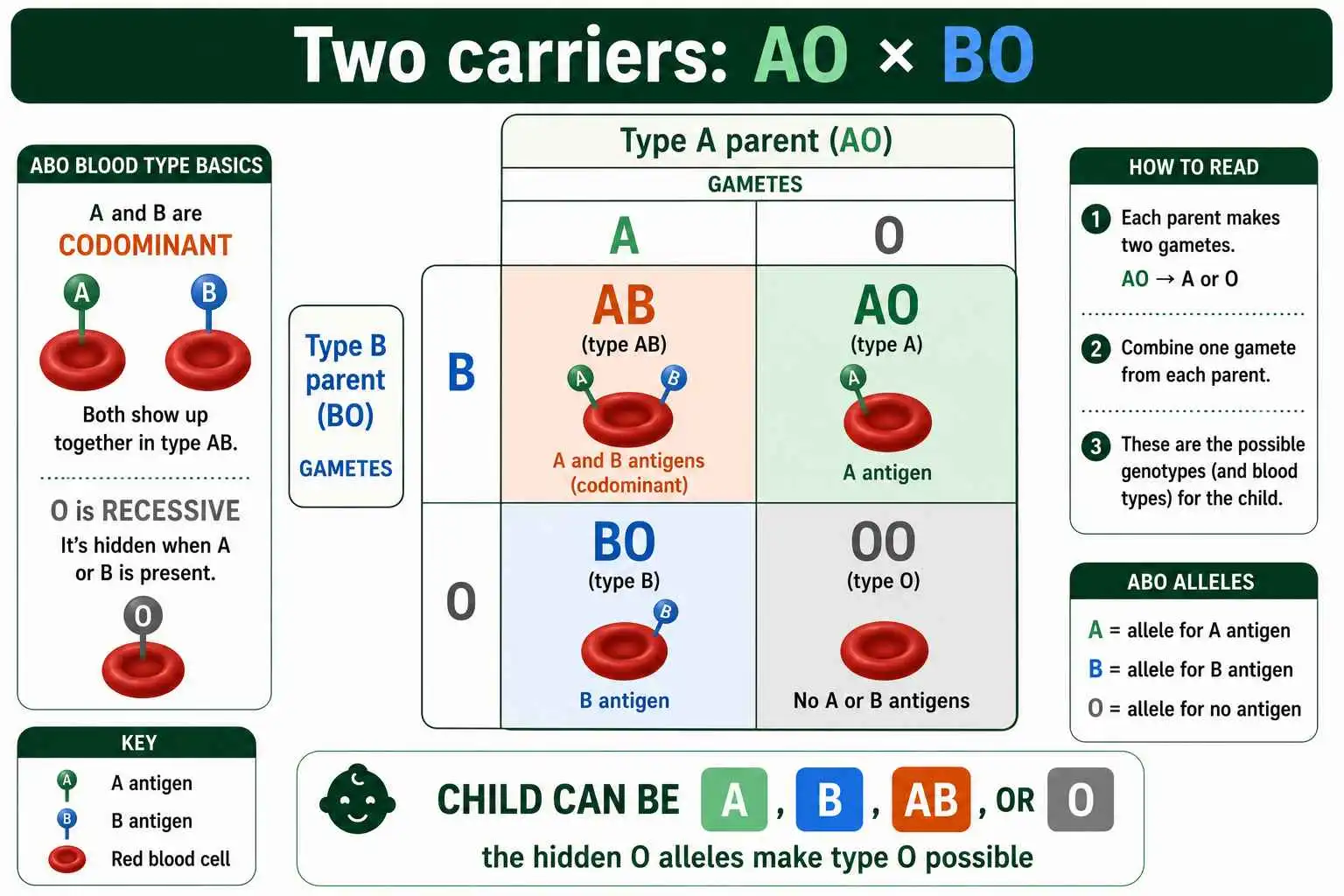
This famous result surprises people, but it follows directly from the hidden O alleles. Both parents secretly carry an O, so an OO child, type O, is possible even though neither parent is type O. The outcome would be different if the parents were homozygous. If the type A parent were AA, no O child could result, because that parent has no O allele to pass. This is exactly why knowing a parent's genotype, not just their blood type, sharpens the prediction. To run any pairing and see the full breakdown of genotypes and probabilities, a blood type calculator handles the ABO cross and the hidden-allele possibilities for you.
Predicting Your Baby's Blood Type: Rh
The Rh prediction works the same way but is simpler, because there are only two alleles and a clean dominant-recessive relationship. You cross the parents' Rh alleles and read the result, remembering that a child is Rh-negative only with two negative alleles.
Consider two Rh-positive parents who are both carriers, each with one positive and one negative allele. Each can pass a positive or a negative. The grid gives one child with two positives, two children with one of each, and one child with two negatives. The three children carrying at least one positive allele are Rh-positive, and the single child with two negatives is Rh-negative. So this pairing gives roughly a 75 percent chance of an Rh-positive child and a 25 percent chance of an Rh-negative child.
The rules for the common Rh pairings are worth stating plainly. Two Rh-positive parents can have a positive or negative child, depending on hidden alleles. An Rh-positive and an Rh-negative parent can also have either, depending on the positive parent's genotype. Two Rh-negative parents can only have Rh-negative children, with no exceptions under normal genetics, since neither parent carries a positive allele. Once you have both the ABO and Rh predictions, you simply combine them, pairing each possible ABO type with each possible Rh result to get the full set of blood types your baby could have.
Complete Parent Blood Type Chart
Putting ABO and Rh together, you can read off the possible child blood types for any parent combination. The chart below shows the possible ABO blood types of a child based on the parents' ABO types, before adding the Rh factor.
| Parent types | Possible child ABO types |
|---|---|
| O and O | O |
| O and A | O, A |
| O and B | O, B |
| O and AB | A, B |
| A and A | O, A |
| A and B | O, A, B, AB |
| A and AB | A, B, AB |
| B and B | O, B |
| B and AB | A, B, AB |
| AB and AB | A, B, AB |
Two patterns in this chart catch most people's attention. First, an O and AB pairing can never produce an O or an AB child, only A or B, because the AB parent has no O to give and the O parent has no A or B to give. Second, an A and B pairing can produce all four blood types when both parents carry a hidden O. To get the full blood type, layer the Rh prediction on top: if both parents are Rh-positive carriers, any of these ABO types could be either positive or negative, while two Rh-negative parents would make every listed type negative. Combining the two charts gives the complete picture for any couple.
Why Blood Type Prediction Matters: Rh Incompatibility
Predicting blood type is not only a curiosity. The Rh factor carries a genuine medical importance during pregnancy, which is why doctors test it early. The concern is a situation called Rh incompatibility, and understanding it shows why the prediction has real stakes.
Rh incompatibility happens when an Rh-negative mother carries an Rh-positive baby. The baby can inherit the Rh-positive factor from an Rh-positive father, even though the mother is negative. If the baby's Rh-positive blood mixes with the mother's during birth or pregnancy, the mother's immune system may recognize the Rh antigen as foreign and produce antibodies against it. This usually does not harm a first pregnancy, but in a later pregnancy with another Rh-positive baby, those antibodies can cross the placenta and attack the baby's red blood cells.
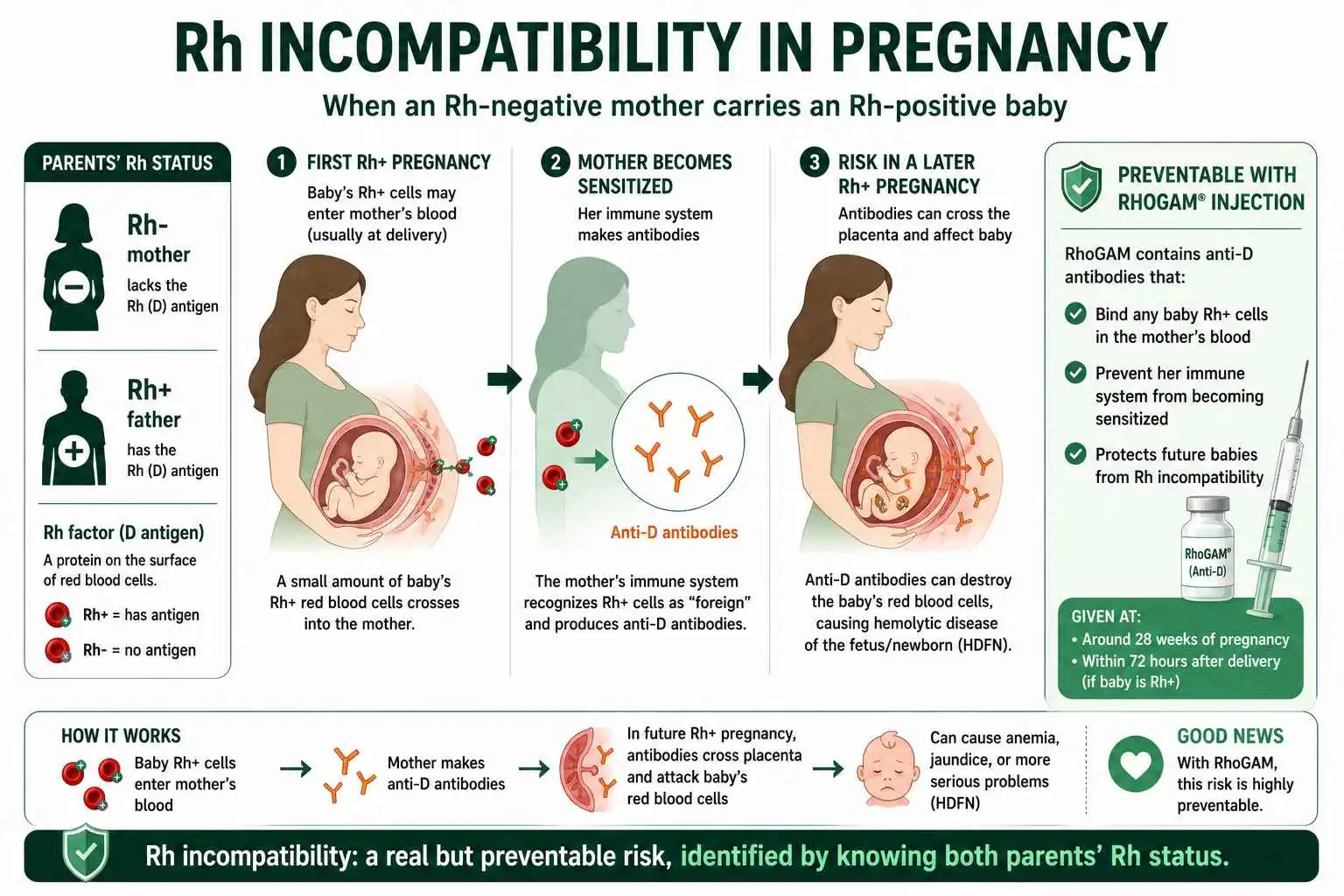
The resulting condition is called hemolytic disease of the fetus and newborn, and it can be serious. The good news is that it is highly preventable today. An Rh-negative mother can receive an injection of Rh immunoglobulin, known by the brand name RhoGAM, which stops her immune system from making the harmful antibodies. As the March of Dimes explains, this preventive treatment has made Rh disease rare in places with good prenatal care. This is the practical reason knowing both parents' Rh status matters: it lets doctors identify and prevent a risk before it ever affects a baby.
How Common Is Each Blood Type?
Once you can predict a baby's blood type, a natural follow-up is how common that type actually is. Blood type frequencies vary widely around the world, which is itself a result of the inheritance patterns playing out across whole populations over many generations.
Globally, type O is the most common ABO group, followed by type A, then type B, with type AB the rarest of the four. Because about 85 percent of people are Rh-positive, O-positive tends to be the single most common full blood type in many populations, while the negative types are scarcer. AB-negative is often cited as the rarest of the eight common types, since it requires the uncommon AB combination together with two recessive Rh-negative alleles.
These frequencies are not the same everywhere. Different populations carry different proportions of the A, B, and O alleles, so the mix of blood types shifts from one region to another. Some populations have notably high rates of type B, for instance, while others are predominantly type O. This variation matters for blood banks, which must maintain supplies matched to the population they serve. It also reflects the simple fact that blood type is inherited: the allele frequencies in a population determine how often each type appears, exactly as the inheritance rules predict at the family level scaled up to millions of people. For anyone curious about how allele proportions translate into population-wide genotype counts, a genotype frequency calculator shows the math behind these distributions.
Blood Type and Transfusion Compatibility
Blood type prediction connects directly to one of the most important uses of blood typing: making transfusions safe. The same antigens that define a blood type determine which blood a person can safely receive, which is why typing is done before any transfusion.
The rules follow from the antigens and antibodies each type carries. A person's immune system attacks any ABO antigen it does not recognize, so a type A person cannot receive type B blood, and vice versa. Type O blood, carrying neither A nor B antigen, can be given to people of any ABO type, which is why O-negative is called the universal donor. Type AB, carrying both antigens and making no anti-A or anti-B antibodies, can receive any ABO type, making AB-positive the universal recipient. The Rh factor adds its own rule: an Rh-negative person should not receive Rh-positive blood, because it can trigger an immune response, while Rh-positive people can receive either.
Understanding a baby's likely blood type therefore has a practical echo in medicine, since the same genetics that predicts inheritance also governs compatibility. A family that knows its blood types has a small head start in a medical emergency, though hospitals always confirm with a fresh test before transfusing. The inheritance of antigens at the family level and the compatibility of those antigens in transfusion are two sides of the same genetic coin, both flowing from the ABO and Rh alleles a person carries.
Rare Exceptions and a Word on Paternity
Blood type inheritance follows reliable rules, but a few rare exceptions exist, and it is important to understand them before drawing any strong conclusions from a child's blood type. These exceptions are uncommon, yet they matter because people sometimes misuse blood type to question parentage.
The best-known exception is the Bombay phenotype, a rare condition in which a person genetically carries A or B alleles but cannot display them, so they test as type O. A parent with the Bombay phenotype could pass on an A or B allele despite appearing to be type O, producing a child whose blood type seems impossible from the parents' apparent types. Mutations and other rare blood group variants can occasionally cause similar surprises. These cases are unusual, but they are real.
This leads to an important caution. Blood type is not a reliable paternity test. While the inheritance rules hold true the vast majority of the time, the rare exceptions mean an unexpected blood type in a child is not proof of anything about parentage. If a child's blood type does not match what the parents expected, the explanation is far more likely to be a hidden allele or a rare variant than anything else. The only conclusive test of paternity is a DNA test, not a blood type comparison. Treating a blood type calculator as a definitive paternity tool is a misuse of it, and a genuinely harmful one, so its predictions should be understood as genetic probabilities rather than proof.
Frequently Asked Questions
Can two O parents have a non-O child?
No, under normal genetics. Both type O parents have the genotype OO, so they can only pass O alleles, and all their children will be type O. The only exceptions are extremely rare cases like the Bombay phenotype or a mutation.
Can two Rh-positive parents have an Rh-negative baby?
Yes. If both Rh-positive parents carry a hidden Rh-negative allele and each passes it on, the child inherits two negative alleles and is Rh-negative. This is why Rh-positive parents can have an Rh-negative child, but two Rh-negative parents cannot have a positive one.
What blood type can an A and B couple have?
A type A and type B couple can have a child of any blood type, A, B, AB, or O, if both parents are carriers of a hidden O allele. The O child results when each parent passes their hidden O. If neither carries an O, only AB, A, or B are possible.
Can blood type prove who the father is?
No. Blood type can sometimes rule a man out as a possible father, but it cannot prove paternity, and rare exceptions like the Bombay phenotype can mislead even that. Only a DNA test can reliably determine parentage.
The Practical Takeaway
A baby's blood type comes down to two independent inheritances: the ABO allele and the Rh allele from each parent. ABO involves three alleles with A and B codominant and O recessive, while Rh follows simple dominance with positive over negative. Predicting a child's type means solving each system separately, then combining them, and the parent charts make the possibilities easy to read. Hidden recessive alleles explain the surprises, like an A and B couple having a type O child.
Beyond curiosity, the prediction matters medically, since Rh incompatibility between an Rh-negative mother and Rh-positive baby is a real but preventable risk. You can work out any couple's possible blood types and the odds of each with the Punnett Square Calculator, keeping in mind that rare exceptions exist and that blood type is never a substitute for a DNA paternity test. For authoritative medical detail on the Rh factor in pregnancy, the Cleveland Clinic resource is a trustworthy place to read further.