Recessive Traits in Babies: What to Really Expect
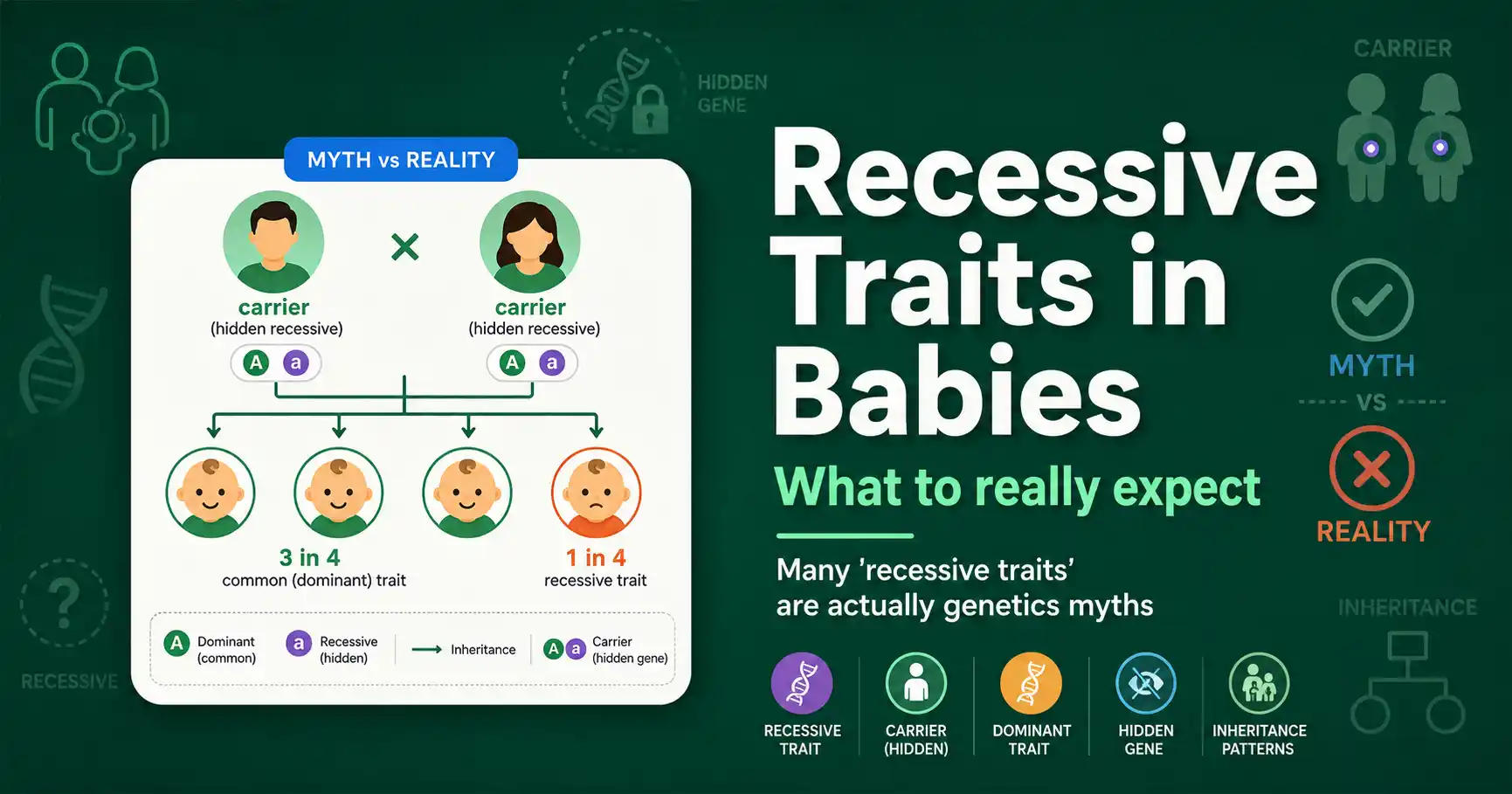
A recessive trait is one that shows up only when a child inherits the same variant from both parents, which is why two parents without the trait can have a child who has it. This is real genetics, and it explains how features can seemingly skip a generation. But here is the surprise: most of the "recessive traits" taught in school, like tongue rolling and attached earlobes, are actually myths. They are not controlled by a single gene at all.
This guide separates the real recessive inheritance from the classroom myths. It explains how recessive traits truly work, which popular examples are wrong, where recessive inheritance genuinely applies, and what it means for predicting your baby. To estimate the traits that can be predicted, you can check your baby's odds for the reliably inherited traits and skip the ones that genetics cannot actually forecast.
How Recessive Traits Really Work
A recessive trait appears only when a child inherits two copies of the recessive variant, one from each parent. Understanding this explains the "where did that come from" surprises in families.
Everyone carries two copies of most genes, one from each parent, and the copies can differ. A dominant variant shows its effect with just one copy, while a recessive variant shows only when both copies are the recessive version. This means a person can carry a recessive variant, and pass it on, without showing the trait themselves. Geneticists call such a person a carrier.
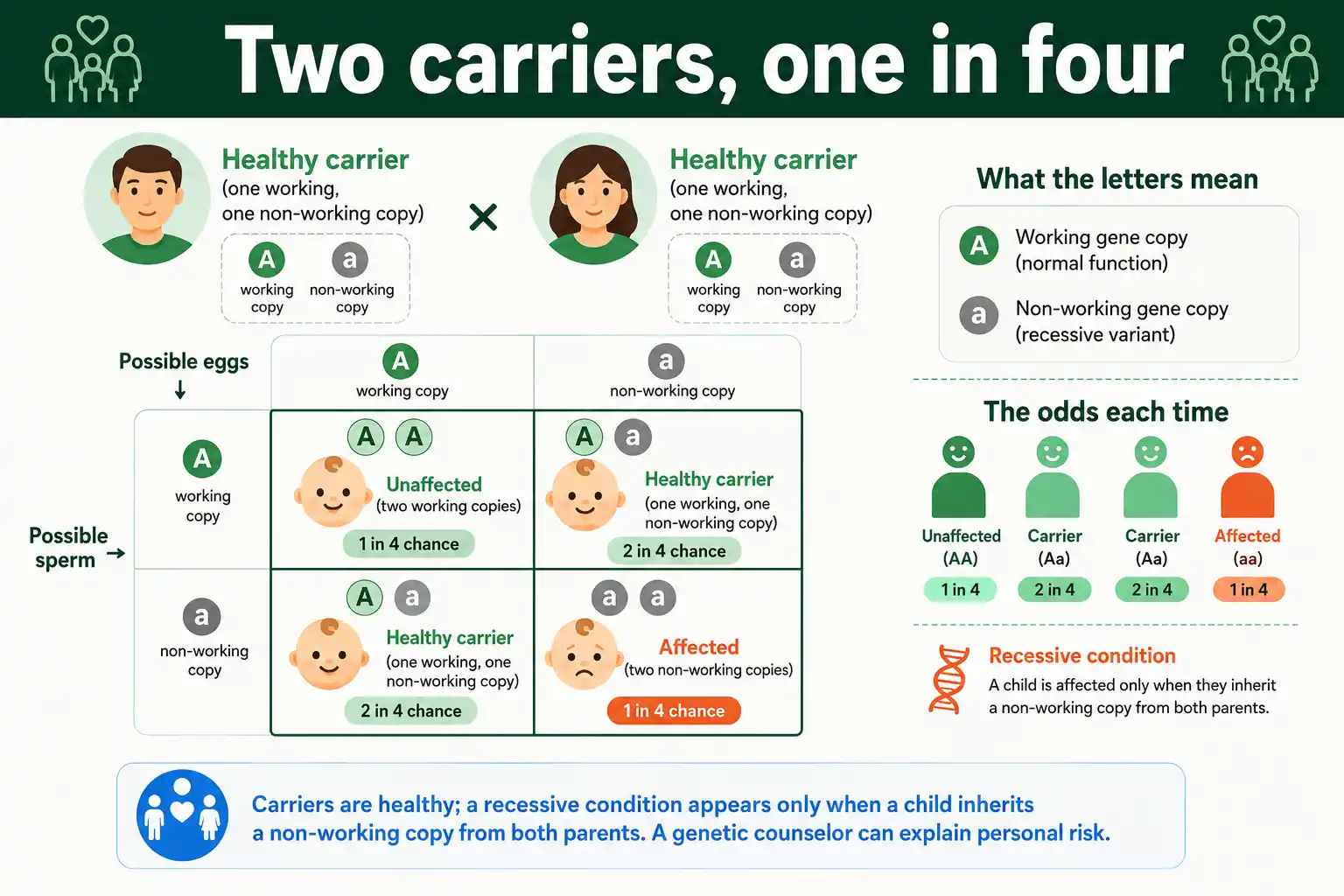
When two carriers have a child, each has a chance of passing on their hidden recessive variant. If the child inherits the recessive version from both parents, the trait appears, even though neither parent shows it. This is the classic one-in-four chance for two carriers, and it is why a trait can seem to skip generations, hiding in carriers and reappearing when two of them have a child together.
A simple way to picture it: imagine each parent carries one "showing" copy and one "hidden" copy of a gene. Each parent passes just one copy to the child, chosen at random, like a coin flip. There is a one-in-four chance the child gets the hidden copy from both, a one-in-two chance they get one of each, and a one-in-four chance they get the showing copy from both. Only the child who draws the hidden copy from both shows the recessive trait. That single combination out of four is where the familiar 25 percent figure comes from, and it explains why recessive traits are uncommon in any one child yet keep reappearing across a family.
The Big Surprise: Most "Recessive Traits" Are Myths
Here is what most articles get wrong: the famous textbook examples of recessive traits are not actually simple recessive traits. Decades of research have shown they do not follow the one-gene rule at all.
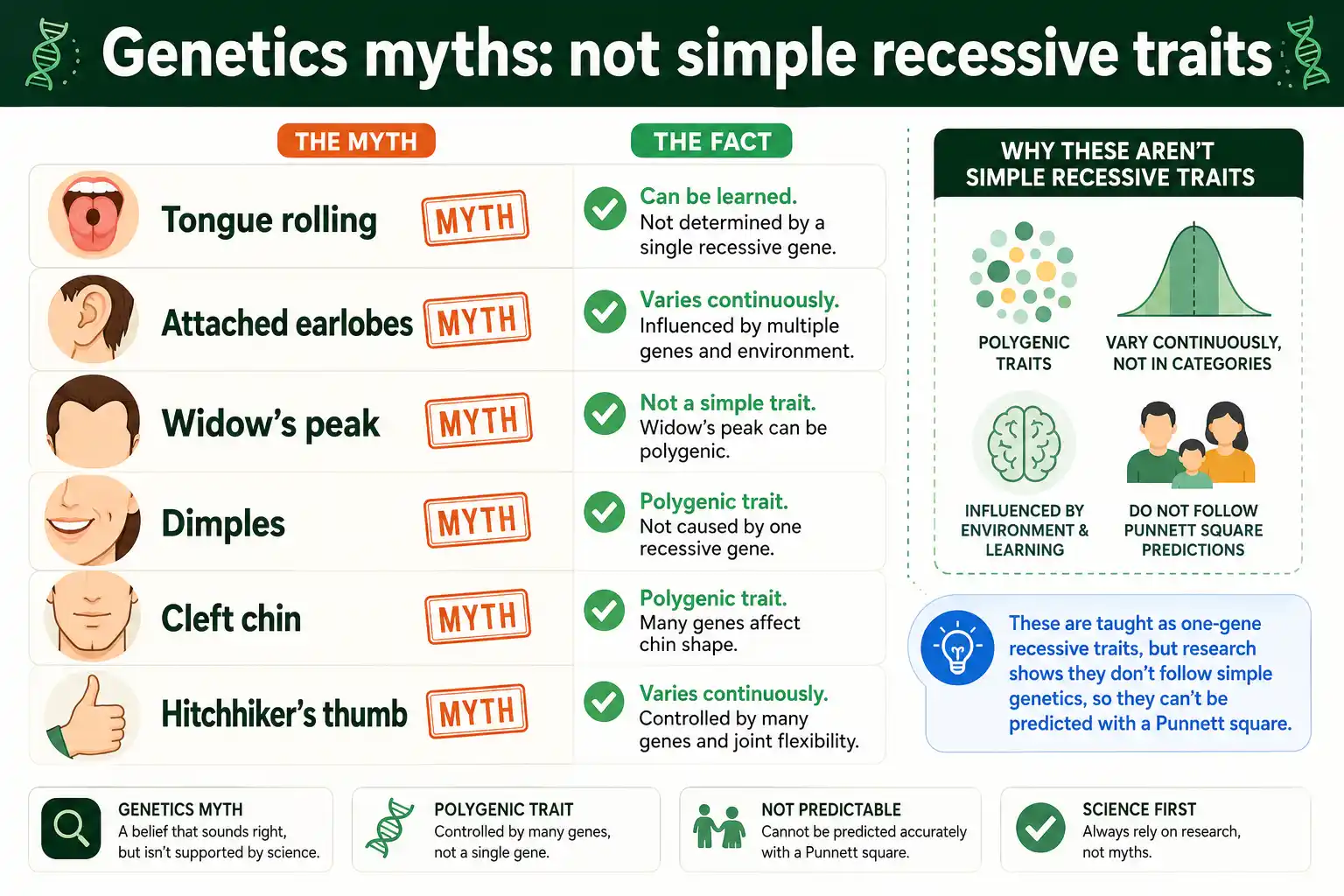
Tongue rolling is the most famous example. Generations of students were taught that rolling your tongue is a dominant trait and not rolling is recessive. But studies found plenty of non-rolling parents with tongue-rolling children, which is impossible under the simple model, and identical twins who differ in tongue rolling, which proves it is not purely genetic. Tongue rolling can even be learned. The same is true of attached earlobes: careful studies found earlobe attachment varies continuously rather than falling into two clean types, and it is shaped by many genes, not one. The University of Utah Learn.Genetics resource on observable traits explains that no published studies support the single-gene story for earlobes.
The list of debunked "simple" traits is long: widow's peak, cleft chin, dimples, hitchhiker's thumb, and hand clasping have all been shown to be more complex than the textbook says, or not clearly genetic at all. As the geneticist John McDonald documented in his Myths of Human Genetics, most visible human traits used in classrooms do not have a simple dominant-recessive pattern. So if you have been predicting your baby's dimples or tongue-rolling with a Punnett square, the genetics does not actually support it.
Where Recessive Inheritance Is Real
Recessive inheritance is genuine and important, just not for the cosmetic traits usually cited. It applies most clearly to certain genetic conditions and a few well-studied traits.
Red hair is a real example, as covered in our guide on baby hair color genetics: it follows a largely recessive pattern through the MC1R gene, so two non-redheaded carriers can have a red-haired child. Blue and lighter eye colors behave in a partly recessive way too, though eye color is polygenic rather than purely one-gene. These traits show real recessive behavior because a specific gene with a strong effect is involved.
The clearest and most important examples of recessive inheritance are genetic conditions. Many inherited disorders, including cystic fibrosis, sickle cell disease, and Tay-Sachs disease, are recessive: a child develops the condition only by inheriting a non-working gene copy from both parents, who are usually healthy carriers. This is exactly the carrier logic above, applied to health rather than appearance. Because both parents must be carriers, these conditions can appear in families with no prior history, which is why carrier screening exists. If you have questions about recessive genetic conditions in your family, a genetic counselor or doctor can provide personalized guidance and testing, which is the right step for any real concern about inherited health conditions.
Carrier screening is worth understanding because it makes the hidden-carrier idea concrete. A simple test can reveal whether a prospective parent carries a recessive variant for common conditions, and if both partners carry a variant for the same condition, a counselor can explain the one-in-four risk and the options available. Many people are carriers of something without ever knowing, since carriers are healthy by definition. This is the same recessive logic that runs through our explainer on Punnett squares and genetic disorders, applied as a practical health tool rather than a classroom exercise. None of this is cause for alarm, it is simply how recessive inheritance works, and modern screening makes it manageable.
Can Two Parents Without a Trait Have a Child With It?
This is the core question behind recessive inheritance, and the answer is a clear yes, for genuinely recessive traits. It is the practical takeaway parents care about.
For a truly recessive trait, two parents who do not show it can absolutely have a child who does, if both parents are carriers. This is how two brown-haired parents can have a red-haired child, how two hearing parents can have a child with a recessive form of hearing loss, and how two unaffected parents can have a child with a recessive condition. The trait was hidden in both parents as carriers, and it surfaced when the child inherited it from both.
The reverse also happens for dominant traits: a parent with a dominant trait may not pass it on, since they can pass their other, recessive copy instead. So a trait appearing or disappearing between generations is completely normal and expected, not a sign that anything is unusual. It is simply the hidden-carrier system at work, the same logic across hair color, eye color, and inherited conditions.
What This Means for Predicting Your Baby
The honest lesson is to predict only the traits that genuinely follow clear inheritance, and treat the rest as the fun guesses they are. Knowing which is which makes you better informed than most baby-trait articles.
Blood type follows clear, predictable rules and can be charted reliably. Eye color and hair color follow real but polygenic patterns, so they can be estimated as probabilities, not certainties. Red hair and recessive conditions follow genuine recessive inheritance through known genes. But dimples, tongue rolling, earlobes, widow's peak, and similar "fun" traits do not follow simple genetics, so any predictor claiming to forecast them precisely is overpromising. The ZME Science roundup of genetic myths still taught in schools is a good reality check.
Treat baby-trait prediction as part science, part fun. Use the reliable patterns where they exist, enjoy the guesswork everywhere else, and remember that every baby is a fresh combination no chart can fully capture.
It is worth being a little skeptical of any tool or article that promises to predict the "fun" traits with confidence. A predictor that tells you the precise odds of dimples or a widow's peak is selling certainty the science does not support, and it can give a false impression of how genetics works. The most trustworthy predictors are upfront about which traits they can estimate and which they cannot, which is the same honesty any good genetics resource should offer.
Frequently Asked Questions
Can two parents without a trait have a baby with it?
Yes, for recessive traits. If both parents carry a hidden recessive variant without showing the trait, each can pass it on, and a child who inherits it from both will show the trait. This is how two brown-haired parents can have a red-haired child, or how two carrier parents can have a child with a recessive condition, even with no family history.
Is tongue rolling really a recessive trait?
No. Despite being taught for decades as a simple genetic trait, tongue rolling is not controlled by one gene. Studies found non-rolling parents with rolling children, identical twins who differ in the ability, and evidence that it can be learned. Tongue rolling has some genetic influence but does not follow a simple dominant-recessive pattern, so it should not be used to demonstrate basic genetics.
Are attached earlobes recessive?
No. The idea that attached earlobes are recessive to free earlobes is a myth. Careful studies show earlobe attachment varies continuously rather than in two clean categories, and it is influenced by many genes. No published research supports the single-gene model, so earlobe shape cannot be predicted with a simple Punnett square.
Sorting Myth From Reality
Recessive inheritance is real: a trait shows only when a child inherits the recessive variant from both parents, which is why two carriers can have a child with a trait neither displays. This genuinely explains red hair, lighter eye colors, and many inherited conditions. But most of the classic "recessive traits" from biology class, tongue rolling, attached earlobes, widow's peak, dimples, are myths that do not follow simple genetics at all.
The practical message is to predict the traits that truly follow inheritance, blood type firmly, eye and hair color as probabilities, real recessive conditions through carrier logic, and to enjoy the rest as guesswork. For any concern about inherited health conditions, a genetic counselor is the right resource. To see how reliable a trait predictor can really be, our guide on how accurate baby trait predictors are takes an honest look at what these tools can and cannot do.