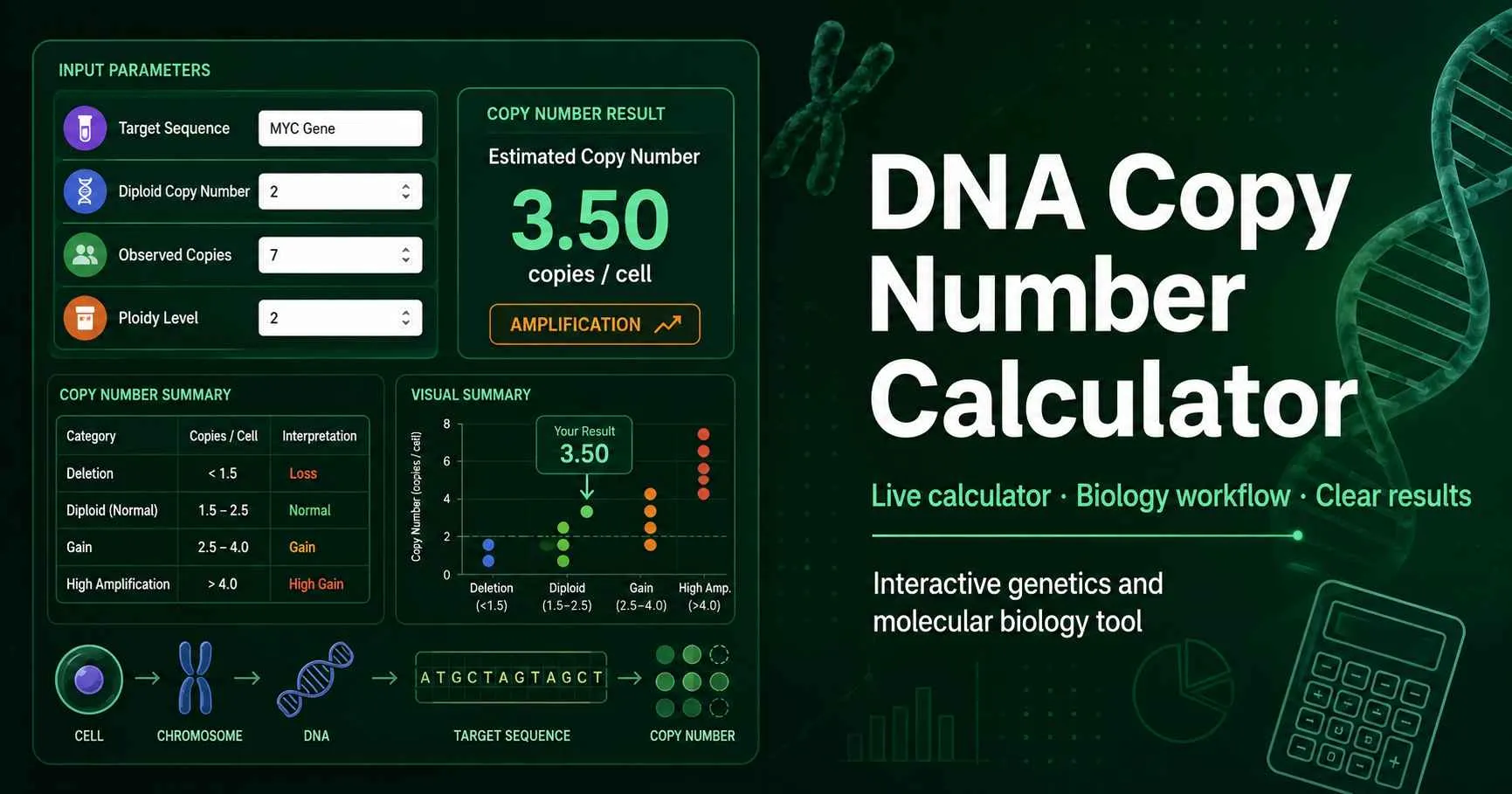
DNA Copy Number Calculator for qPCR and Molecular Biology

Calculate DNA copies per microliter from concentration, template length, and molecule type. Use the result for qPCR standards, plasmid templates, PCR products, synthetic oligos, and copy-number dilution planning.

DNA copy number calculator from ng/µL and bp length

Enter your DNA concentration and length. The calculator updates copies/µL, copies per reaction, nM concentration, molecular weight, and dilution volumes live.

DNA copy number presets

DNA sample inputs

Enter the measured DNA concentration and the full template length that one molecule carries.

Main result

3.0415 × 10^10 copies/µL

This value estimates the number of DNA molecules in each microliter of your stock.

DNA copy number visual summaryLinear dsDNA ampliconCopy signal scales with molecules per microlitercopies/µL

Copies per reaction

6.0830 × 10^10

Molarity

50.505 nM

Molecular weight

99,000 g/mol

Mass per reaction

10 ng

Calculation breakdown

Corrected concentration

5 ng/µL

Average mass used

660 g/mol per bp

Estimated molecular weight

99,000 g/mol

Copy-number log10 value

10.483

Mass for target copies

1.6439 × 10^-4 ng

Avogadro constant

6.02214076 × 10^23 mol⁻¹

DNA copy number calculator diagram showing DNA concentration, base pair length, Avogadro constant, and calculated DNA molecules per microliter
Figure 1. DNA copy-number conversion links molecule length, molecular weight, and Avogadro’s constant. A qPCR standard, plasmid DNA molecule, or PCR amplicon can only yield accurate copies/µL when the full template length and DNA mass concentration match the same physical molecule.

DNA copy number calculator: what the result means

DNA copy number means the estimated number of template molecules in a measured volume. A qPCR user usually wants copies/µL for a stock standard and copies per reaction for the actual PCR tube.

The calculation uses DNA mass, molecular weight, and Avogadro’s constant. Short templates contain more molecules per ng than long templates because each molecule weighs less. This is why a 150 bp amplicon and a 5,000 bp plasmid give very different copy numbers at the same ng/µL concentration.

Thermo Fisher describes DNA copy-number tools as a way to dilute DNA stocks to a specific copy number per µL. NEB also treats DNA mass-to-moles conversion as a core molecular-biology calculation for cloning and assembly workflows. See Thermo Fisher’s copy-number calculator context.

How to use DNA Copy Number Calculator correctly

1

Choose the DNA molecule type

Select dsDNA, plasmid DNA, ssDNA, or ssRNA so the calculator can apply the correct average molecular mass.

2

Enter the complete DNA length

Type the full length in bp or nt. Use complete plasmid length for plasmid standards, not only the insert or amplicon region.

3

Add DNA concentration and reaction volume

Enter concentration in ng/µL and template volume in µL. The calculator reports copies/µL and copies per reaction instantly.

4

Use advanced mode for dilution planning

Enter a target copies/µL and final volume to calculate how much stock DNA and diluent you need for a working standard.

Use the DNA Dilution Calculator after this step when you need to prepare a lower-concentration working stock. Use the ng/µL to nM Calculator when molarity matters more than molecule count.

DNA copy number formula from concentration and molecular weight

Use this formula when concentration uses ng/µL and molecular weight uses g/mol:

copies/µL = concentration(ng/µL) × 10⁻⁹ × 6.02214076 × 10²³ ÷ molecular weight(g/mol)

The calculator estimates molecular weight from length when you do not provide an exact value. It uses 660 g/mol per base pair for double-stranded DNA and plasmids, 330 g/mol per nucleotide for ssDNA, and 340 g/mol per nucleotide for ssRNA. IDT uses the same 660 g/mol average mass in its nanograms-to-copy-number explanation for double-stranded amplicons. Read IDT’s copy-number calculation note.

dsDNA and plasmids

Use length × 660 g/mol. Enter complete plasmid length for plasmid standards.

ssDNA oligos

Use length × 330 g/mol unless your supplier gives exact oligo mass.

ssRNA standards

Use length × 340 g/mol for quick RNA copy-number estimates.

DNA Copy Number Calculator components and purpose

Each input answers one laboratory question. The table explains what to enter and why that value changes the result.

Molecule type

Selects dsDNA, plasmid, ssDNA, or ssRNA mass assumptions.

User action: Choose the molecule that matches your standard material.

DNA length

Sets molecular weight.

User action: Use full plasmid length, full amplicon length, or full oligo length.

Concentration

Sets DNA mass per microliter.

User action: Use the measured ng/µL value after cleanup or quantification.

Template volume

Converts stock copies/µL into copies per PCR reaction.

User action: Use the exact template volume added to each reaction.

Advanced target copies

Plans a working stock at a defined copy number.

User action: Use this for qPCR standard curves and controlled template inputs.

DNA copy number examples for qPCR standards and plasmids

qPCR amplicon example: 150 bp at 5 ng/µL

A 150 bp dsDNA amplicon has an estimated molecular weight of 99,000 g/mol. At 5 ng/µL, the stock contains about 3.04 × 10^10 copies/µL. If you add 2 µL to one reaction, the reaction receives about 6.08 × 10^10 template copies.

This stock is too concentrated for most qPCR standard curves. Use advanced mode to plan a working dilution, then prepare serial dilutions with the Serial Dilution Calculator.

Plasmid example: 4,200 bp at 25 ng/µL

A 4,200 bp plasmid has an estimated molecular weight of 2,772,000 g/mol. At 25 ng/µL, it contains about 5.43 × 10^9 plasmid molecules per µL. One microliter adds the same number of plasmid templates to a reaction.

Enter total plasmid size, not insert size. A vector backbone adds mass to each molecule, so ignoring it inflates the calculated copies/µL.

DNA copy number interpretation table

copies/µL

Stock concentration expressed as molecule count.

Use: Use for qPCR standard preparation.

copies per reaction

Template count added to one PCR or qPCR tube.

Use: Use for absolute quantification setup.

nM

Molar concentration of DNA molecules.

Use: Use for oligo, cloning, and assembly workflows.

molecular weight

Mass of one mole of DNA molecules.

Use: Check this when plasmids or long templates look unexpectedly low.

DNA copy number accuracy and practical limits

Copy-number accuracy depends on the concentration method, DNA purity, template length, and dilution technique. A fluorometric dsDNA assay usually estimates double-stranded DNA more selectively than absorbance alone. Absorbance can overstate template mass when RNA, nucleotides, phenol, or salts remain in the sample.

The calculator estimates molecule count, not amplification efficiency. A sample can contain many DNA molecules and still amplify poorly if inhibitors, damaged templates, primer mismatch, or secondary structure affect PCR. Pair this calculation with the PCR Master Mix Calculator when you plan reaction volumes.

DNA Copy Number Calculator FAQs

How do you calculate DNA copy number from ng/µL?

Convert the DNA concentration from ng/µL into grams per microliter, divide by molecular weight in g/mol, then multiply by Avogadro’s constant. For a double-stranded DNA fragment, the calculator estimates molecular weight as length in base pairs multiplied by 660 g/mol per base pair. A 150 bp amplicon at 5 ng/µL gives about 3.04 × 10^10 copies/µL. Use the full template length, not only the amplified region, when the template is a plasmid or genomic fragment.

Should I enter plasmid length or insert length for copy number?

Enter the full plasmid length. A plasmid molecule includes the vector backbone, insert, promoter, resistance marker, origin of replication, and every other base pair in the circular DNA. Copy number counts molecules, so the molecular weight must represent the complete molecule. If you enter only the insert length, the calculator will overestimate plasmid copies.

Why does DNA length change copies per microliter?

Longer DNA molecules weigh more per molecule. The same 10 ng mass contains many more copies of a 100 bp amplicon than a 5,000 bp plasmid. Copy number therefore depends on both DNA mass concentration and molecular weight. This is why qPCR standards need accurate amplicon or plasmid length values.

Can this calculator prepare qPCR standard curves?

Yes. Use the copies/µL result to prepare the top standard for an absolute qPCR curve. Then use the advanced dilution planner to make a defined working stock, such as 10^6 copies/µL. After that, prepare a serial dilution series with clear labels and consistent pipetting volumes.

What molecular weight does this DNA copy number calculator use?

The calculator uses 660 g/mol per base pair for double-stranded DNA and plasmids, 330 g/mol per nucleotide for single-stranded DNA, and 340 g/mol per nucleotide for single-stranded RNA. These average values work well for routine laboratory planning. Use the exact molecular-weight override when your supplier provides a sequence-specific mass.

Does copy number mean the same thing as genome copy number variation?

No. This calculator estimates physical DNA molecules in a tube. Genome copy number variation describes duplicated or deleted genomic regions inside cells or organisms. Both use the words copy number, but they answer different questions. qPCR standard preparation usually needs molecule copies per microliter, not a CNV genotype call.

Why can NanoDrop concentration give wrong copy numbers?

Absorbance-based concentration can include contaminating RNA, nucleotides, salts, phenol, or fragmented DNA. The calculator assumes the entered concentration represents the target molecule. Use the correction percentage when you know the usable fraction is lower than the measured concentration. For precise qPCR standards, confirm DNA quality and use careful dilution practice.