Double Digest Calculator for Restriction Enzyme Fragment Sizes

Predict how two restriction enzymes cut linear DNA or a circular plasmid. The tool reports recognition sites, cut positions, fragment sizes, compatible sticky ends, and reaction setup warnings. Use it before diagnostic digestion, insert excision, or vector preparation.

Predict double digest cut sites and gel bands

Paste a DNA sequence, select two enzymes, and compare the double digest with both single digests. Basic mode answers the fragment-size question. Advanced mode adds reaction-volume checks for the wet-lab setup.

Choose a digest setup

Start with a realistic plasmid or insert example, then paste your own sequence and enzyme pair.

DNA sequence and enzyme pair

Paste the full linear sequence or circular plasmid sequence. The tool ignores spaces, numbers, and FASTA headers.

Digest summary

Sequence length

233 bp

Unique cuts

2

EcoRI sites

1

BamHI sites

1

Ends are not directly compatible

EcoRI leaves AATT (5-overhang) and BamHI leaves GATC (5-overhang). Use ligation only after compatible end design, blunting, adapters, or a different enzyme pair.

EcoRI: Produces a 5′ AATT cohesive end.

BamHI: Produces a 5′ GATC cohesive end.

Cut map

Circular DNA cut map751233 bpcircular template

Predicted fragments

F2 · 189 bp516
F1 · 44 bp750

Single digest comparison

Compare each single digest with the combined digest before you interpret gel lanes.

EcoRI only

  • 233 bp linearized

BamHI only

  • 233 bp linearized

Double digest

  • 189 bp F2
  • 44 bp F1
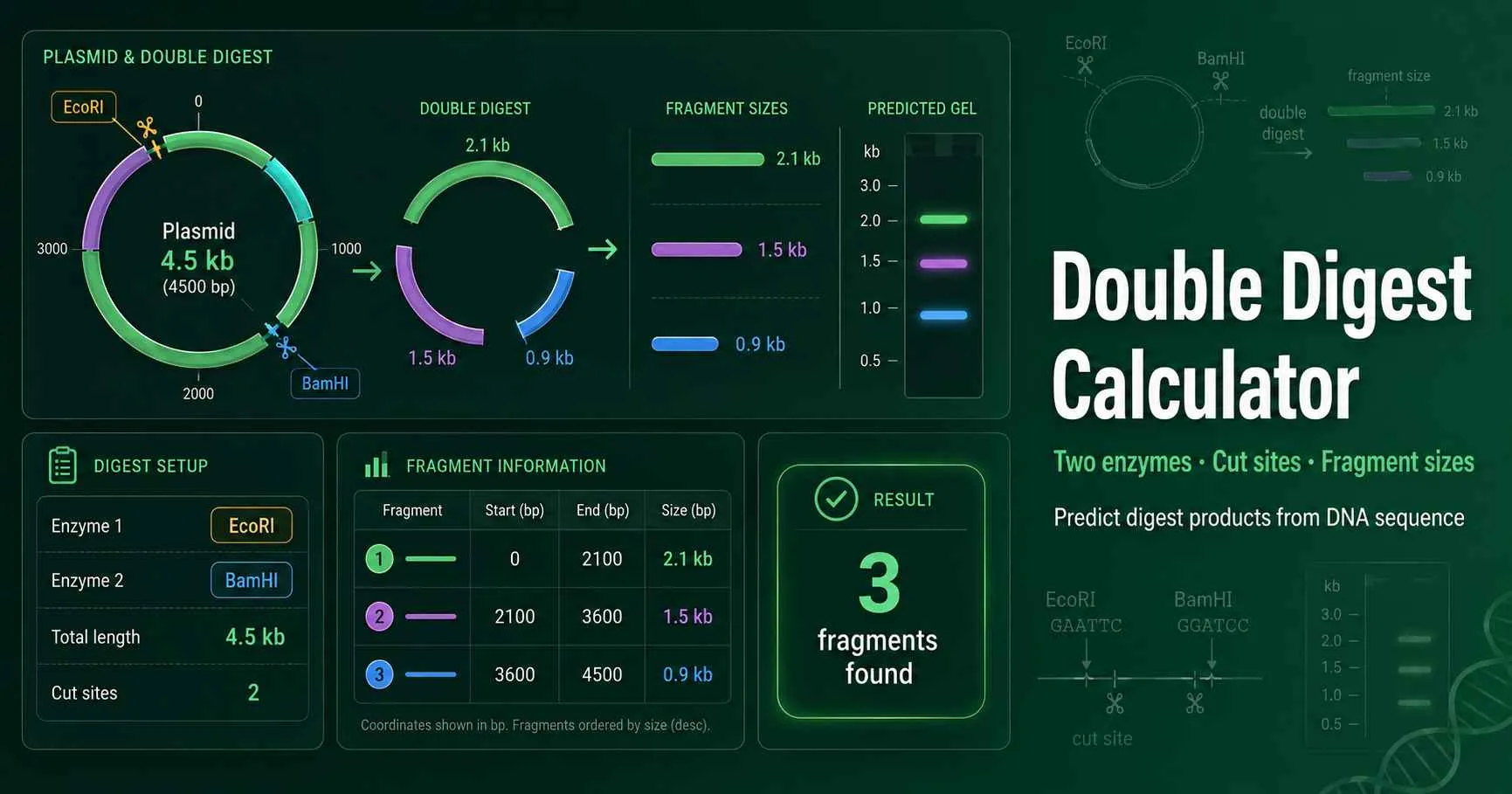
Double digest diagram showing two restriction enzymes cutting a circular plasmid into predicted DNA fragments and gel bands
Figure 1. A double restriction digest uses two endonucleases, such as EcoRI and BamHI, to cut defined recognition sequences in a DNA molecule. The fragment pattern links the enzyme sites, plasmid topology, cohesive ends, and expected agarose gel bands into one testable map.

Double digest results tell you which DNA bands to expect

A double digest cuts one DNA molecule with two restriction endonucleases. Most users want one practical answer: “What band sizes should I see on my gel?” This calculator answers that by scanning the sequence for both recognition sites and measuring the distance between cut positions.

Circular plasmids need different math than linear PCR products. A plasmid has no true first base during digestion, so the final fragment wraps from the last cut site back to the first cut site. Linear DNA has physical ends, so fragments also run from each end to the nearest cut.

Molecular cloning uses this logic every day. A diagnostic digest can confirm an insert, check orientation, or distinguish similar plasmid clones. Addgene describes diagnostic digests as a way to cut plasmids into predicted fragments and analyze those bands by gel electrophoresis. Read Addgene’s diagnostic digest guide.
What each part of the digest tool does

Each input controls a specific biological assumption. Use the table before you trust a fragment pattern from any digest calculator.

Tool partWhat you enterWhy it matters
DNA sequenceA plasmid, insert, PCR product, or synthetic fragmentThe sequence determines the exact recognition sites and fragment sizes.
Template typeCircular plasmid or linear DNATopology changes the fragment calculation at the sequence ends.
Enzyme pairTwo restriction enzymes such as EcoRI and BamHIEach enzyme contributes a recognition site, cut offset, and DNA end type.
Cut mapNo manual inputThe visual map shows where cuts fall before you interpret gel bands.
Advanced reaction setupDNA mass, concentration, enzyme volume, buffer stockThe volume check catches negative water and high glycerol before the tube is prepared.

Basic mode gives bands; Advanced mode checks the tube setup

Basic mode for gel prediction

Use Basic mode when you need cut sites, fragment sizes, and sticky-end compatibility. This fits classroom problems, plasmid map checks, and quick insert-excision planning. It keeps the workflow focused on sequence logic.

Advanced mode for reaction planning

Use Advanced mode when you also need DNA volume, buffer volume, water volume, and enzyme-volume warnings. It does not replace the supplier protocol, but it helps you catch pipetting problems early.

Fragment-size formulas depend on DNA topology

The calculator treats the cleaned sequence as a coordinate system. It records each cut position, sorts unique cuts, then calculates distances between neighboring cuts.

DNA typeHow fragments are measuredCommon result
Linear DNAFrom the left end to the first cut, between cuts, and from the last cut to the right end.Two cuts usually create three fragments.
Circular plasmidFrom each cut to the next cut around the circle, including the wraparound segment.Two unique cuts usually create two fragments.
One-cut plasmidOne cut opens the circle at a single position.The gel often shows one linear band near the full plasmid size.

Double digest examples for cloning and plasmid verification

Example 1: EcoRI and BamHI release an insert

A 5,200 bp circular plasmid has one EcoRI site at 800 bp and one BamHI site at 2,100 bp. The distance from EcoRI to BamHI equals 1,300 bp. The wraparound fragment equals 5,200 − 1,300 = 3,900 bp.

A correct gel should show two main bands near 3.9 kb and 1.3 kb after complete digestion. If the 5.2 kb band remains strong, one or both enzymes may have cut incompletely.

Example 2: BamHI and BglII create compatible ends

BamHI recognizes GGATCC and BglII recognizes AGATCT. Both leave a 5′ GATC overhang. The fragments can ligate together because the cohesive ends match.

The final ligation junction usually does not regenerate the original BamHI or BglII recognition site. That matters when you plan a scar, a diagnostic digest, or a second cloning step.

Restriction digest checks before you run the gel

Fragment prediction solves only half of the problem. The physical reaction also needs compatible conditions. NEB notes that double-digest planning should account for buffer selection and provides tools for choosing reaction conditions. Check NEB’s double-digest guidance.

CheckWhy users miss itPractical action
Buffer compatibilityDifferent enzymes can lose activity in the wrong buffer.Use the supplier chart for the exact enzyme versions.
Incubation temperatureMost enzymes use 37°C, but not all do.Avoid combining enzymes with conflicting temperature needs without a protocol.
Glycerol levelLarge enzyme volumes add glycerol from storage buffer.Keep enzyme volume modest or increase total reaction volume.
Methylation sensitivitySome sites cut poorly when methylated.Check Dam, Dcm, or CpG sensitivity when bacterial plasmids fail.
Partial digestionToo little time, wrong buffer, or too much DNA can leave uncut template.Run single-digest controls and include an uncut lane.

Double digest questions students and lab users ask

What does a double digest calculator tell me?

It tells you where two restriction enzymes cut a DNA sequence and what fragment sizes those cuts create. The result helps you plan a diagnostic digest, confirm a plasmid map, or predict whether two enzymes release an insert. The calculator also reports sticky-end compatibility and a basic reaction-volume check. You should still confirm buffer activity, incubation time, and enzyme units with the supplier protocol before running the experiment.

How do I read the fragment sizes from a circular plasmid?

For circular DNA, each fragment equals the distance from one cut site to the next around the plasmid. One cut linearizes the plasmid and produces one band near the full plasmid size. Two unique cuts usually produce two fragments. More cuts create more bands, although similar-size fragments may merge on an agarose gel.

Why do EcoRI and BamHI often appear in cloning examples?

EcoRI and BamHI cut common multiple-cloning sites and produce different 5′ sticky ends. Different ends can support directional cloning because the insert has a preferred orientation. EcoRI leaves AATT, while BamHI leaves GATC. Those overhangs do not ligate directly to each other, but each ligates to a matching compatible end from the same or a compatible enzyme.

Can BamHI and BglII sticky ends ligate together?

Yes, BamHI and BglII both leave a 5′ GATC overhang. The ends can anneal and ligate, but the final junction often destroys the original recognition sites. That can help cloning because the joined scar may resist recutting. Always check the final sequence if you need to preserve a diagnostic site.

Why does the same double digest give unexpected gel bands?

Unexpected bands can come from partial digestion, star activity, wrong plasmid topology, methylation sensitivity, or an incorrect sequence map. Supercoiled, nicked, and linear plasmids also migrate differently before digestion. Run single-digest controls when a double digest fails to match the predicted pattern. The single lanes show whether one enzyme failed or whether the input plasmid differs from the map.

What glycerol percentage should I watch in restriction digests?

Many restriction enzymes ship in about 50% glycerol. A high enzyme volume can push final glycerol above 5%, which may increase star activity for some enzymes. The Advanced mode estimates glycerol from the total enzyme volume and reaction volume. Increase total reaction volume or use less enzyme when the warning appears.

Does this tool choose the final reaction buffer for me?

No. The tool helps you model cut sites, fragments, ends, and pipetting feasibility. Buffer compatibility depends on enzyme version, supplier, buffer formulation, methylation sensitivity, and incubation temperature. Use the supplier double-digest chart or online protocol tool before you prepare the tube.