Sticky End Compatibility Calculator

Check whether two restriction enzyme ends can ligate before you set up a cloning reaction. The tool compares overhang sequence, 5′ or 3′ polarity, blunt-end status, hybrid-site behavior, and directional cloning risk.

Compare restriction enzyme overhangs before ligation

Use Basic mode for a quick two-end check. Use Advanced mode when you need to test both junctions in a directional cloning plan.

Load a common compatibility example

End A

Choose an enzyme or enter a custom cohesive end.

BamHI

G/GATCC

5′ overhang

Overhang: GATC

5′ GATC cohesive end

End B

Compare the second enzyme or overhang against End A.

BglII

A/GATCT

5′ overhang

Overhang: GATC

BamHI-compatible GATC end

Live result

These sticky ends are compatible for ligation

BamHI and BglII expose the same 5′ overhang sequence (GATC). The single-stranded termini can anneal before DNA ligase seals the phosphodiester backbone.

Compatibility details

End A

GATC

5′ overhang

End B

GATC

5′ overhang

Cohesion score

6

Moderate cohesive pairing

Ligation note

Usable

Plan controls

Recleavage: Different enzymes with the same overhang often create a hybrid junction. Many hybrid junctions cannot be cut again by either original enzyme.

Cloning note: Different compatible ends can help cloning, but they may still allow mixed junctions if both vector ends accept the same overhang.

Restriction end overhang comparisonEnd comparisonGATCBamHI5′ overhangmatchGATCBglII5′ overhangMatching overhang sequence and matching 5′/3′ polarity matter more than recognition-site name.

Compatible enzymes for BamHI

These enzymes in the built-in list create the same end type and overhang as BamHI.

Export this check

Download a small report for a cloning notebook or lab worksheet.

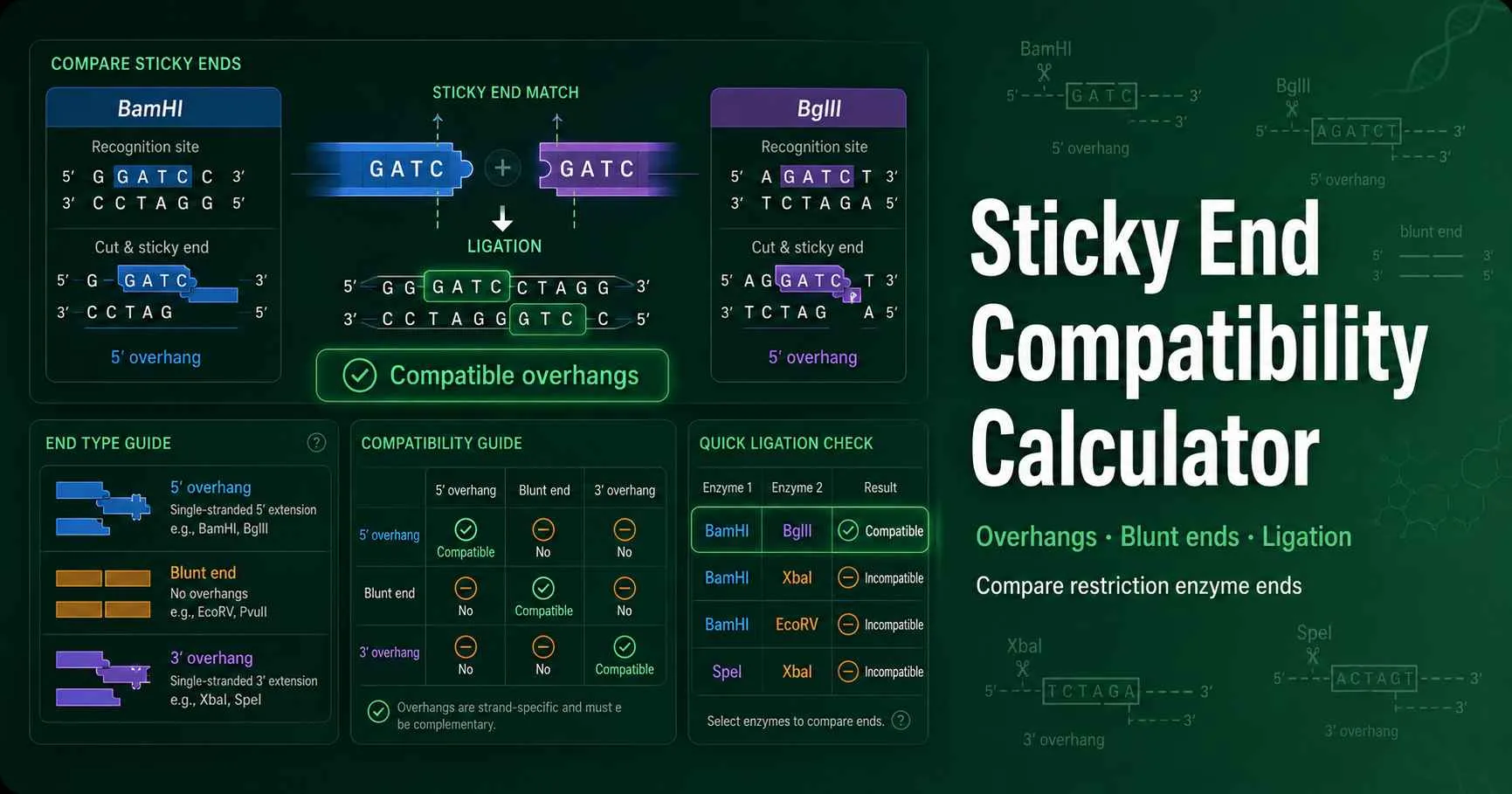
Sticky end compatibility diagram showing restriction enzyme overhangs, blunt ends, and ligation junctions for molecular cloning
Figure 1. Restriction endonucleases such as BamHI, BglII, XbaI, SpeI, EcoRI, and SmaI create DNA termini with specific overhang sequences or blunt ends. Compatible cohesive ends anneal through Watson-Crick base pairing before DNA ligase seals the backbone.

Sticky end compatibility means matching overhang sequence and polarity

A sticky end works because a restriction enzyme leaves a short single-stranded DNA overhang. Two ends can ligate when their exposed bases can pair in the same orientation. BamHI and BglII both leave a 5′ GATC overhang, so they can form a stable ligation junction even though their recognition sites differ.

The enzyme name alone does not decide compatibility. The useful attributes are the recognition sequence, cleavage position, overhang sequence, and overhang polarity. NEB lists compatible cohesive ends because different restriction enzymes can create the same ligatable termini. Review NEB compatible cohesive ends.

Blunt ends follow a different rule. They do not use single-stranded base pairing, so SmaI and EcoRV ends can ligate to each other. That flexibility helps in some cloning workflows, but it often lowers ligation efficiency and increases background colonies.

What each part of the tool checks

Each control answers a cloning question. Use the table as a quick guide before changing enzyme pairs or custom overhangs.

End selectors

Purpose
Choose the two DNA ends you want to compare.
Use it when
You know the restriction enzymes or the custom overhang sequence.

Compatibility verdict

Purpose
Reports whether the ends can ligate directly.
Use it when
You need a yes/no answer before planning the ligation setup.

Directional planner

Purpose
Checks both vector-insert junctions and reverse-orientation risk.
Use it when
You cut vector and insert with two different enzymes.

Practical cloning examples with compatible and incompatible ends

BamHI and BglII: compatible GATC ends

BamHI cuts GGATCC and leaves a 5′ GATC overhang. BglII cuts AGATCT and leaves the same 5′ GATC overhang. The two ends can anneal, so ligase can join the vector and insert.

The finished junction often becomes a hybrid site. That scar may not be cut efficiently by either BamHI or BglII. Use a sequence viewer or a restriction digest predictor before choosing a diagnostic digest.

PstI and KpnI: same polarity but different sequences

PstI and KpnI both create 3′ overhangs, but PstI exposes TGCA while KpnI exposes GTAC. Matching polarity alone does not create compatibility. The base sequence must match as well.

You can still clone with those enzymes if each vector end matches the correct insert end. Use the advanced planner, then calculate insert mass with the vector insert ligation calculator before setting up the reaction.

Rules for interpreting sticky-end and blunt-end results

Same 5′ overhang

Compatible

BamHI and BglII both expose GATC.

Same 3′ overhang

Compatible

Two enzymes must expose the same 3′ sequence.

Different polarity

Not compatible

A 5′ AGCT end does not equal a 3′ AGCT end.

Two blunt ends

Compatible but weaker

Blunt ends ligate without cohesive base pairing.

Use the compatibility result in a cloning workflow

Start with the end check. If both junctions match, calculate the insert-to-vector molar ratio next. If the result says the ends are not compatible, choose another enzyme pair, add adaptors, or repair the ends before ligation.

Restriction cloning still needs controls. Run vector-only ligation to estimate self-ligation background. Add insert-only and no-ligase controls when troubleshooting matters. Addgene describes restriction cloning as cutting a plasmid backbone and insert with compatible enzymes before ligase creates the final circular plasmid. Read Addgene’s restriction cloning guide.

After ligation, verify the clone. A colony PCR product, diagnostic digest, and Sanger read can catch wrong orientation, vector religation, partial digestion, and unexpected hybrid junctions. For fragment-size planning, pair this page with the double digest calculator.
Use these tools to move from end compatibility to reaction setup and digest verification.

Sticky end compatibility FAQs

What makes two sticky ends compatible?

Two sticky ends are compatible when they expose the same single-stranded overhang in the same 5′ or 3′ orientation. BamHI and BglII both create a 5′ GATC overhang, so their ends can anneal before DNA ligase seals the backbone. PstI and KpnI both create 3′ overhangs, but their overhang sequences differ, so they do not ligate directly. Blunt ends do not need base pairing, but they usually ligate less efficiently than cohesive ends.

Can different restriction enzymes create compatible ends?

Yes. Many enzymes recognize different DNA sequences but leave identical cohesive overhangs. XbaI, SpeI, NheI, and AvrII all create a 5′ CTAG end in common teaching examples. BamHI, BglII, and Sau3AI create a 5′ GATC end. The ligated hybrid junction may not regenerate either original restriction site, so you should check the final sequence before using a diagnostic digest.

Are all blunt ends compatible with each other?

All blunt ends can ligate because they do not require a matching overhang. SmaI, EcoRV, and HpaI all produce blunt termini in the built-in enzyme list. Blunt ligation lacks the temporary base-pairing step that sticky ends provide. Many protocols compensate by using more insert DNA, more ligase, longer incubation, or a higher vector-to-insert contact rate.

Why does 5′ versus 3′ overhang direction matter?

The overhang polarity controls which strand protrudes from the cut DNA end. A 5′ AGCT overhang does not behave like a 3′ AGCT overhang because the single-stranded extension points in the opposite chemical orientation. DNA ligase needs the ends to align correctly before it forms phosphodiester bonds. This calculator therefore checks both the sequence and the overhang type.

Does compatibility guarantee successful cloning?

No. Compatibility only tells you whether two DNA ends can anneal and ligate. A successful clone also depends on vector dephosphorylation, insert-to-vector molar ratio, enzyme inactivation, ligase conditions, transformation efficiency, and selection strategy. Directional cloning works best when the two vector ends differ and the insert carries matching, non-identical ends.

Can BamHI and BglII be recut after ligation?

A BamHI-to-BglII junction usually creates a hybrid sequence rather than restoring a clean BamHI or BglII site. That can help prevent the finished construct from being recut at the ligation scar. It can also make diagnostic planning harder if you expected the old site to remain. Always inspect the final junction sequence when recleavage matters.

How should I use this result in a cloning plan?

First, confirm that each vector end matches the intended insert end. Next, check whether the reverse insert orientation can also ligate. Then calculate insert mass with a vector-insert ligation calculator and review the expected digest fragments. A compatibility check saves time, but it does not replace sequence verification of the final plasmid.