How to Find Gametes From a Genotype (AaBb Method)
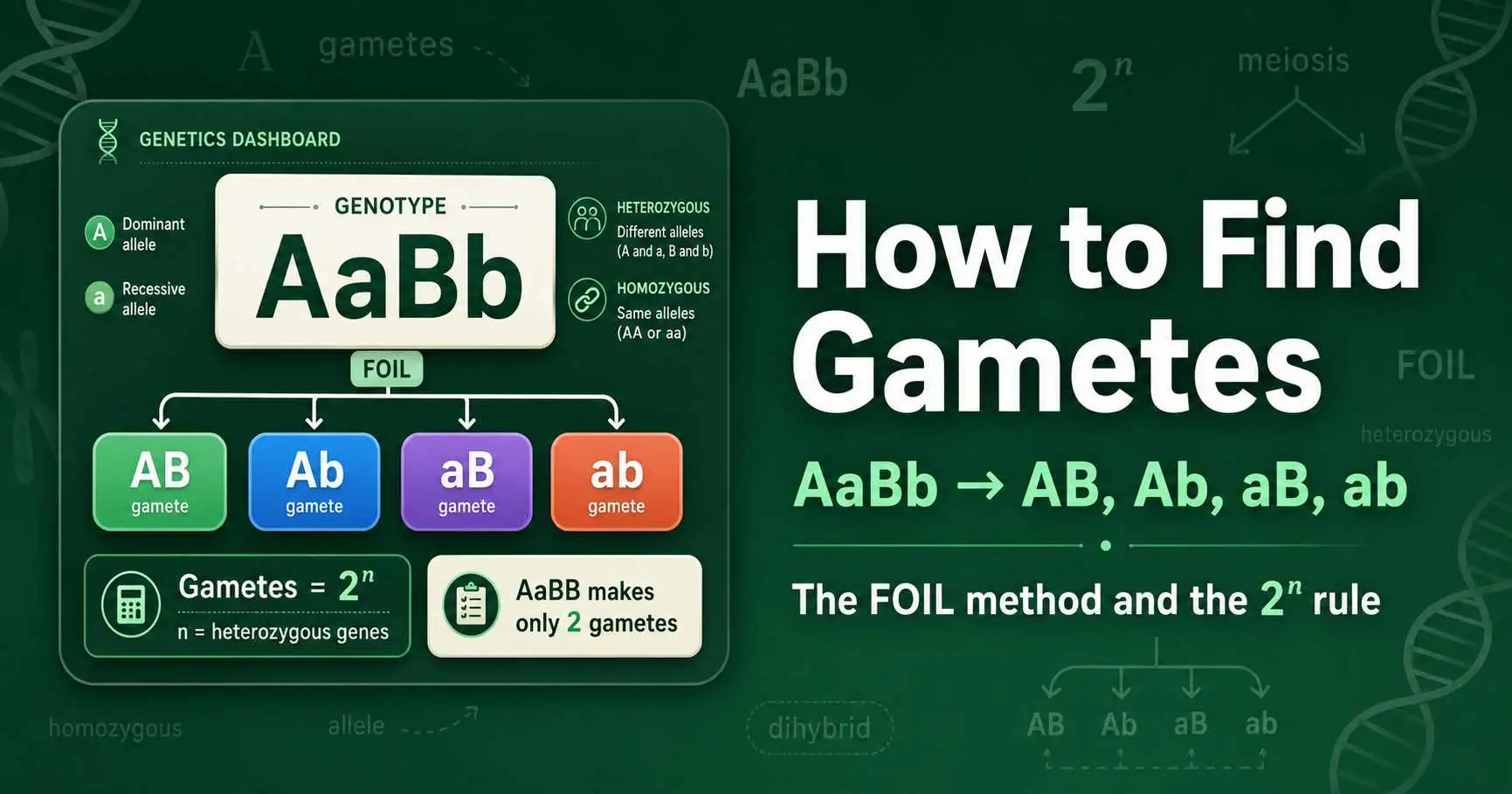
To find the gametes from a genotype, you separate the two alleles of each gene and list every possible combination, taking one allele from each gene. For a genotype like AaBb, this gives four gametes: AB, Ab, aB, and ab. The number of different gametes follows a simple rule: 2 raised to the power of the number of heterozygous genes. Getting these gametes right is the single most important step in any cross, because every box in the Punnett square is built from them.
Finding gametes is where most students stumble on dihybrid crosses, usually by producing the wrong combinations or the wrong number of them. This guide shows you exactly how to find the gametes from any genotype, using the reliable FOIL method for two genes and the 2ⁿ rule for counting, so you never have to guess. Worked examples cover one, two, and three genes, including the tricky cases where a gene is homozygous. Master this and the rest of any cross falls into place, since the gametes are the starting point for everything that follows. For the full method of building a cross afterward, our guide on how a Punnett square works takes it from here.
What a Gamete Actually Is
Before finding gametes, it helps to be clear on what a gamete is, because the whole method follows from this definition. A gamete is a sex cell, an egg or a sperm, and it carries only one allele for each gene. This is the rule that governs everything: one allele per gene, never two.
The reason traces back to meiosis, the cell division that makes gametes. Every body cell carries two alleles of each gene, one inherited from each parent. During meiosis, these pairs separate, so each gamete ends up with just one allele from each pair. This separation is Mendel's law of segregation, and it is why a gamete from an Aa parent carries either A or a, but never both. When that gamete later joins another at fertilization, the offspring regains two alleles per gene, one from each parent.
This single fact explains the most common gamete error, which is writing a full genotype where a gamete belongs. A gamete from an Aa parent is A or a, not "Aa," because the two alleles have separated. For a parent with two genes, like AaBb, each gamete still carries one allele from each gene, giving combinations like AB or ab, never a doubled allele like AA or a full genotype like AaBb. Keeping the definition firmly in mind, one allele per gene per gamete, prevents nearly every mistake that follows.
Finding Gametes for One Gene
The simplest case is a single gene, and it sets the pattern for everything more complex. A genotype with one gene produces gametes by separating its two alleles, with each gamete taking one of them.
For a heterozygous genotype like Aa, the two alleles are different, so they separate into two distinct gametes: one carrying A and one carrying a. That gives two kinds of gamete in equal proportion. This is why a heterozygous parent contributes variety to its offspring, since it can pass either allele. The two gametes are what create the familiar ratios when two heterozygotes are crossed.
A homozygous genotype works the same way but produces only one kind of gamete. For AA, both alleles are A, so separating them still gives only A gametes, since there is nothing else to pass. The same is true for aa, which yields only a gametes. This is a crucial point that carries into harder problems: a homozygous gene contributes only one type of allele to every gamete, so it does not add variety. Recognizing which genes are heterozygous and which are homozygous is the key to counting gametes correctly, as we will see.
Finding Gametes for Two Genes: The FOIL Method
For two genes, the reliable way to find all the gametes is the FOIL method, borrowed from the way you multiply two binomials in algebra. FOIL stands for First, Outside, Inside, Last, and it generates every combination of one allele from each gene without missing any.
Take the genotype AaBb. Write the two genes in order, with the first gene's alleles (A and a) and the second gene's alleles (B and b). Now apply FOIL. First combines the first allele of each gene: A and B give AB. Outside combines the outer alleles: A and b give Ab. Inside combines the inner alleles: a and B give aB. Last combines the final allele of each gene: a and b give ab. The four gametes are AB, Ab, aB, and ab. These four gametes are exactly what produce the classic 9:3:3:1 ratio when two such parents are crossed, as our guide to the dihybrid cross shows.
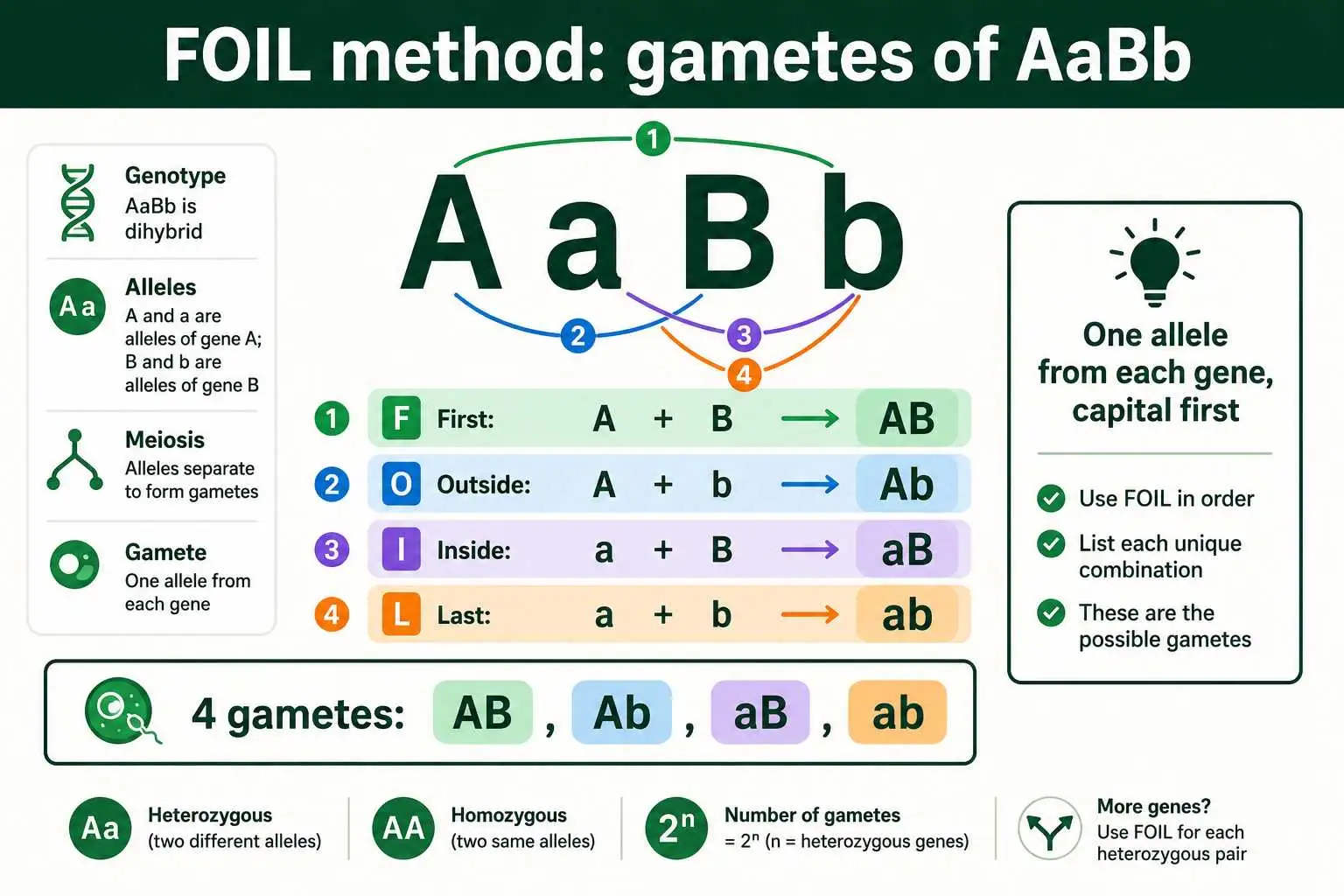
The logic is that each gamete must take exactly one allele from the first gene and one from the second, and FOIL systematically lists all four ways to do that. There is an important notation rule to follow: always pair the alleles from different genes, write the capital before the lowercase within each gene's contribution, and keep the genes in a consistent order, so you write AaBb gametes as AB, Ab, aB, ab, not as scrambled forms like ABab. This keeps your gametes readable and prevents counting errors. If FOIL is hard to remember, you can also think of it as making every possible pairing: each of the two shape alleles pairs with each of the two color alleles, which naturally gives four.
The 2ⁿ Rule: Counting Gametes Quickly
Before listing gametes, it is often useful to know how many there should be, and a simple formula gives the answer instantly. The number of different gametes equals 2 raised to the power of n, where n is the number of genes the organism is heterozygous for.
The rule works because each heterozygous gene offers two choices of allele for a gamete, and the choices are independent. One heterozygous gene gives 2 to the power of 1, which is 2 gametes. Two heterozygous genes give 2 to the power of 2, which is 4 gametes. Three heterozygous genes give 2 to the power of 3, which is 8 gametes. Each added heterozygous gene doubles the count, which is why gamete numbers grow so quickly in multi-gene crosses.
The critical detail, and a frequent source of error, is that n counts only the heterozygous genes, not the total number of genes. Homozygous genes contribute only one allele type, so they do not add variety and do not count toward n. A genotype like AaBB has only one heterozygous gene, the Aa, so it produces 2 to the power of 1, which is just 2 gametes, not 4. The BB gene contributes a B to every gamete regardless. Using the 2ⁿ rule as a check before and after listing your gametes catches mistakes: if you expected 2 gametes but wrote down 4, you know something went wrong.
It is worth understanding why the rule uses powers of two specifically. Each heterozygous gene presents an independent two-way choice for the gamete, either the dominant allele or the recessive one. When choices are independent, the total number of combinations is found by multiplying the options together, so two genes each with two options give two times two, three genes give two times two times two, and so on. That repeated multiplication by two is exactly what 2ⁿ expresses. The same counting principle underlies probability throughout genetics, which is why the gamete count and the probability methods share the same mathematical root. Seeing the rule this way, as independent choices multiplied together, makes it easy to apply to any genotype without memorizing special cases.
Worked Examples Across Different Genotypes
Seeing the method applied to a range of genotypes makes the pattern clear, especially the cases involving homozygous genes that trip students up. Work through each of these to build confidence.
For the genotype AaBb, both genes are heterozygous, so n equals 2 and there are 2² which is 4 gametes. Applying FOIL gives AB, Ab, aB, and ab. This is the standard double-heterozygote case behind the 9:3:3:1 ratio. For the genotype AABb, only the second gene is heterozygous, so n equals 1 and there are just 2 gametes. Since the first gene is always A, the gametes are AB and Ab. The homozygous AA gene fixes an A in every gamete, halving the variety compared to AaBb.
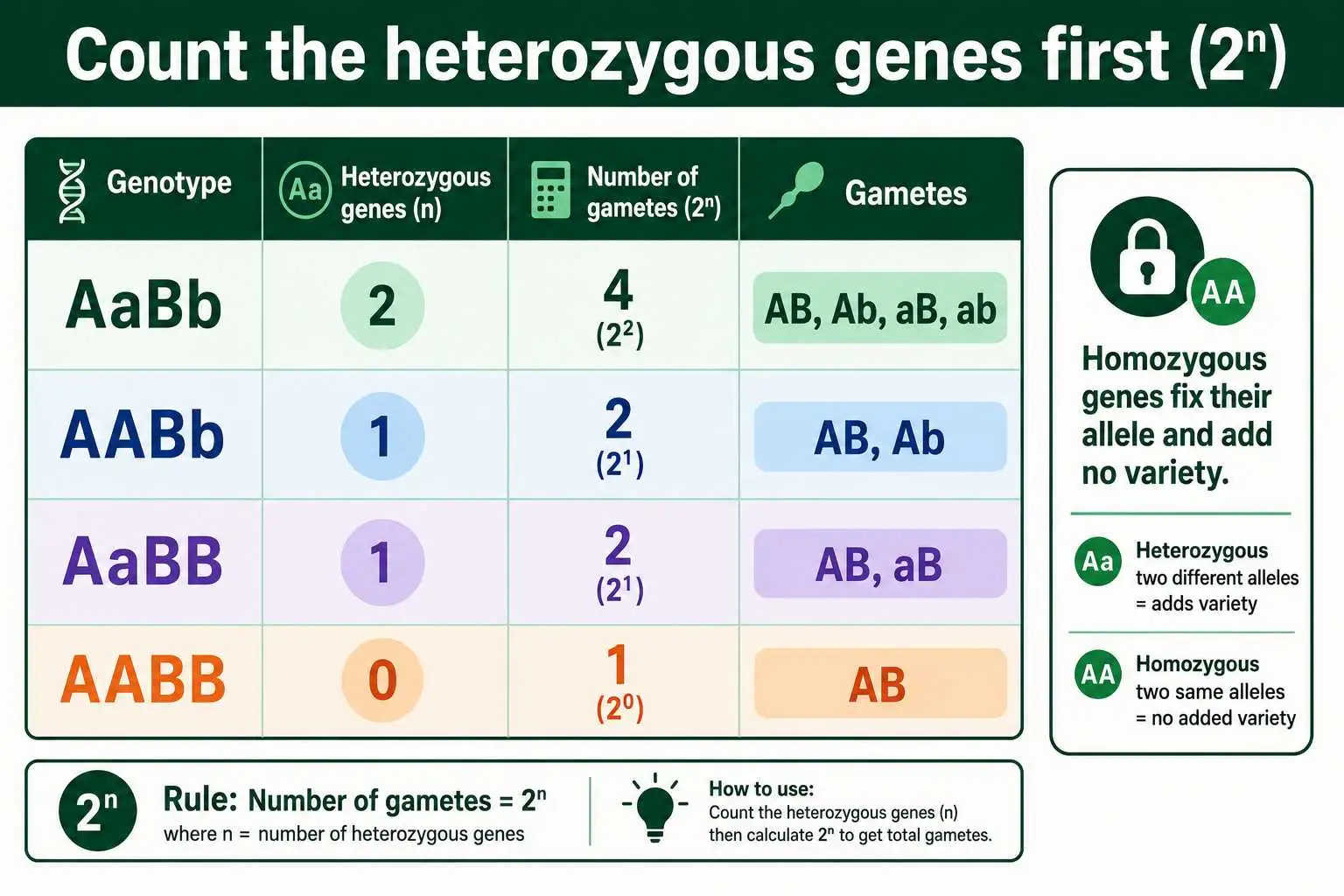
For the genotype AaBB, again only one gene is heterozygous, so there are 2 gametes: AB and aB, with the BB gene fixing a B in each. For a fully homozygous genotype like AABB, no gene is heterozygous, so n equals 0 and there is 2⁰ which is just 1 gamete: AB. The organism can only pass one combination. These examples show the central lesson clearly: count the heterozygous genes first, because they alone determine how many gametes you get, and the homozygous genes simply lock in their single allele.
A common point of confusion deserves a direct answer here: why does AaBB give two gametes rather than four, when it has the same four letters as AaBb? The difference is that in AaBb the second gene offers a real choice between B and b, while in AaBB the second gene can only ever contribute a B. With no choice at the second gene, the only variety comes from the first gene's A or a, giving just AB and aB. The number of letters in the genotype is irrelevant; what matters is how many of the genes are heterozygous. This is exactly why the 2ⁿ rule counts heterozygous genes rather than total genes, and keeping that distinction sharp prevents one of the most frequent gamete-counting errors.
Finding Gametes for Three or More Genes
The same principles extend to three genes and beyond, where the gamete count grows but the method stays the same. For a trihybrid genotype like AaBbCc, all three genes are heterozygous, so n equals 3 and there are 2³ which is 8 gametes.
To list them systematically, take one allele from each gene in every possible combination. The eight gametes for AaBbCc are ABC, ABc, AbC, Abc, aBC, aBc, abC, and abc. A reliable way to generate these without missing any is to be methodical: hold the first gene's allele constant while you cycle through the combinations of the other two, then switch the first gene and repeat. This ordered approach ensures you capture all eight. The same logic that powered FOIL for two genes works here, just with an extra layer of combinations.
For genotypes mixing heterozygous and homozygous genes, count only the heterozygous ones for n, then fix the homozygous alleles in place. A genotype like AaBbCC has two heterozygous genes, so n equals 2 and there are 4 gametes: ABC, AbC, aBC, and abC, with the CC gene placing a C in every one. Beyond three genes, listing gametes by hand becomes tedious, which is why the trihybrid cross calculator handles the gamete generation for multi-gene crosses automatically. The principle never changes, though: one allele from each gene, all combinations, with 2ⁿ telling you how many to expect.
An Alternative: The Branching Method
If the FOIL method does not click for you, a branching or tree approach reaches the same gametes through a visual route. Many students find it more intuitive because it shows the choices physically splitting apart, and it extends naturally to more than two genes.
The branching method works by treating each gene as a fork in a path. Start with the first gene and draw a branch for each of its alleles, so for Aa you draw two branches, one for A and one for a. Then, from the end of each of those branches, draw a new fork for the second gene's alleles, B and b. Following each complete path from start to tip spells out one gamete. The A branch splits into AB and Ab, and the a branch splits into aB and ab, giving the same four gametes as FOIL: AB, Ab, aB, and ab.
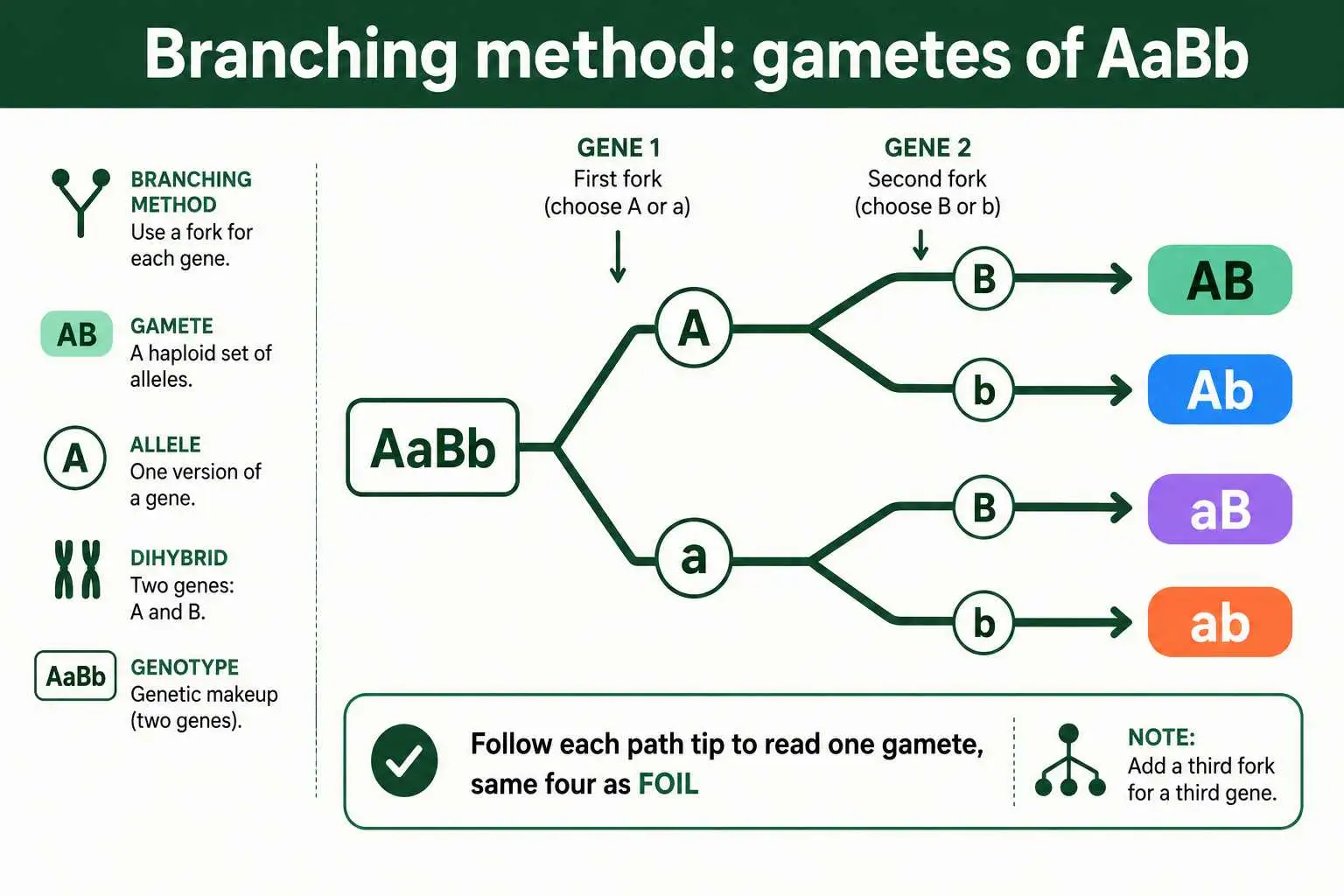
The branching method has a real advantage for three or more genes, where FOIL becomes awkward. For a trihybrid like AaBbCc, you simply add a third fork at the end of each path, splitting once more for the C and c alleles. The tree then has eight tips, matching the eight gametes the 2ⁿ rule predicts. Whichever method you prefer, the result is identical, because both are just systematic ways of taking one allele from each gene in every combination. Choose the one that feels clearer to you and use it consistently, since the goal is accuracy, not a particular technique. As BioNinja notes, the key habits are pairing alleles from different genes and including only the genuinely different gamete combinations.
Why Getting Gametes Right Matters So Much
Finding the correct gametes is not just one step among many; it is the foundation that determines whether the entire cross succeeds. Every other part of a Punnett square depends on starting with the right gametes, so an error here guarantees a wrong answer no matter how carefully you do everything else.
The reason is structural. The gametes go on the axes of the Punnett square, and every box is formed by combining one gamete from the top with one from the side. If a gamete is wrong, every box built from it is wrong, and the final genotype and phenotype ratios will be off. This is why so many dihybrid crosses fail at the very first stage, before the grid is even drawn. A student who produces only two gametes for AaBb instead of four will build a 2x2 grid instead of a 4x4 and never reach the correct 9:3:3:1 ratio.
Getting gametes right also unlocks the faster methods that avoid grids entirely. Once you can find gametes and know the 2ⁿ rule, you understand why the forked-line and probability methods work, since both rely on treating each gene's gametes independently. The gamete skill is therefore the gateway to all of genetics problem-solving, from simple squares to multi-gene probability calculations. You can confirm your gametes for any genotype with a calculator that generates them automatically, so you can check your own work as you learn.
Practice Genotypes to Try Yourself
The fastest way to make gamete-finding automatic is to work through a range of genotypes and check each against the 2ⁿ rule. Try these yourself before reading the answers, covering your eyes if you need to, since active practice beats passive reading.
Start with these single and double-gene genotypes. For Bb, expect 2 gametes: B and b. For BbCc, expect 4 gametes: BC, Bc, bC, and bc. For BBCc, only the second gene is heterozygous, so expect 2 gametes: BC and Bc. For bbcc, fully homozygous, expect just 1 gamete: bc. Notice how the homozygous genes quietly fix their allele in place while the heterozygous ones create the variety. Always count the heterozygous genes first to predict the number, then list the combinations to match it.
Now stretch to three genes. For AaBbCc, expect 8 gametes, all combinations from ABC down to abc. For AaBBCc, only two genes are heterozygous, so expect 4 gametes: ABC, AbC, aBC, and abC, with the BB gene fixing a B throughout. For AABbcc, just one gene is heterozygous, giving 2 gametes: ABc and Abc. If your listed count ever fails to match 2ⁿ, you have either missed a combination or wrongly treated a homozygous gene as heterozygous. Working a handful of these every few days quickly builds the fluency that makes dihybrid and trihybrid crosses straightforward.
Frequently Asked Questions
How many gametes does AaBb produce?
AaBb produces four different gametes: AB, Ab, aB, and ab. Both genes are heterozygous, so by the 2ⁿ rule with n equal to 2, there are 2² which is 4 gamete types, found using the FOIL method.
How do you find gametes using the FOIL method?
For a two-gene genotype like AaBb, FOIL combines First (AB), Outside (Ab), Inside (aB), and Last (ab). This generates all four combinations of one allele from each gene. Always pair alleles from different genes and write the capital first.
Why does AaBB only make two gametes?
Because only one gene is heterozygous. The Aa gene offers two alleles, but the BB gene contributes a B to every gamete, so the only combinations are AB and aB. The 2ⁿ rule gives 2¹ equals 2, since n counts only heterozygous genes.
How do you count the number of gametes from a genotype?
Count the number of heterozygous genes, call it n, then calculate 2 to the power of n. Homozygous genes do not add variety, so they are not counted. For example, AaBbCc has three heterozygous genes, giving 2³ which is 8 gametes.
Get the Gametes, Win the Cross
Finding gametes comes down to one rule and one formula. The rule is that each gamete carries one allele from every gene, found by separating the alleles and listing all combinations, which the FOIL method does cleanly for two genes. The formula is 2ⁿ, where n is the number of heterozygous genes, telling you how many gametes to expect and catching errors before they spread. Homozygous genes never add variety, a detail that explains why AaBB makes two gametes while AaBb makes four.
Once your gametes are correct, the rest of any cross follows, because the gametes are what every box in the square is built from. Practise finding gametes for a range of genotypes until it is automatic, checking your count against the 2ⁿ rule each time. You can verify the gametes for any genotype with the Punnett Square Calculator, which is a quick way to confirm your method. For another clear walkthrough of the FOIL approach to dihybrid gametes, this explainer from Nagwa is a useful companion read.