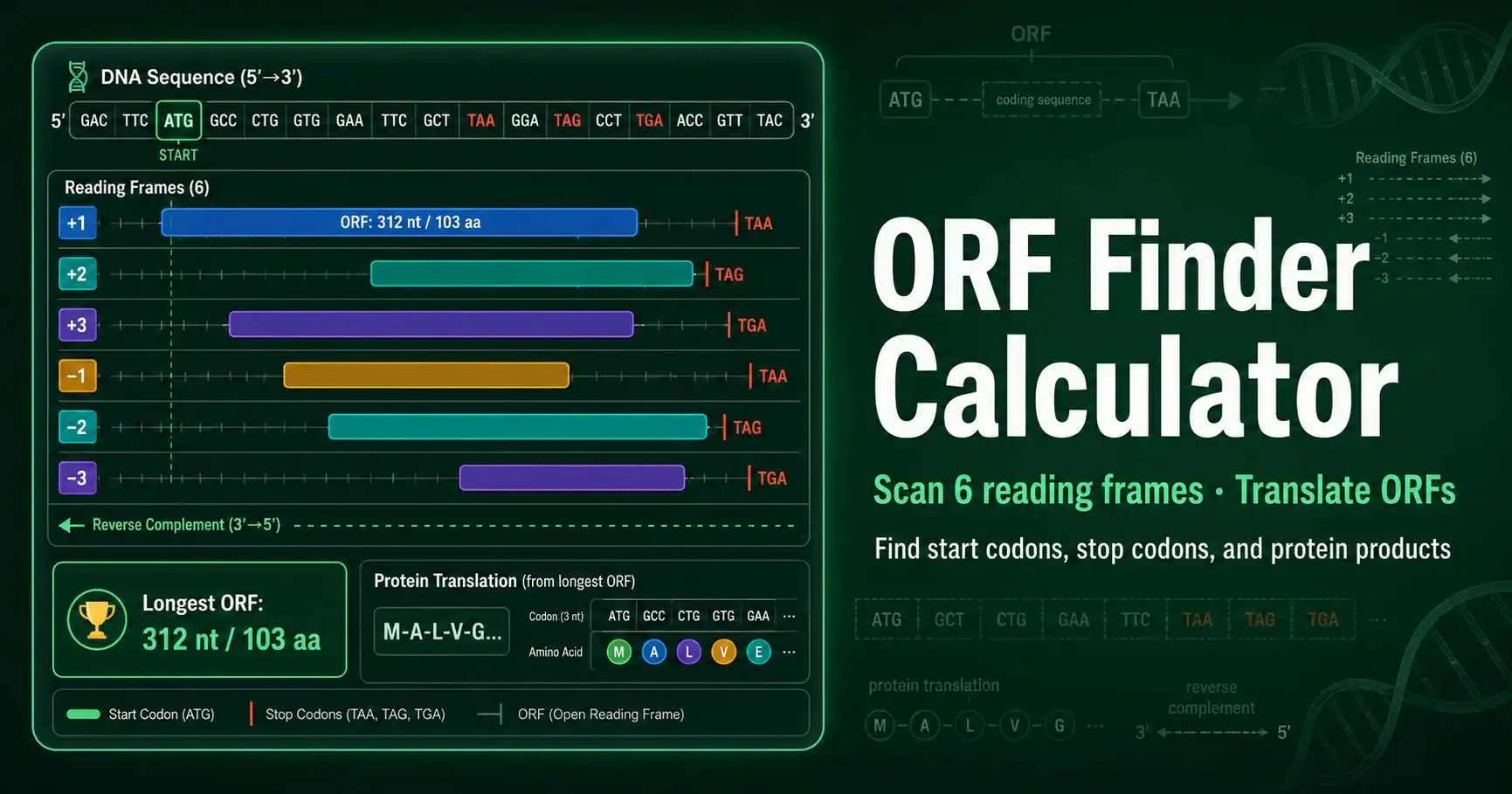
The sequence input accepts FASTA text, copied plasmid sequence, or a plain DNA fragment. It strips headers, spaces, numbers, and punctuation so the scan uses only A, C, G, and T. The live length and GC cards help you spot incomplete pastes or unusually GC-rich inserts before you interpret ORFs.
The reading-frame selector controls strand logic. Use all six frames when you do not know the coding orientation. Use forward or reverse-only scanning after primer design, Sanger sequencing, or cloning maps identify direction.
The start-codon rule changes biological sensitivity. ATG-only mode matches most introductory genetics problems. Alternative-start mode includes GTG, TTG, and CTG, which can matter in bacterial annotation and synthetic biology screening.
The ORF map gives quick visual feedback. Long coloured bars indicate candidate coding regions, while red tick marks show stop codons. The result table then provides exact frame, coordinate, length, start codon, stop codon, GC percentage, and protein preview.