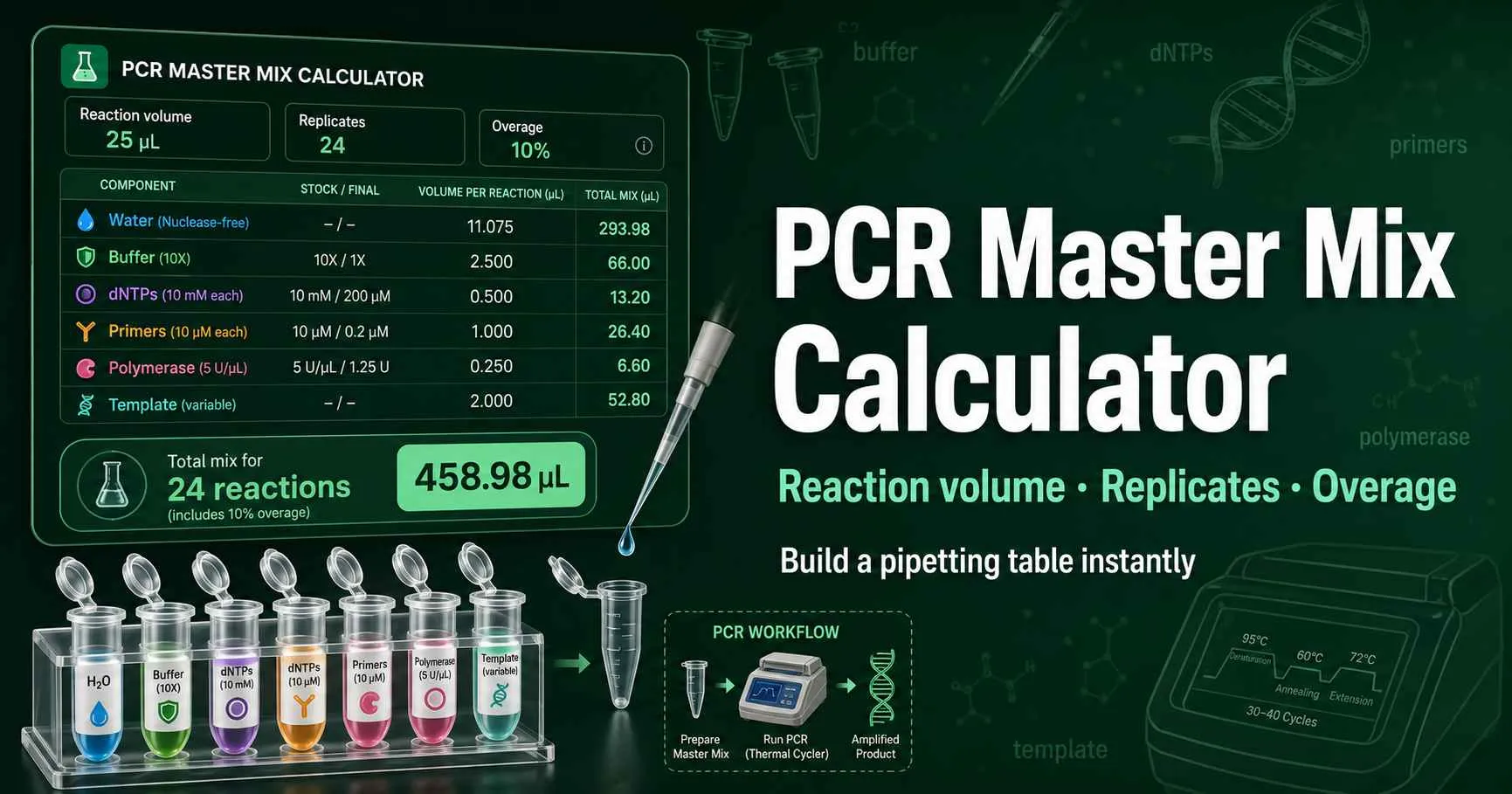
PCR Master Mix Calculator for 2× Mix and Custom Reagents

Calculate PCR master mix volumes before you start pipetting. Enter reaction volume, reaction count, overage, primers, template DNA, and reagent stocks. The calculator returns a per-reaction recipe and a total master-mix table with water, buffer, MgCl₂, dNTPs, polymerase, and additives where needed.

PCR Master Mix Calculator with Basic and Advanced modes

Start with a common 2× commercial mix, or switch to a custom Taq setup. Results update live as you change reaction volume, reaction count, overage, or reagent concentrations.

PCR master mix setup mode

Use Basic mode for a commercial 2× mix. Use Advanced mode when you prepare buffer, MgCl₂, dNTPs, primers, polymerase, and optional additives separately.

PCR master mix tube illustrationPCR master mix

Reaction count and final volume

Enter the final tube volume, number of reactions, and overage for pipetting loss. The calculator multiplies each reagent by reactions × overage.

2× PCR mix inputs

Set the reagent volumes or stock concentrations. Results update live and flag volumes that may be hard to pipette.

A 2× master mix usually contributes half of a 25 µL reaction, so it uses 12.5 µL per tube.

PCR master mix recipe is ready

Prepare 316.8 µL pooled master mix for 12 reactions with 10% overage.

Aliquot

24.0 µL

Water/rxn

10.5 µL

Multiplier

×13.20

Mode

PCR reagent table

Use this table to pipette one reaction or prepare the full master mix batch.

2× PCR master mix

Supplies polymerase, buffer, Mg²⁺, and dNTPs when using a commercial master mix.

Per reaction12.5 µL
Total165.0 µL

Forward primer

Defines the 5′ boundary of the amplicon.

Per reaction0.50 µL
Total6.60 µL

Reverse primer

Defines the 3′ boundary of the amplicon on the opposite strand.

Per reaction0.50 µL
Total6.60 µL

Template DNA

Add separately when samples differ between tubes.

Per reaction1.00 µL
Total13.2 µL

Nuclease-free water

Brings each reaction to the final reaction volume.

Per reaction10.5 µL
Total138.6 µL
Check passed: The reaction has a positive water volume, so the setup fits inside the selected tube volume.
PCR master mix calculator diagram showing tubes, primers, polymerase, dNTPs, MgCl2, water, and total reagent volumes
Figure 1. PCR master mix setup combines DNA polymerase, deoxynucleotide triphosphates, MgCl₂, buffer, forward primer, reverse primer, template DNA, and nuclease-free water. The image should show how each reagent contributes to amplification of a defined DNA amplicon.

PCR master mix calculation: what the tool answers

A PCR master mix calculation answers one practical question: how much of each reagent should you pipette? The calculator converts a single PCR recipe into a complete setup for multiple tubes, strip wells, or plate wells. It also adds extra volume, so the last reaction still receives the correct aliquot.

Basic mode fits commercial 2× master mixes. These products usually contain DNA polymerase, dNTPs, MgCl₂, and reaction buffer, so you add primers, template DNA, and water. Sigma-Aldrich describes PCR master mixes as ready-to-use solutions that simplify routine PCR and high-throughput setup. See PCR master mix background.

Advanced mode fits custom PCR recipes. You enter stock and final concentrations for 10× buffer, MgCl₂, dNTP mix, primers, and DNA polymerase. Thermo Fisher notes that PCR performance depends on reagent components such as primers, dNTPs, Mg²⁺, buffer, polymerase, and template quality. Review PCR component considerations.

PCR Master Mix Calculator components and their purpose

Each section of the tool solves a specific lab setup problem. Use this table when you want to know which input controls which part of the PCR recipe.

Tool componentWhat it controlsWhy users need it
Basic 2× mix modeUse it when your reagent already contains DNA polymerase, buffer, MgCl₂, and dNTPs.Fast setup for routine PCR, colony PCR, and genotyping screens.
Advanced custom mix modeUse it when you prepare each PCR reagent from individual stocks.Controls final MgCl₂, dNTP, primer, enzyme, and additive levels.
Reaction count and overageMultiplies per-reaction volumes by reactions × overage.Prevents the final tube from running dry after pipetting loss.
Template toggleControls whether template DNA enters the pooled master mix.Protects sample identity when each tube uses a different DNA sample.
Warning cardsFlag negative water, tiny reagent volumes, or unusual concentration ranges.Helps users catch setup mistakes before they waste reagents.
CSV downloadExports the reagent table as a spreadsheet-ready file.Makes the setup easier to print, save, or paste into a lab notebook.

Basic 2× mix mode

Use it when your reagent already contains DNA polymerase, buffer, MgCl₂, and dNTPs.

Fast setup for routine PCR, colony PCR, and genotyping screens.

Advanced custom mix mode

Use it when you prepare each PCR reagent from individual stocks.

Controls final MgCl₂, dNTP, primer, enzyme, and additive levels.

Reaction count and overage

Multiplies per-reaction volumes by reactions × overage.

Prevents the final tube from running dry after pipetting loss.

Template toggle

Controls whether template DNA enters the pooled master mix.

Protects sample identity when each tube uses a different DNA sample.

Warning cards

Flag negative water, tiny reagent volumes, or unusual concentration ranges.

Helps users catch setup mistakes before they waste reagents.

CSV download

Exports the reagent table as a spreadsheet-ready file.

Makes the setup easier to print, save, or paste into a lab notebook.

PCR master mix formulas used by the calculator

The calculator uses standard dilution arithmetic. It treats every reagent as a volume that must fit inside the final reaction volume.

2× mix volume

reaction volume ÷ 2

A 25 µL reaction uses 12.5 µL of 2× PCR master mix.

Custom reagent volume

V₁ = C₂V₂ ÷ C₁

A 10 µM primer stock at 0.4 µM final in 25 µL needs 1.0 µL.

Polymerase volume

units per reaction ÷ stock U/µL

0.625 U from a 5 U/µL stock needs 0.125 µL.

Total master mix

per-reaction volume × reactions × (1 + overage/100)

12 reactions with 10% overage use a multiplier of 13.2.

Water volume

final volume − all reagent volumes

Water fills the remaining reaction volume after every reagent enters the tube.

How to use PCR Master Mix Calculator correctly

  1. 1. Choose 2× mix or custom PCR setup

    Pick Basic mode when your master mix already contains polymerase, dNTPs, MgCl₂, and buffer. Pick Advanced mode when you control those reagents individually.

  2. 2. Enter reaction volume, reaction count, and overage

    Use the final tube volume, not just the reagent volume. Set overage between 5% and 15% for most bench setups.

  3. 3. Add primers, template DNA, and custom stocks

    Set primer volumes in Basic mode. In Advanced mode, enter stock concentrations and desired final concentrations for each reagent.

  4. 4. Use the total-with-overage column for the pooled tube

    Pipette the total values into one master-mix tube. Dispense the aliquot volume into each PCR tube, then add template separately if samples differ.

PCR master mix examples for real lab setups

PCR master mix example: 12 reactions with a 2× mix

A student prepares 12 reactions, each at 25 µL. The recipe uses 12.5 µL of 2× master mix, 0.5 µL forward primer, 0.5 µL reverse primer, 1 µL template DNA, and 10.5 µL water per reaction.

With 10% overage, the multiplier equals 13.2. The pooled tube needs 165.0 µL of 2× master mix, 6.6 µL forward primer, 6.6 µL reverse primer, and 138.6 µL water if template stays separate. Each tube then receives 24 µL master mix plus 1 µL template DNA.

Custom PCR example: primer and MgCl₂ calculation

A 25 µL Taq PCR uses 10× buffer at 1×, 25 mM MgCl₂ at 1.5 mM, 10 mM dNTPs at 0.2 mM each, and 10 µM primers at 0.4 µM each. The calculator returns 2.5 µL buffer, 1.5 µL MgCl₂, 0.5 µL dNTP mix, and 1.0 µL of each primer.

A 5 U/µL polymerase stock needs 0.125 µL to add 0.625 U. That volume is too small for reliable pipetting, so the warning card suggests a working dilution. This protects the reaction from enzyme variation between tubes.

PCR setup workflow after the master mix calculation

Check primer quality before you scale a reaction. Use the Primer Dimer Calculator to screen 3′ complementarity and the PCR Product Size Calculator to verify primer binding sites and amplicon length.

Normalize DNA template before a large run. If your samples differ in concentration, use the DNA Dilution Calculator to bring them to the same ng/µL or copy-number target. Equal input helps you compare band intensity or downstream Ct values more fairly.

Add reagents in a consistent order. Many labs add water first, then buffer or master mix, then primers, then polymerase, and finally template DNA in a clean area. Keep polymerase cold and avoid repeated freeze-thaw cycles when possible.

PCR master mix result interpretation table

Result messageWhat it meansWhat to do next
Water is positiveAll reagents fit inside the selected reaction volume.Use the table and prepare the master mix.
Water is below 1 µLThe setup leaves little room for volume correction.Increase reaction volume or use more concentrated stocks.
Water is negativeThe reagent volumes exceed the final reaction volume.Reduce reagent volumes or select a larger final volume.
Tiny reagent volumeThe calculated volume may be below reliable pipetting range.Prepare a working dilution and recalculate.

PCR Master Mix Calculator FAQs

What does a PCR Master Mix Calculator do?

A PCR Master Mix Calculator converts one reaction recipe into a complete pipetting table. It calculates water, primers, template DNA, 2× master mix, or custom reagent volumes for the selected number of reactions. It also adds overage so the final tube still contains enough liquid after pipetting loss. This saves time when you prepare many PCR tubes or plate wells.

Should template DNA go into the PCR master mix?

Add template DNA separately when each reaction uses a different sample, negative control, or positive control. Include template in the pooled mix only when every tube receives the same template. Most diagnostic, genotyping, and screening PCR setups keep template separate to reduce cross-contamination and preserve sample identity. The calculator lets you switch this choice on or off.

How much 2× PCR master mix do I use in a 25 µL reaction?

Use 12.5 µL of a 2× PCR master mix in a 25 µL reaction. A 2× reagent reaches 1× final concentration when it contributes half of the final reaction volume. The remaining 12.5 µL contains primers, template DNA, and nuclease-free water. The calculator applies the same rule to 10 µL, 20 µL, 50 µL, and custom reaction volumes.

What overage should I use for PCR master mix?

Use 5% to 10% overage for a small PCR setup and 10% to 15% for a larger plate setup. Overage compensates for liquid left in tips, tube walls, and reservoirs. For 24 reactions with 10% overage, the calculator prepares enough mix for 26.4 reaction equivalents. That extra volume prevents the final tube from running short.

What primer concentration should I use for PCR?

Many routine PCR reactions start with each primer near 0.2 to 0.5 µM final concentration. Difficult targets may need optimization, especially when primer dimers or non-specific bands appear. The advanced mode calculates primer volume from stock concentration and target final concentration. Pair this setup with the primer design checks in your PCR workflow.

Why does the calculator warn about tiny volumes?

Very small volumes create pipetting error. A 0.08 µL enzyme or primer volume may calculate correctly, but most standard micropipettes cannot transfer it accurately. Dilute the stock reagent and pipette a larger volume when the warning appears. This improves reproducibility across tubes and plate wells.

Can this calculator make a custom PCR master mix without a commercial 2× mix?

Yes. Advanced mode calculates 10× buffer, MgCl₂, dNTP mix, forward primer, reverse primer, polymerase, optional additive, template DNA, and water. It uses C₁V₁ = C₂V₂ for buffer, MgCl₂, dNTPs, and primers. It calculates polymerase volume from units per reaction and enzyme stock concentration.