Punnett Square Practice Problems With Answers
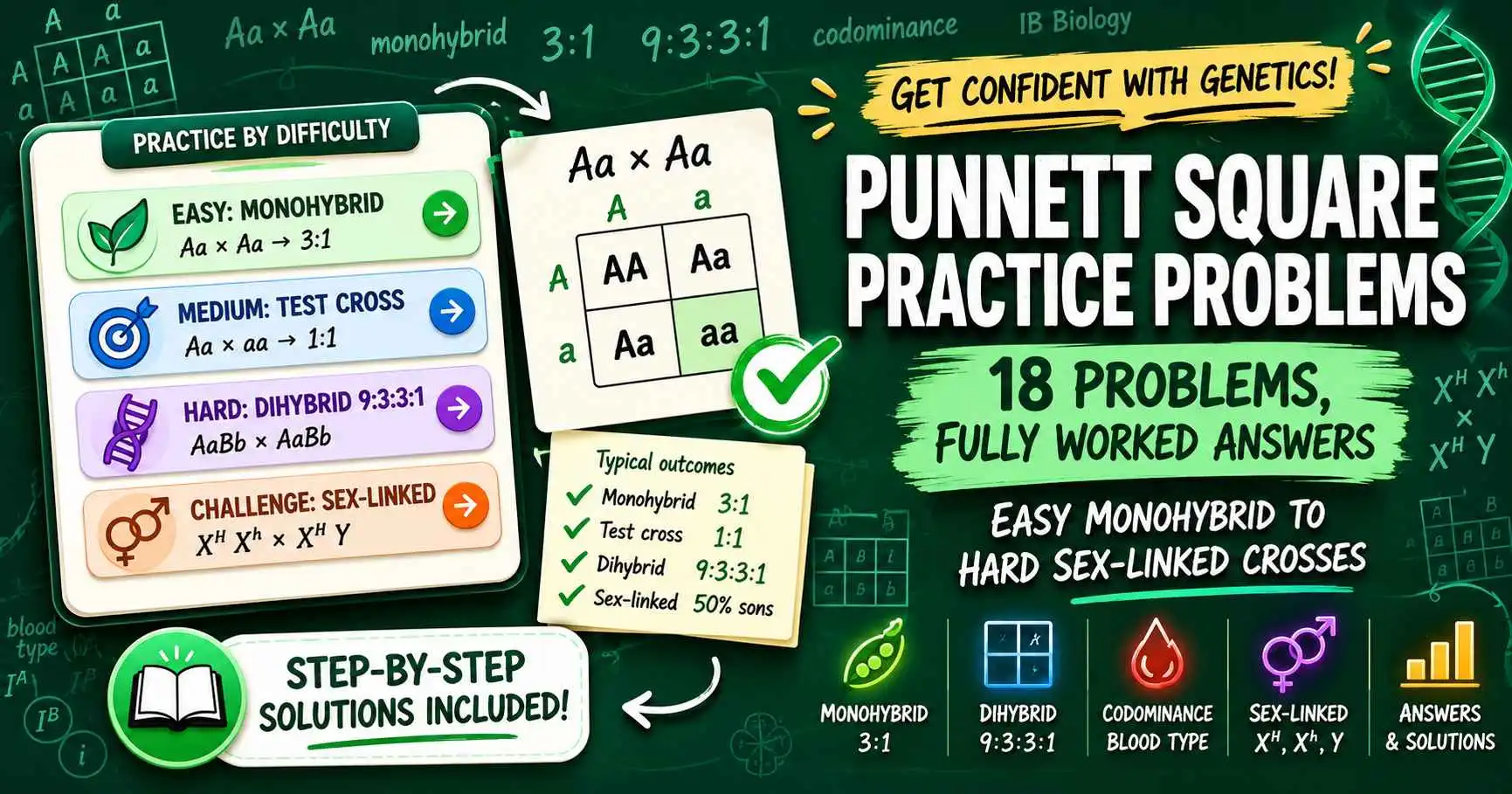
This is a complete set of Punnett square practice problems with fully worked answers, arranged from easy to hard. Each problem includes the question, the step-by-step solution, and the final genotype or phenotype ratio, so you can check your method as well as your answer. The set moves through monohybrid crosses, working backwards, test crosses, dihybrid crosses, codominance and incomplete dominance, multiple alleles, and sex linkage, covering everything a genetics course is likely to ask.
Work each problem yourself first, then read the solution to confirm your reasoning. The goal is not just the right answer but the right method, since exams reward clear working. If you need to review how to build a cross before you start, our guide on how a Punnett square works covers the fundamentals.
How to Use This Practice Set
These problems build in difficulty, so working through them in order is the most effective approach. The early problems reinforce the basic monohybrid method, the middle problems add new patterns one at a time, and the later problems combine several ideas at once. By the end, you will have practised every common cross type. The early problems reinforce the basic monohybrid method, the middle problems add new patterns one at a time, and the later problems combine several ideas at once. By the end, you will have practised every common cross type.
For each problem, follow the same disciplined method: define your allele key, write the parents' genotypes, work out the gametes, fill the Punnett square, then read the genotype and phenotype ratios. Resist the urge to jump straight to the answer, because the marks in any genetics exam come from showing this working. The worked solutions below model exactly this layout, so you can compare your approach step by step.
A quick note on reading ratios. Every problem asks for either a genotype ratio, a phenotype ratio, or a probability, and these are different. The genotype ratio counts allele combinations, the phenotype ratio counts visible traits, and a probability expresses one outcome as a fraction or percentage. Always check which the question wants before writing your final answer, since giving the wrong one is the most common avoidable mistake.
Easy Problems: Monohybrid Crosses
These first problems use a single gene with simple dominance. They are the foundation for everything else, so make sure you are fully confident with them before moving on.
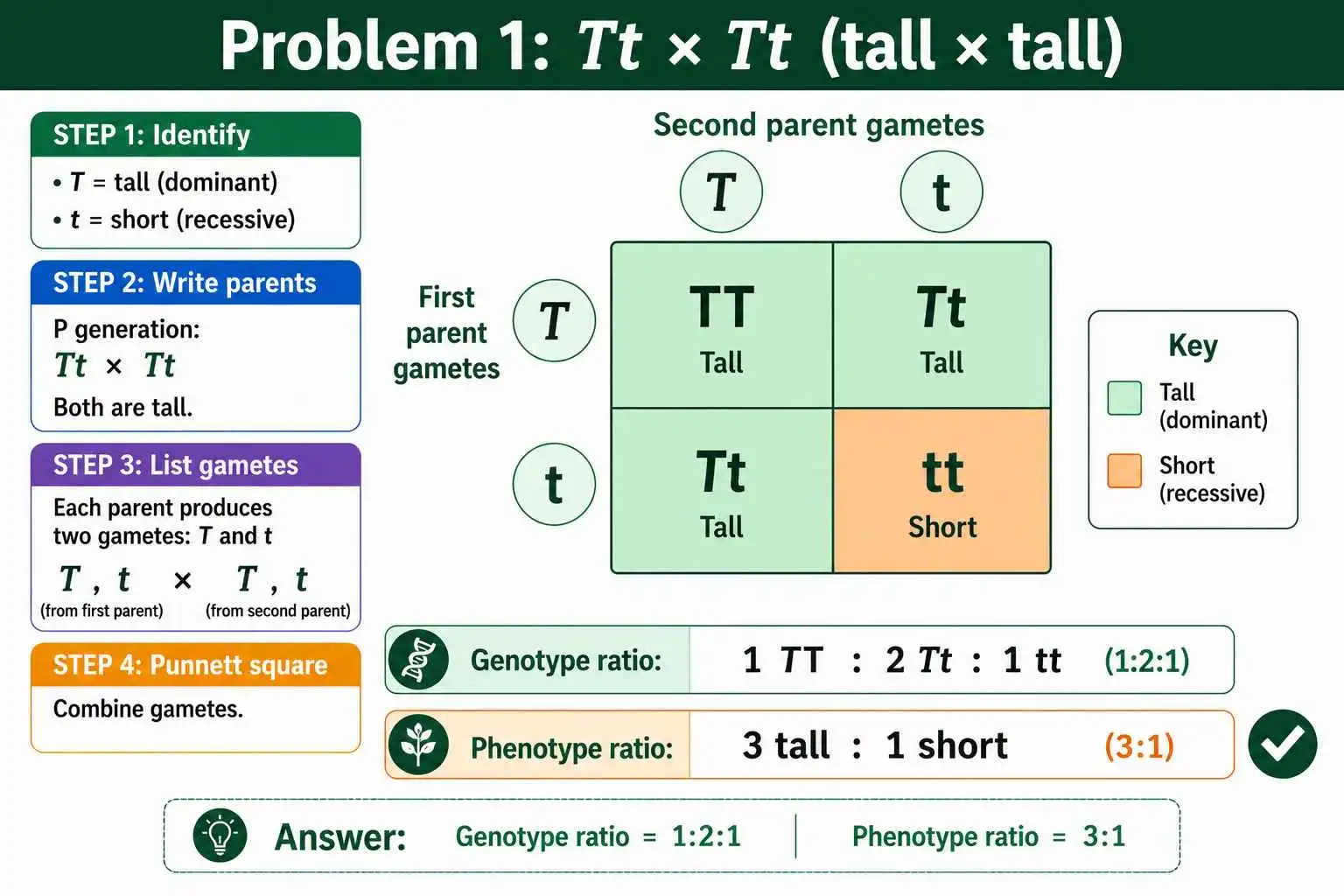
Problem 1. In pea plants, tall (T) is dominant to short (t). Cross two heterozygous tall plants (Tt × Tt). What are the genotype and phenotype ratios of the offspring?
Solution. Each Tt parent produces T and t gametes. Filling the 2x2 grid gives TT, Tt, Tt, and tt. The genotype ratio is 1 TT : 2 Tt : 1 tt, or 1:2:1. For phenotypes, the three plants with at least one T are tall and the tt plant is short, giving a phenotype ratio of 3 tall : 1 short, or 3:1.
Problem 2. In rabbits, black fur (B) is dominant to brown fur (b). A homozygous black rabbit (BB) is crossed with a brown rabbit (bb). What is the phenotype of the offspring?
Solution. The BB parent gives only B gametes, and the bb parent gives only b gametes. Every box in the grid is Bb. So all offspring are heterozygous black. The phenotype ratio is 100 percent black, with no brown offspring possible from this cross.
Problem 3. In pea plants, purple flowers (P) are dominant to white (p). A heterozygous purple plant is crossed with a white plant (Pp × pp). What is the probability of a white-flowered offspring?
Solution. The Pp parent gives P and p gametes, and the pp parent gives only p. The grid produces Pp, pp, Pp, pp. Two of the four boxes are pp, so the probability of a white offspring is 2 out of 4, which is 1/2, or 50 percent. The phenotype ratio is 1 purple : 1 white.
Medium Problems: Working Backwards and Test Crosses
These problems ask you to reason from offspring back to parents, or to use a test cross to reveal a hidden genotype. They test deeper understanding than a straight cross.
Problem 4. In guinea pigs, short hair (S) is dominant to long hair (s). Two short-haired guinea pigs are crossed and produce some long-haired offspring. What must the parents' genotypes be?
Solution. A long-haired offspring is ss, meaning it received an s allele from each parent. Since both parents are short-haired but each passed an s allele, both parents must be heterozygous, Ss. The cross is Ss × Ss, which produces the 3:1 ratio that explains the long-haired offspring appearing.
Problem 5. A black guinea pig of unknown genotype is crossed with a brown guinea pig (bb). Half the offspring are black and half are brown. What is the unknown parent's genotype?
Solution. This is a test cross. The brown parent is bb and gives only b gametes. Because half the offspring are brown (bb), the unknown black parent must have supplied a b allele to half the offspring, so it carries one b. Combined with the B that makes it black, its genotype is Bb, heterozygous. Had the unknown parent been BB, all offspring would have been black.
Problem 6. In tomatoes, red fruit (R) is dominant to yellow (r). A red tomato plant is crossed with a yellow plant (rr), and all offspring are red. What is the most likely genotype of the red parent?
Solution. The yellow parent is rr and gives only r gametes. Since every offspring is red, the red parent must have contributed an R allele to all of them, with no r showing up. This means the red parent is most likely homozygous, RR. If it had been Rr, you would expect about half the offspring to be yellow.
Harder Problems: Dihybrid Crosses
Dihybrid problems track two genes at once, producing a 4x4 grid and the 9:3:3:1 ratio. They are a step up in complexity, so take care with the gametes. Our guide to the dihybrid cross and 9:3:3:1 ratio explains the full method.
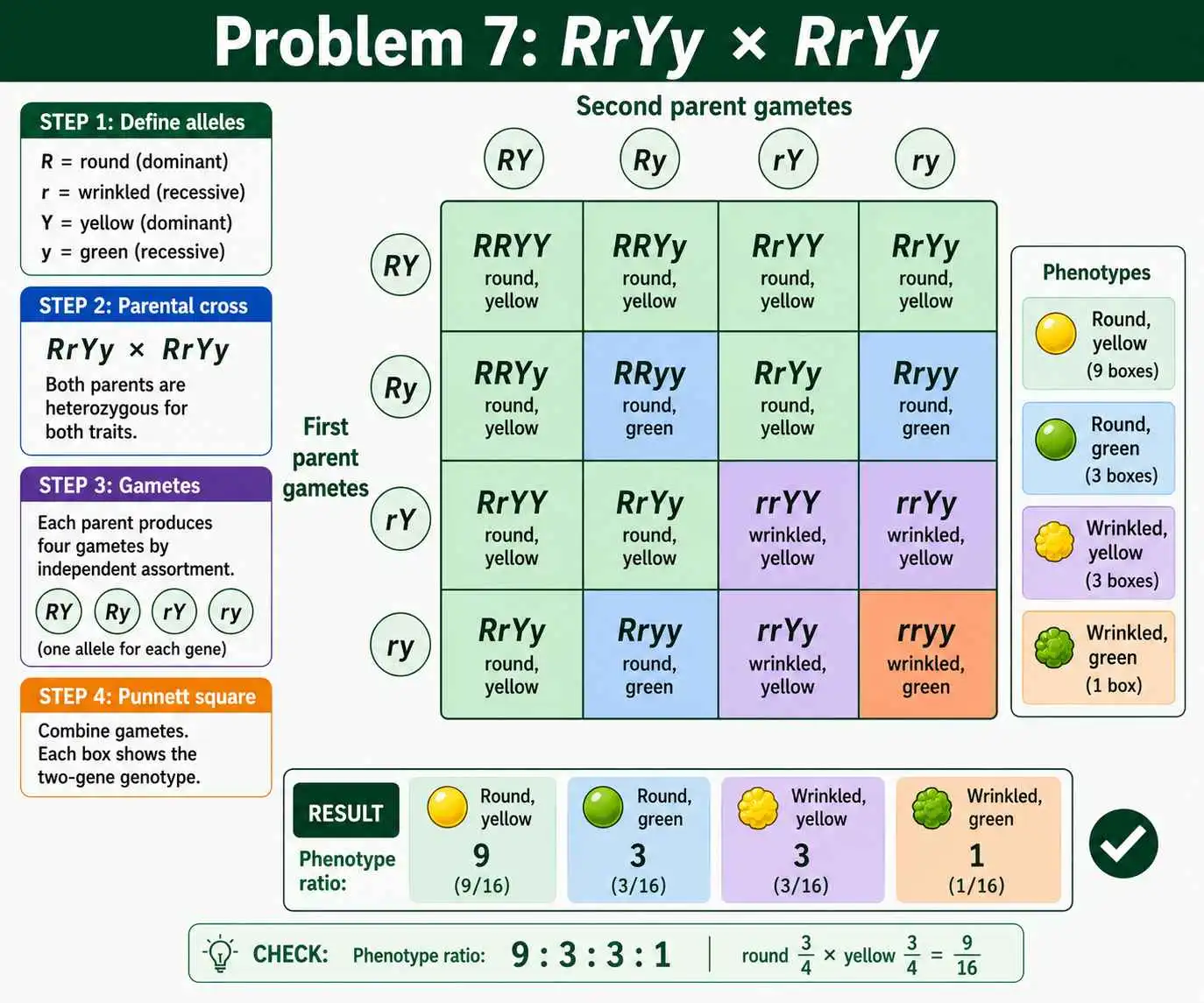
Problem 7. In pea plants, round seeds (R) are dominant to wrinkled (r), and yellow seeds (Y) are dominant to green (y). Cross two plants heterozygous for both traits (RrYy × RrYy). What is the phenotype ratio of the offspring?
Solution. Each RrYy parent produces four gametes: RY, Ry, rY, and ry. Filling the 16-box grid and sorting by phenotype gives nine round yellow, three round green, three wrinkled yellow, and one wrinkled green. The phenotype ratio is 9:3:3:1. You can reach this faster with probability: round is 3/4 and yellow is 3/4, so round yellow is 3/4 × 3/4 = 9/16.
Problem 8. Using the same traits, what is the probability that an offspring of an RrYy × RrYy cross is wrinkled and green?
Solution. Wrinkled is the recessive seed shape, with a probability of 1/4, and green is the recessive seed color, also 1/4. Multiplying the independent probabilities gives 1/4 × 1/4 = 1/16. So one in sixteen offspring is expected to be wrinkled and green, which matches the single rryy box in the grid.
Problem 9. In a dihybrid test cross, RrYy is crossed with rryy. What is the phenotype ratio of the offspring?
Solution. The RrYy parent produces four gametes, RY, Ry, rY, and ry, while the rryy parent produces only ry. Each offspring therefore directly shows one of the four gamete types from the heterozygous parent. The result is one round yellow, one round green, one wrinkled yellow, and one wrinkled green, a 1:1:1:1 ratio. This is the classic test cross result for two traits.
Non-Mendelian Problems: Codominance and Incomplete Dominance
These problems break the simple dominance rule, so the heterozygote looks different from both homozygotes. Watch the notation carefully.
Problem 10. In snapdragons, red (R) and white (W) show incomplete dominance, so heterozygotes are pink. Cross two pink snapdragons (RW × RW). What are the phenotype ratios?
Solution. Each RW parent gives R and W gametes. The grid produces RR, RW, RW, and WW. Because each genotype shows a distinct color, the phenotype ratio matches the genotype ratio: 1 red : 2 pink : 1 white, or 1:2:1. Notice this differs from the 3:1 of simple dominance, because the pink heterozygote is visible.
Problem 11. In cattle, coat color shows codominance: red and white alleles together produce roan. Cross a roan bull with a roan cow. What phenotype ratio results?
Solution. Both parents are heterozygous, each carrying one red and one white allele, and each produces both gamete types. The grid gives one homozygous red, two roan, and one homozygous white. The phenotype ratio is 1 red : 2 roan : 1 white, again 1:2:1, with the roan offspring showing both colors at once rather than a blend.
Problem 12. A pink snapdragon is crossed with a red one (RW × RR). What is the probability of a white offspring?
Solution. The RW parent gives R and W gametes, and the RR parent gives only R. The grid produces RR, RW, RR, RW. The genotypes are half RR (red) and half RW (pink). There are no WW boxes, so the probability of a white offspring is zero. White is impossible here because the red parent cannot contribute a W allele.
Advanced Problems: Multiple Alleles and Blood Type
Blood type problems use three alleles, with IA and IB codominant and i recessive. They reward careful tracking of which genotypes hide a recessive i. Our guide to multiple alleles explains the system.
Problem 13. A type A parent (IA i) has children with a type B parent (IB i). What blood types are possible in their children, and in what ratio?
Solution. The type A parent gives IA and i gametes, and the type B parent gives IB and i gametes. The grid produces IA IB, IA i, IB i, and ii. Reading these as blood types gives one AB, one A, one B, and one O, a 1:1:1:1 ratio. This couple can have a child of any blood type, because both carry a hidden i allele.
Problem 14. Can a type O child result from a type A parent and a type AB parent?
Solution. A type AB parent has the genotype IA IB and can only pass IA or IB, never i. A type O child requires the genotype ii, with two recessive alleles. Since the AB parent cannot contribute an i allele, a type O child is impossible from this pairing, regardless of the type A parent's genotype.
Problem 15. Two parents both have type AB blood. What are the possible blood types of their children, and in what ratio?
Solution. Each IA IB parent gives IA and IB gametes. The grid produces IA IA, IA IB, IA IB, and IB IB. These are type A, type AB, type AB, and type B. So the phenotype ratio is 1 A : 2 AB : 1 B. No type O child is possible, since neither parent carries an i allele to pass on.
Challenge Problems: Sex Linkage
These final problems involve genes on the X chromosome, so you must write alleles on the sex chromosomes and read sons and daughters separately. Our guide to sex-linked Punnett squares covers the method in full.
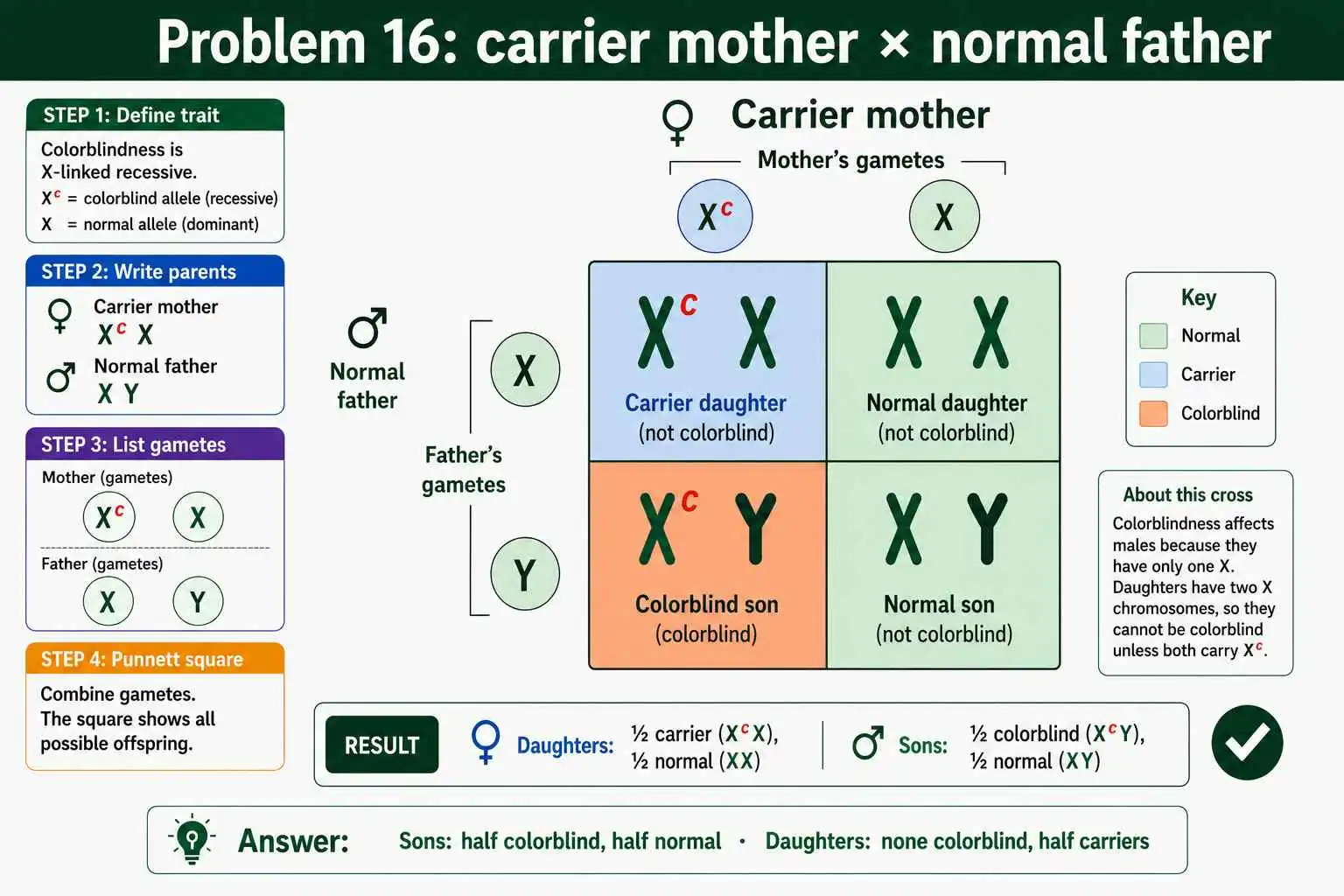
Problem 16. Colorblindness is X-linked recessive. A carrier mother (Xc X) has children with a normal father (XY). What proportion of the sons will be colorblind?
Solution. The carrier mother gives Xc and X gametes, and the father gives X and Y. Sons receive the father's Y plus one of the mother's X chromosomes. Half the sons receive the Xc and are colorblind, and half receive the X and have normal vision. So half of the sons are expected to be colorblind. None of the daughters are colorblind, though half are carriers.
Problem 17. A colorblind father (Xc Y) has children with a mother who is not a carrier (XX). What is the chance their daughters are colorblind?
Solution. The father gives Xc and Y gametes, and the mother gives only X. Daughters receive the father's Xc plus the mother's X, making every daughter Xc X, a carrier with normal vision. None of the daughters are colorblind, because they all receive a normal X from their mother. All sons receive the father's Y and the mother's X, so they are XY and have normal vision too.
Problem 18. A carrier mother (Xc X) has children with a colorblind father (Xc Y). What proportion of all children are expected to be colorblind?
Solution. The mother gives Xc and X gametes, the father gives Xc and Y. The four outcomes are Xc Xc (colorblind daughter), Xc X (carrier daughter), Xc Y (colorblind son), and X Y (normal son). So two of the four children are colorblind, one daughter and one son, giving an overall probability of 1/2, or 50 percent. This cross shows that a daughter can be colorblind when the father is affected and the mother is a carrier.
Tips for Avoiding Common Errors
As you work through these problems, a few recurring mistakes are worth guarding against, because they account for most lost marks in genetics. Spotting them in your own work is the fastest way to improve your accuracy.
The first is writing a whole genotype as a gamete. A gamete carries only one allele per gene, so a Bb parent makes B and b gametes, never "Bb," and an RrYy parent makes RY, Ry, rY, and ry, never "RrYy." Whenever you list gametes, check that each one has exactly one allele for each gene. The second frequent error is confusing the genotype ratio with the phenotype ratio. A monohybrid cross of two heterozygotes gives a 1:2:1 genotype ratio but a 3:1 phenotype ratio, and these are different answers to different questions. Always reread what the problem asks for before writing your final ratio.
A third mistake appears in non-Mendelian problems, where students apply the 3:1 phenotype ratio out of habit. With codominance or incomplete dominance, the heterozygote is visible, so the phenotype ratio becomes 1:2:1, matching the genotypes. A fourth error is treating sex-linked crosses like ordinary ones and giving a single combined ratio, when the correct approach reads sons and daughters separately. Finally, in probability problems, remember that each offspring is an independent event, so a 1/4 chance applies to every child regardless of previous children. Watching for these five errors as you check each solution will sharpen your method more than simply doing more problems.
Matching Problems to Your Course Level
Different courses emphasise different problem types, so it helps to know which of these eighteen problems matter most for your level. Working the right subset first makes your practice more efficient.
If you are studying introductory or middle-school biology, focus on the easy monohybrid problems and the working-backwards questions, which build the core skill of reading a cross in both directions. For a high-school course such as GCSE or its equivalents, add the dihybrid crosses and the non-Mendelian problems on codominance and incomplete dominance, since these patterns appear frequently in exams. For advanced courses like AP or IB Biology, the full set is relevant, with particular attention to the dihybrid, multiple-allele, and sex-linkage problems, which are the ones most often extended into harder exam questions.
The blood type and sex-linkage problems deserve extra practice at every advanced level, because they combine several ideas at once and are common sources of errors. Once you can solve all eighteen confidently and explain your reasoning aloud, you have covered the range of single-gene and two-gene genetics that nearly any course will test. The skill transfers directly: a student who can work these problems can handle an unfamiliar cross by applying the same disciplined method, which is the real goal of practice.
Frequently Asked Questions
How do I check if my Punnett square answer is right?
Confirm that your gametes each carry one allele per gene, that the grid is the correct size, and that your ratio parts sum correctly (4 for a monohybrid cross, 16 for a dihybrid). Then state whether you were asked for a genotype ratio, phenotype ratio, or probability.
What is the difference between a genotype and phenotype ratio in these problems?
The genotype ratio counts allele combinations, like 1:2:1 for a monohybrid cross. The phenotype ratio counts visible traits, like 3:1 for the same cross under simple dominance. The two come from the same grid but group the boxes differently.
Why do codominance problems give a 1:2:1 phenotype ratio?
Because the heterozygote shows a distinct phenotype rather than matching the dominant homozygote. Each of the three genotypes looks different, so the phenotype ratio equals the genotype ratio of 1:2:1, instead of collapsing to 3:1.
How do I solve sex-linked problems?
Write the alleles on the X and Y chromosomes, work out the gametes, fill the grid, then read sons and daughters as separate groups. Their outcomes usually differ, so a single combined ratio is often the wrong answer.
Keep Practising
You now have eighteen worked Punnett square problems covering every common cross type, from simple monohybrid ratios through dihybrid crosses, non-Mendelian patterns, multiple alleles, and sex linkage. The key in every case is the same disciplined method: define the alleles, find the gametes, fill the grid, and read the correct ratio for what the question asks. Working backwards problems and test crosses train you to reason in both directions, which is exactly what harder exam questions demand.
Return to these problems until the method is automatic, then test yourself with new crosses. You can generate and check any cross you invent with the Punnett Square Calculator, which is a fast way to create extra practice and confirm your working. For more interactive practice with instant feedback, the Khan Academy genetics exercises are an excellent free resource to work alongside this set. For additional worked examples across every cross type, the Biology LibreTexts genetics collection provides detailed solutions you can study for extra depth.