Cat Coat Genetics: Predicting Calico & Tortie Colors
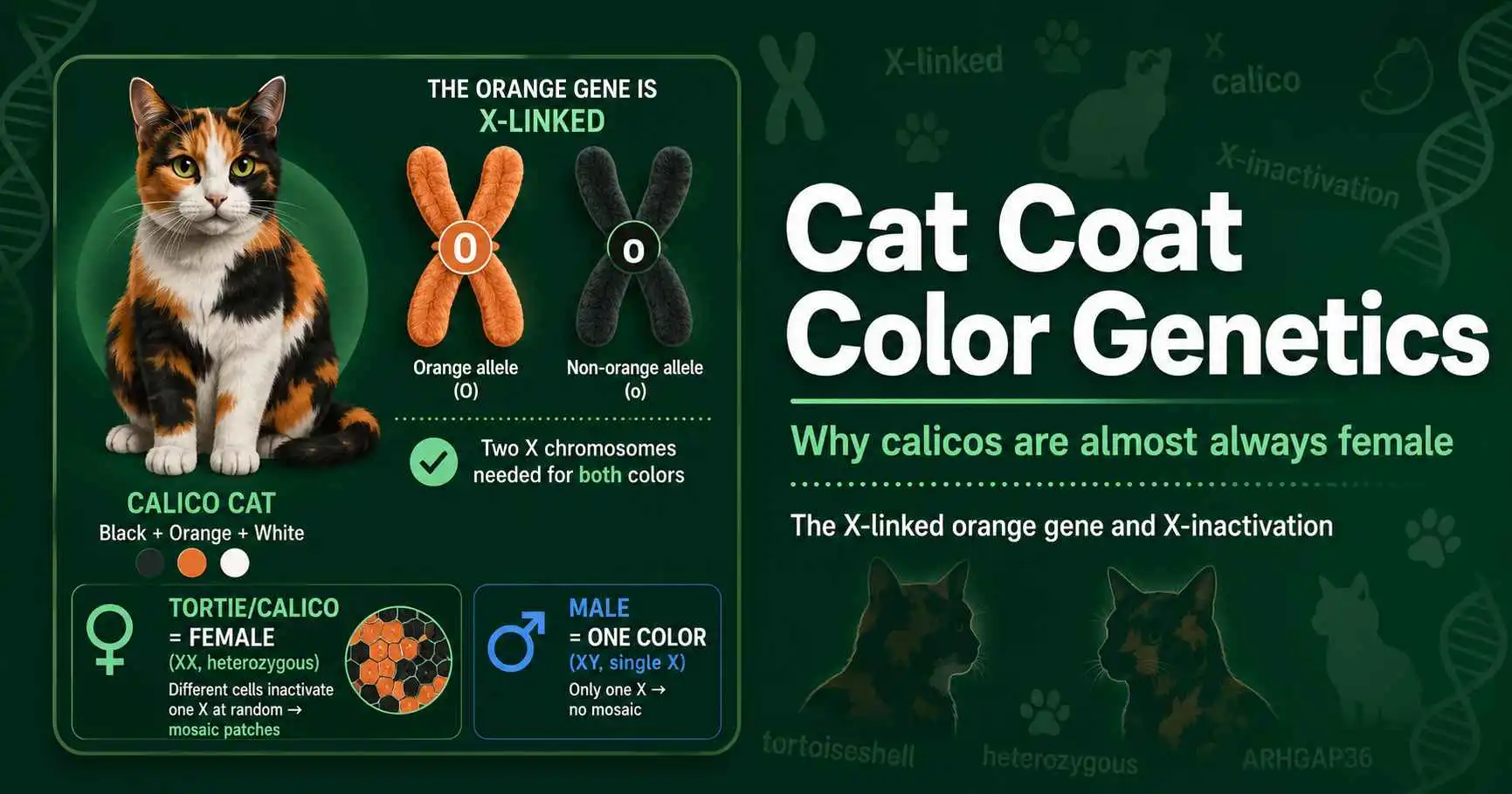
Cat coat color is shaped by several genes, but the one that makes feline genetics so fascinating sits on the X chromosome. This is the orange gene, which decides whether a cat produces orange or non-orange pigment. Because it is X-linked, it explains one of the most striking facts in all of pet genetics: calico and tortoiseshell cats are almost always female. A male cat, with his single X chromosome, can be orange or non-orange but rarely both at once.
That single, small piece of chromosome biology unlocks the whole puzzle of mottled, patchy cat coats. The orange gene combined with X-chromosome inactivation produces the random patchwork that defines calicos and torties, a pattern that has served as the textbook example of X-inactivation for over sixty years. This guide walks through the genes behind cat color, explains exactly why the calico pattern is female-limited, and shows how to predict kitten colors from a pair of parents. If you want to see the X-linked logic in full first, our guide to X-linked inheritance and sex-linked traits lays out the chromosome rules this article relies on.
The Orange Gene: Cat Color's Defining Feature
The orange gene is the heart of cat coat color genetics, and it behaves quite unlike the color genes in most other animals because it lives on the X chromosome. Its main job is to switch pigment production between two types: the orange or red pigment, and the dark black or brown pigment. The gene has two alleles, usually written O for orange and o for non-orange.
What makes the orange gene special is its location. Most coat color genes sit on the regular chromosomes, the autosomes, where males and females inherit them identically. The orange gene instead sits on the X chromosome, so its inheritance is tied to sex. A female cat has two X chromosomes and therefore two copies of the orange gene, while a male cat has one X and one Y, giving him only a single copy. This difference in copy number is the source of every interesting pattern that follows.
Recent science has even pinned down the molecular cause. In 2025, researchers identified that the orange coloration traces to a small deletion near a gene called ARHGAP36 on the cat X chromosome, which switches on orange pigment production in pigment cells. The finding solved a puzzle that had stood since the gene was first mapped, and it confirmed at the molecular level what breeders had observed for generations: orange in cats is inherited along the X chromosome, following the rules of sex linkage rather than ordinary autosomal inheritance.
What makes the discovery especially striking is that the cat orange gene has no clear counterpart in other mammals. Most coat color genes, like those for black, brown, and dilution, are shared across many species, which is why dogs, cats, and mice often follow similar color rules. The orange mutation, by contrast, appears unique to cats, arising from a change that switches on a gene in pigment cells where it is normally silent. This is part of why feline color genetics feels so distinctive: the single gene responsible for the most famous cat patterns is, in evolutionary terms, a one-off. It also explains why the gene resisted identification for so long, since researchers could not simply look to a known equivalent in another animal to find it.
Why Calico and Tortoiseshell Cats Are Almost Always Female
The reason calico and tortoiseshell cats are nearly always female comes down to needing two X chromosomes to show both orange and non-orange at the same time. A cat displays a tortie or calico coat only when it carries one orange allele and one non-orange allele, which requires two X chromosomes to hold both.
Consider the genotypes. A female cat has two X chromosomes, so she can be orange (carrying two orange alleles), non-orange (carrying two non-orange alleles), or heterozygous (carrying one of each). That heterozygous female, with one orange allele and one non-orange allele, is the one who shows both colors, producing the mottled tortoiseshell or calico pattern. A male cat, with only one X chromosome, carries just a single orange allele. He is therefore either fully orange or fully non-orange, with no way to display both colors across his coat.
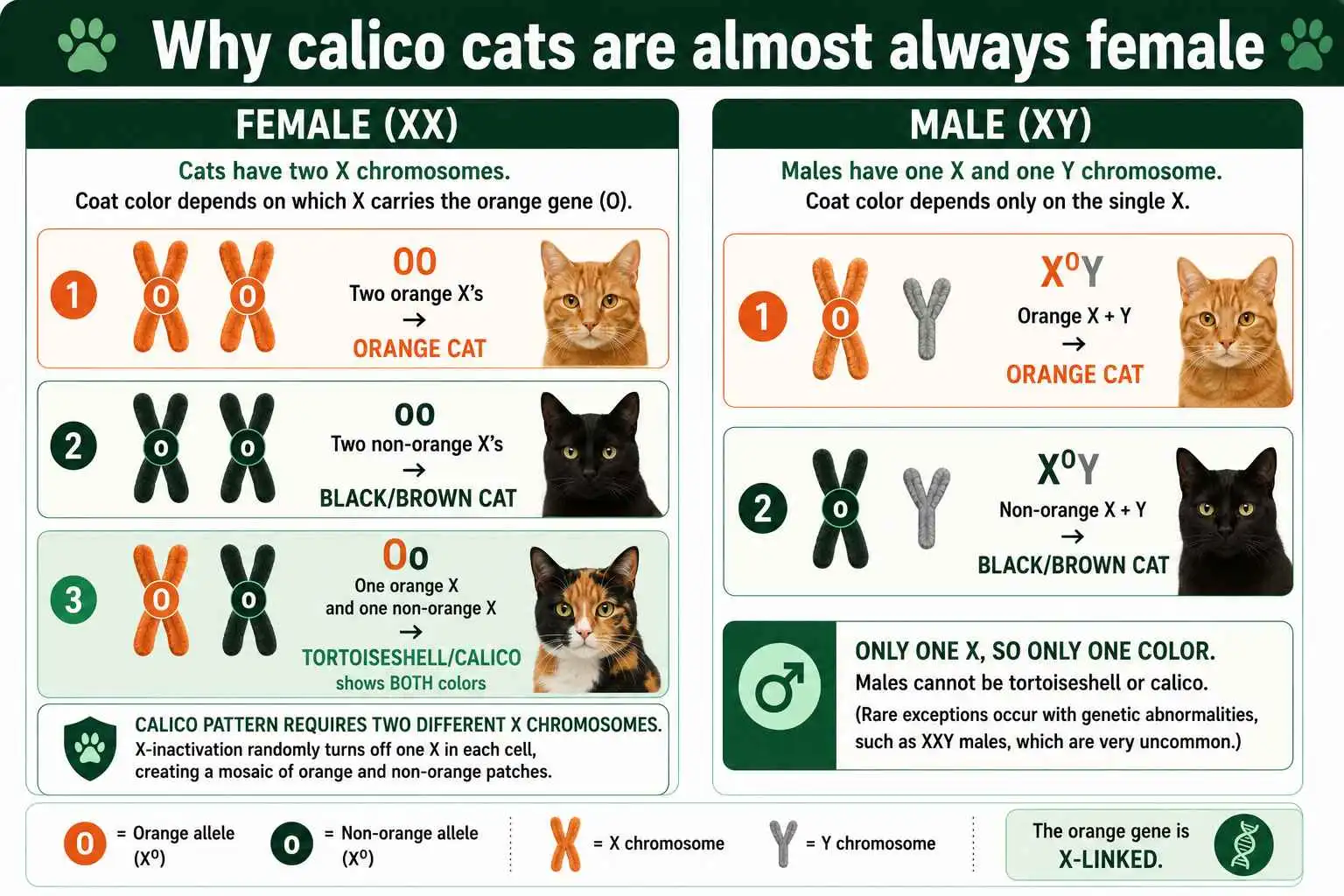
This is a textbook case of X-linked inheritance, the same principle that governs traits like colorblindness in humans. The trait sits on the X chromosome, and the difference in how many X chromosomes each sex carries produces a strong sex bias in the phenotype. Just as more males show X-linked recessive conditions because they have one X, more females show the tortie and calico patterns because only two X chromosomes can carry both color alleles at once. The orange gene flips the usual direction of the bias, but the underlying chromosome logic is identical.
X-Inactivation: How the Patchwork Forms
Carrying both color alleles explains why a female can be a tortie, but it does not by itself explain the patchy pattern. For that, you need X-chromosome inactivation, an elegant process that is the real star of the calico story. It is the reason the colors appear in distinct patches rather than blending evenly.
Here is what happens. Early in a female embryo's development, each cell randomly switches off one of its two X chromosomes, a process sometimes called Lyonization after the scientist Mary Lyon who proposed it. That inactivated X coils into a dense structure and stays silent, and crucially, all the descendant cells from that original cell keep the same X switched off. So the embryo becomes a mosaic, with some patches of cells expressing one X chromosome and other patches expressing the other.
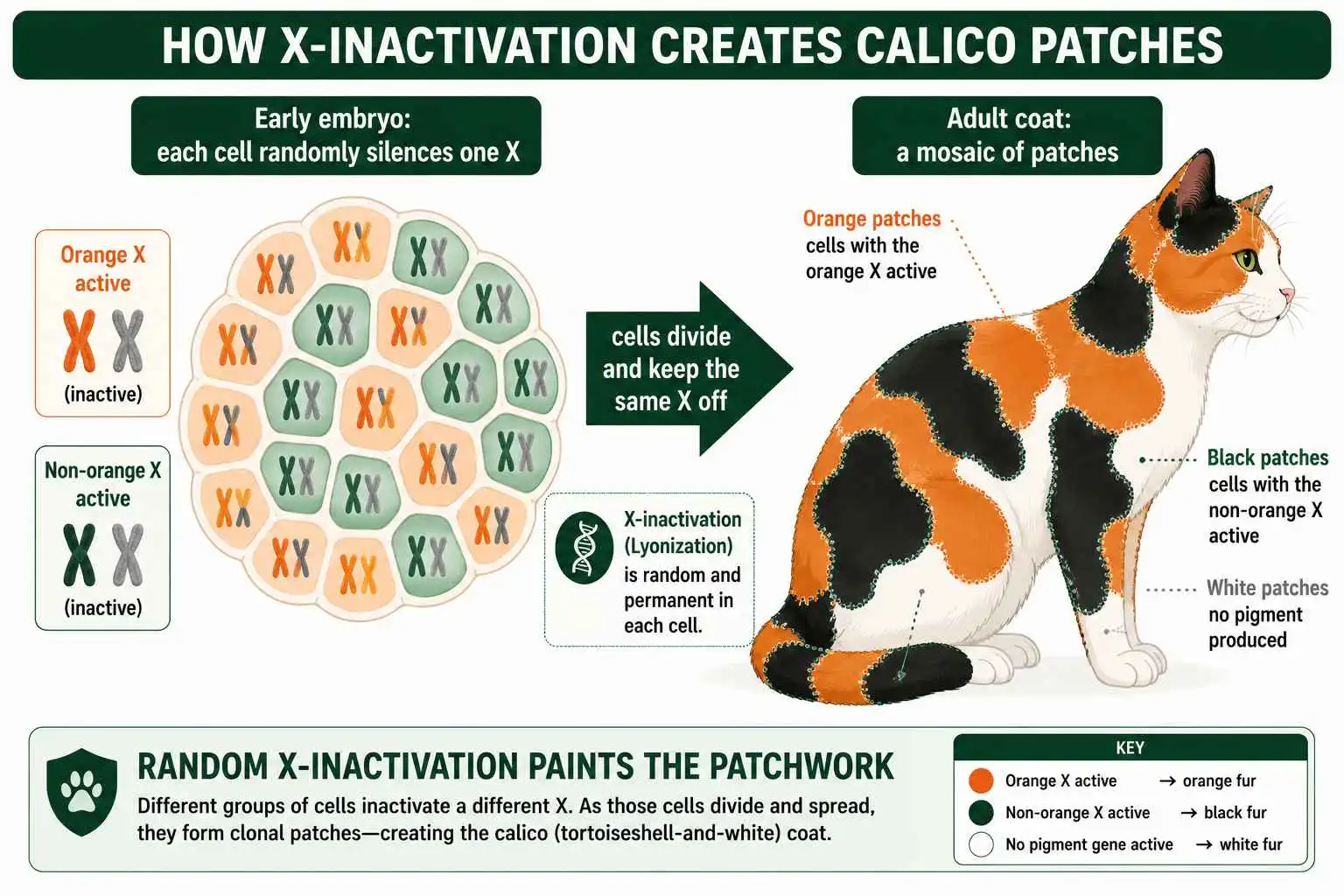
Now apply this to a heterozygous female cat carrying one orange allele and one non-orange allele on her two X chromosomes. A heterozygous genotype, with two different alleles, is precisely what makes the patchwork possible, since a homozygous cat with two matching alleles would be a single solid color instead. In the patches where the X carrying the orange allele stays active, the fur grows orange. In the patches where the X carrying the non-orange allele stays active, the fur grows black or brown. Because the inactivation is random and happens early, the result is a patchwork of orange and dark fur scattered across the coat. That patchwork is the tortoiseshell pattern, and adding white patches from a separate gene turns it into a calico. The discreteness of the patches reflects how each early cell's choice was copied into a whole region of the adult coat.
The Rare Male Calico
Almost all calico and tortoiseshell cats are female, but on rare occasions a male appears, and understanding why ties the whole genetic story together. A normal male cat cannot be calico, because his single X chromosome carries only one orange allele, so he cannot display both colors. The rare male calico is a genetic exception.
The most common explanation is an extra X chromosome. A male cat born with the genotype XXY, an aneuploidy similar to Klinefelter syndrome in humans, has two X chromosomes despite being male. With two X chromosomes, he can carry both an orange and a non-orange allele, and X-inactivation can then create the calico patchwork just as it does in a female. These XXY males are usually sterile, which is one reason the trait does not pass on readily. Other rare routes to a male calico include chimerism, where two embryos fused into one cat, or a somatic mutation early in development.
The rarity of male calicos is itself strong evidence for the genetics. If the calico pattern depended on autosomal genes, males and females would show it equally often. The overwhelming female bias, broken only by males with an extra X chromosome or other unusual events, confirms that the orange gene is X-linked and that two X chromosomes are required for the pattern. The exception, in other words, proves the rule.
Other Genes That Shape Cat Color
While the orange gene drives the most distinctive cat patterns, several other genes work alongside it to determine a cat's full appearance. These genes are autosomal, inherited the same way in both sexes, and they layer on top of the orange gene's effects.
The black or brown gene, sometimes called the B locus, determines the shade of the dark pigment. Its dominant allele produces black, while recessive alleles can shift the dark pigment to chocolate or cinnamon. This is the same kind of black-versus-brown gene found in other animals, and in a non-orange cat it sets whether the dark areas are black or a warmer brown. The dilution gene, the D locus, lightens whatever colors are present. A cat with two recessive dilute alleles shows a paler coat, turning black into blue-grey and orange into a soft cream. Many of the named cat colors, like lilac and fawn, are dilute versions of darker base colors.
The white spotting gene is what adds the white patches that turn a tortoiseshell into a calico. White areas are regions where pigment cells never arrived during development, leaving the fur unpigmented. A separate masking gene can also turn a cat entirely white regardless of its other color genes, a striking parallel to how one gene can override another. Layered together, these genes explain the enormous variety of cat coats, but the orange gene and X-inactivation remain the reason for the patterns that make feline genetics famous.
Tabby Patterns and the Agouti Gene
Many cats, including most orange cats, show a striped or swirled tabby pattern, and this comes from yet another gene working alongside the orange gene. Understanding tabby rounds out the picture of why orange cats almost always look striped rather than solid.
The agouti gene controls whether individual hairs are banded with color. Its dominant allele produces agouti hairs, which carry alternating bands of pigment that create the tabby pattern of stripes, spots, or swirls. The recessive version gives solid, non-banded hairs, allowing a uniform color. A separate tabby pattern gene then determines the specific shape, whether mackerel stripes, blotched swirls, or spots.
There is a quirk worth knowing about orange cats. The orange pigment pathway does not fully suppress the tabby pattern the way solid black can, so nearly all orange cats display visible tabby markings even when they are genetically non-agouti. This is why a truly solid orange cat is uncommon, and why ginger cats so reliably show those classic stripes. The tabby genes interact with the orange gene rather than overriding it, layering pattern on top of color in a way that adds to the rich variety of feline coats. This kind of gene-on-gene interaction, where one locus shapes how another is expressed, appears throughout coat color genetics across species.
How to Predict Kitten Colors With a Punnett Square
Predicting kitten colors uses a Punnett square, with one important adjustment for the orange gene: you write its alleles on the X chromosome, just as with any X-linked trait. The non-orange and orange alleles sit on the X, and the Y chromosome carries no orange allele at all.
Set up the cross by writing each parent's genotype on their sex chromosomes. A tortoiseshell mother is heterozygous, carrying one orange and one non-orange allele on her two X chromosomes. An orange father carries the orange allele on his single X plus a Y. To find the kittens, list each parent's gametes and combine them in the grid, then read the results separately for male and female kittens, because their outcomes differ. This is the same sons-versus-daughters approach used for any sex-linked cross.
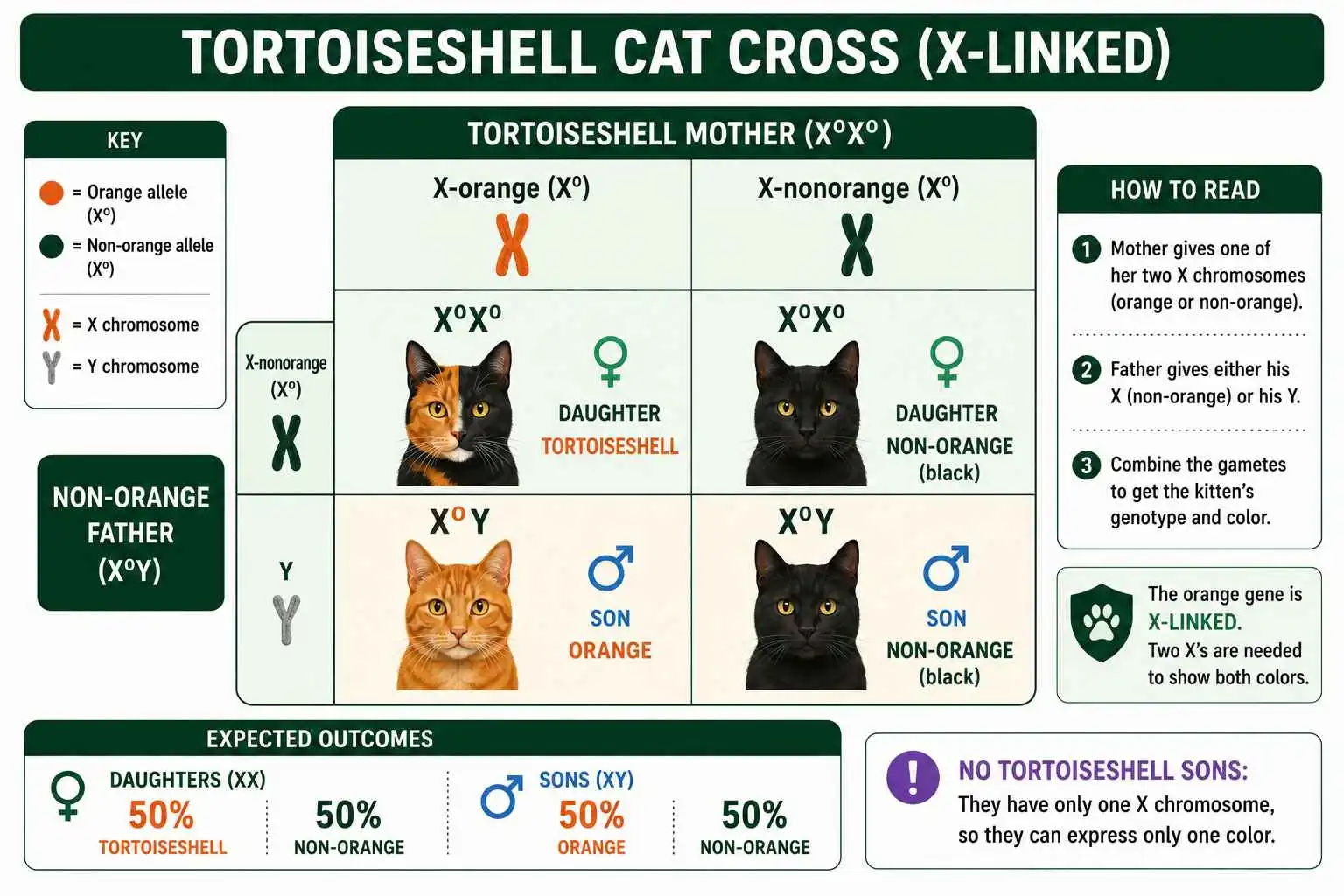
Reading the grid reveals the sex-linked pattern clearly. Daughters inherit an X from each parent, so a daughter of a tortie mother and an orange father can be orange or tortoiseshell depending on which maternal X she receives. Sons inherit their single X only from the mother, so a son will be orange or non-orange depending solely on which maternal allele he gets, never tortoiseshell. To work through any pairing and see the color odds for male and female kittens laid out, a good calculator handles the X-linked setup and sorts the outcomes by sex automatically.
A Worked Example: Predicting a Litter
To see the method in action, take a common pairing: a tortoiseshell mother bred with a black, non-orange father. The mother carries one orange and one non-orange allele on her two X chromosomes, and the father carries a single non-orange allele on his X plus a Y.
Work out the gametes. The tortie mother produces two kinds of egg, one carrying the orange X and one carrying the non-orange X. The non-orange father produces two kinds of sperm, one carrying his non-orange X and one carrying his Y. Combine them and read the four outcomes by sex. The daughters each receive the father's non-orange X plus one of the mother's two X chromosomes, so half the daughters are tortoiseshell (orange plus non-orange) and half are non-orange. The sons each receive the father's Y plus one of the mother's X chromosomes, so half the sons are orange and half are non-orange.
So this pairing produces no orange daughters and no tortoiseshell sons, which makes sense once you trace the chromosomes. A daughter can only be orange if she inherits an orange X from both parents, but this father has no orange allele to give. A son can never be tortoiseshell because he has only one X and cannot carry both alleles. Predicting the white patches that would make a tortie daughter into a calico requires the separate white spotting gene, but the orange-versus-dark outcome follows directly from the X-linked cross. Notice how the kitten colors split differently for the two sexes, a hallmark of any X-linked trait that the grid makes plain. This sex-dependent split is exactly what you would never see with an ordinary autosomal color gene, where sons and daughters would inherit colors in the same proportions.
What This Means for Cat Breeders
The X-linked orange gene has real consequences for anyone breeding cats, because the sex of a kitten and its color are linked in ways that autosomal genes never produce. A breeder who understands the chromosome logic can predict, and sometimes deliberately aim for, particular color outcomes.
The clearest rule is that a kitten's father shapes his daughters' colors but not his sons'. Because a father passes his single X to every daughter and his Y to every son, an orange father guarantees that all his daughters inherit at least one orange allele, while contributing nothing to his sons' color at the orange locus. A son's orange status depends entirely on his mother. This is why pairing an orange male with a non-orange female reliably produces tortoiseshell daughters, since each daughter gets orange from her father and non-orange from her mother. The same pairing produces only solid-colored sons, because they take their single X entirely from the non-orange mother.
Breeders aiming for calico or tortoiseshell kittens therefore focus on producing heterozygous females, which means crossing parents that supply an orange allele and a non-orange allele to their daughters. As one University of Miami genetics resource explains, the female-limited nature of these patterns is a direct result of X-inactivation acting on the heterozygous genotype. No amount of selective breeding can reliably produce male calicos, since that requires the rare XXY chromosome error rather than any heritable combination. Recognizing these limits saves breeders from chasing outcomes the genetics simply will not allow, and it turns color planning into a predictable application of sex-linked inheritance. For breeders wanting to estimate the precise odds of each color and sex combination before a planned pairing, working the cross through a phenotype probability calculator gives exact proportions rather than rough guesses.
Frequently Asked Questions
Why are almost all calico cats female?
The orange gene is on the X chromosome, and a cat needs two X chromosomes to carry both an orange and a non-orange allele at once. Females have two X chromosomes and can show both colors, while males have only one X and are usually a single color.
Can a male cat be calico?
Rarely. A male calico usually has an extra X chromosome, the genotype XXY, which lets him carry both color alleles. These males are typically sterile. Chimerism or a somatic mutation can also produce a rare male calico.
What is the difference between calico and tortoiseshell?
Both have orange and dark patches from the orange gene and X-inactivation. A tortoiseshell has the two colors mixed together, while a calico adds distinct white patches from a separate white spotting gene, creating three clear areas of color.
What gene makes cats orange?
The X-linked orange gene controls orange versus non-orange pigment. Research in 2025 traced it to a deletion near the ARHGAP36 gene on the X chromosome, which switches on orange pigment production in a cat's pigment cells.
Putting the Genetics to Work
Cat coat color shows genetics at its most elegant. The orange gene sits on the X chromosome, so a cat needs two X chromosomes to display both orange and dark fur, which is why calico and tortoiseshell cats are nearly always female. X-chromosome inactivation then scatters the two colors into the random patchwork that defines these coats, with rare male calicos arising only from an extra X chromosome. Other genes for black, dilution, and white spotting layer on top to fill out the full palette.
When you predict a litter, treat the orange gene as the X-linked trait it is: write its alleles on the X chromosome and read the male and female kittens separately. You can run any feline pairing and see the color odds for each sex with the Punnett Square Calculator, which applies the sex-linked logic for you. For a clear, hands-on look at how X-inactivation paints these coats, this resource from Science Buddies is well worth exploring.