Homozygous vs Heterozygous: How to Tell Them Apart
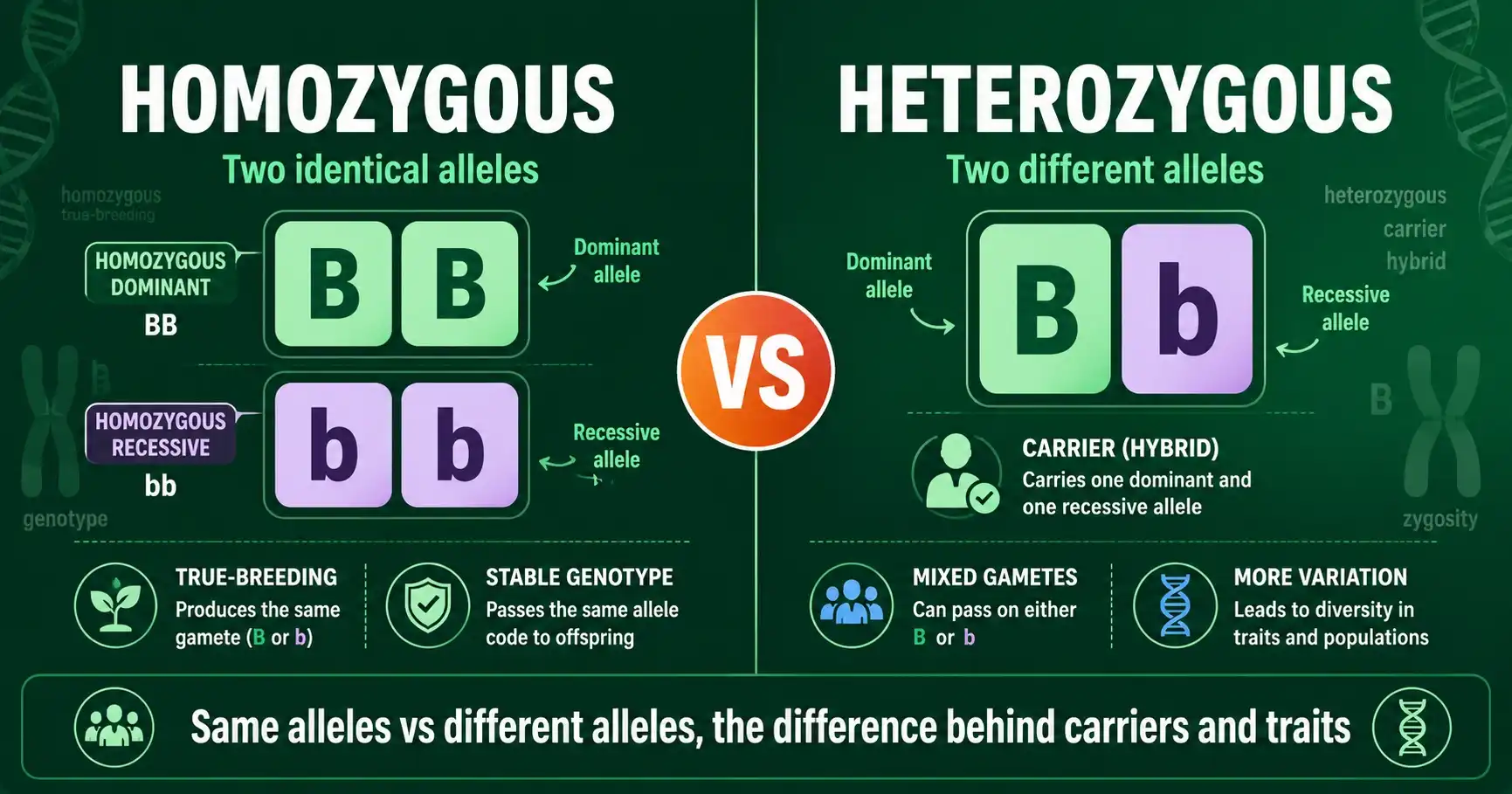
Homozygous means an organism carries two identical alleles for a gene, such as BB or bb. Heterozygous means it carries two different alleles, such as Bb. That single difference, identical versus different, sits behind a huge amount of genetics, from why a child can inherit a disease neither parent shows to why a tall pea plant might hide a recessive allele.
The words look intimidating, but the prefixes give them away. "Homo" means same, so homozygous is same alleles. "Hetero" means different, so heterozygous is different alleles. This guide explains both terms in plain language, shows you how to tell which is which, and works through the cases where appearance alone will fool you. By the end you will understand carriers, test crosses, and the special situations where a heterozygote does not behave the way the textbook rule predicts.
What Does Homozygous Mean?
Homozygous describes a genotype with two matching alleles for a gene. You inherit one allele from each parent, and when those two copies are identical, you are homozygous for that trait. Because the alleles agree, there is no internal competition over which one shows.
There are two kinds. Homozygous dominant means both alleles are the dominant form, written with two capital letters such as BB or TT. Homozygous recessive means both alleles are the recessive form, written with two lowercase letters such as bb or tt. In either case, the matching pair produces a clear, predictable phenotype, because there is only one type of allele to express.
Homozygous organisms are also described as true-breeding or purebred. A true-breeding tall pea plant has the genotype TT, so it can only pass on a T allele. Cross it with another TT plant and every offspring will be TT and tall. This reliability is why breeders prize homozygous lines: they produce consistent offspring generation after generation. The downside is that a homozygous recessive genotype for a harmful allele leaves no healthy backup copy, which matters a great deal for inherited disorders, as we will see. As Cleveland Clinic explains, a homozygous genotype simply expresses the trait of the matching alleles, whether dominant or recessive.
What Does Heterozygous Mean?
Heterozygous describes a genotype with two different alleles for a gene, written as one capital and one lowercase letter, such as Bb or Tt. You received one version from each parent, and the two versions disagree about which trait to produce. What happens next depends on how the alleles interact.
Under simple dominance, the dominant allele wins. In a heterozygous Bb individual, the dominant B allele produces enough working product to mask the recessive b, so the organism shows the dominant trait. A Bb person has brown eyes, looking no different from a homozygous BB person. The recessive allele is still there in the genotype; it is just hidden in the phenotype.
This hidden allele is the most important feature of a heterozygote. Even though the recessive trait does not appear, the recessive allele can still be passed to offspring. A heterozygous organism is sometimes called a hybrid, because it carries a mix of two different alleles. The single dominant allele is enough to drive the visible trait, but the genotype quietly carries information the appearance does not reveal. That gap between what shows and what is carried is the root of nearly every interesting case in this topic.
Homozygous vs Heterozygous: The Key Differences
The cleanest way to separate the two terms is to lay their features side by side. Both describe a pair of alleles, but everything about how that pair behaves depends on whether the two copies match.
| Feature | Homozygous | Heterozygous |
|---|---|---|
| Alleles | Two identical (BB or bb) | Two different (Bb) |
| Notation | Same letters | One capital, one lowercase |
| Allele interaction | None, alleles match | Dominant usually masks recessive |
| Also called | True-breeding, purebred | Hybrid |
| Hidden recessive allele | Only if homozygous recessive | Yes, always carries one |
| Offspring when self-crossed | All identical for the trait | Produces a mix |
The most consequential difference is the hidden recessive allele. A homozygous dominant organism (BB) carries no recessive allele at all, so it cannot pass one on. A heterozygous organism (Bb) always carries one, even though it looks identical to the homozygous dominant. This is why two healthy-looking parents can have a child with a recessive condition: both parents can be heterozygous carriers. Knowing your zygosity, the term for whether you are homozygous or heterozygous, can therefore matter for understanding inherited risk.
How to Tell If a Genotype Is Homozygous or Heterozygous
When you have the written genotype, telling them apart is instant. Look at the two letters. If they are the same, the organism is homozygous. If they differ, it is heterozygous.
So BB and bb are both homozygous, because each has a matching pair. The first is homozygous dominant and the second is homozygous recessive, but both are homozygous. Bb is heterozygous, because the two alleles differ. The letters alone settle it, with no biology required, as long as you have the genotype in front of you.
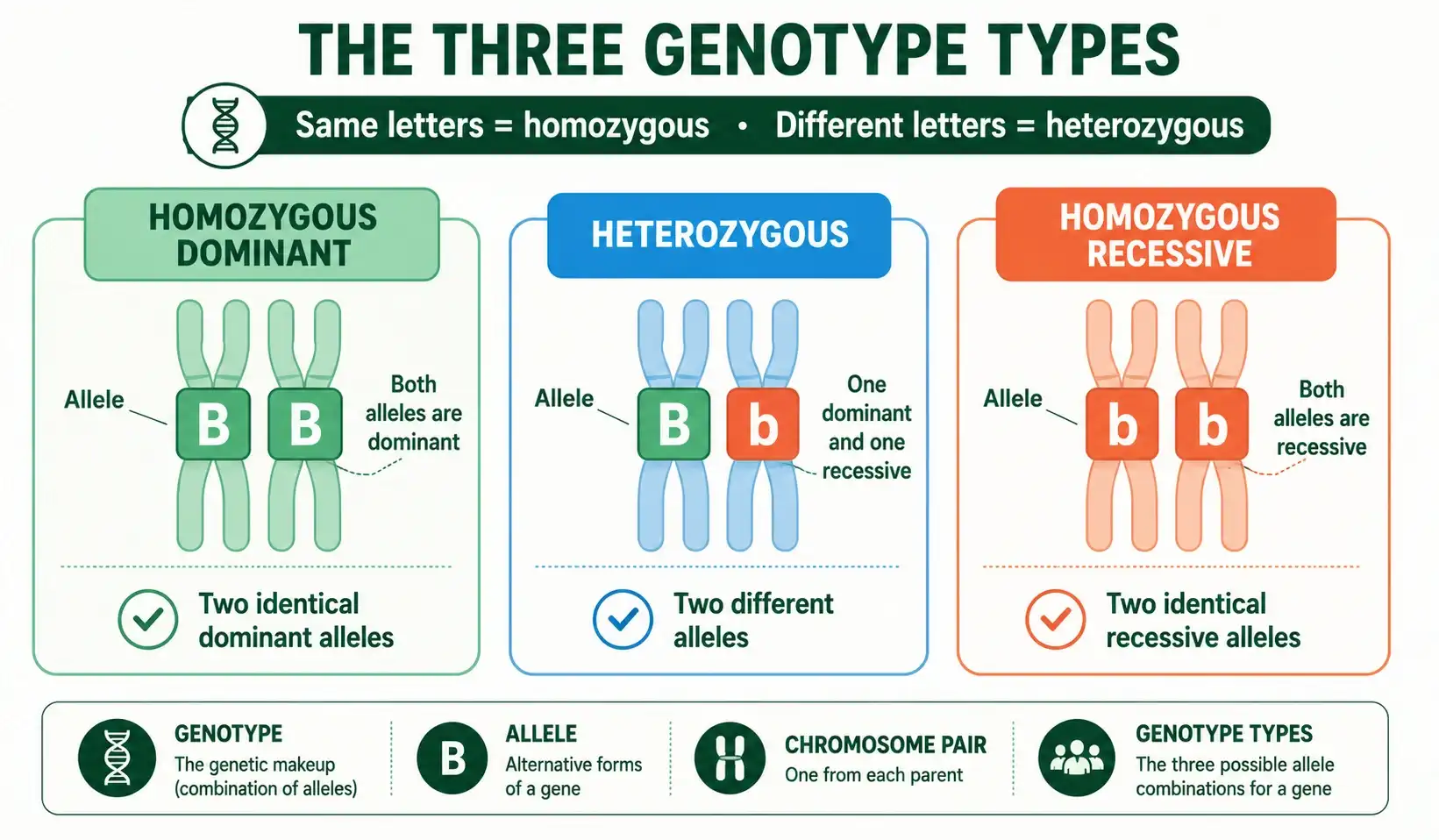
This even extends to more than one gene. For a two-gene genotype like AaBB, you check each gene separately. This organism is heterozygous for the A gene, because Aa has two different alleles, and homozygous for the B gene, because BB matches. An organism can be homozygous for one trait and heterozygous for another at the same time, so always evaluate one gene at a time.
The catch is that you usually do not start with the genotype. In the real world you start with the organism in front of you, and its appearance does not always reveal whether it is homozygous or heterozygous. That is where the problem gets interesting.
Why Appearance Alone Cannot Tell You
You cannot reliably tell a homozygous dominant organism from a heterozygous one just by looking, and this trips up a lot of people. The reason is dominance. Both BB and Bb produce the dominant phenotype, so a brown-eyed person could be either BB or Bb, and a tall pea plant could be either TT or Tt.
Think about what the dominant allele does. It produces enough working product to express the dominant trait whether it is paired with another dominant allele or with a recessive one. A single dominant allele is enough. So the visible trait tells you only that at least one dominant allele is present. It does not tell you whether the second allele is dominant or recessive.
The one case where appearance does settle it is the recessive phenotype. A blue-eyed person must be homozygous recessive (bb), and a short pea plant must be tt, because the recessive trait only appears when no dominant allele is present to mask it. So a recessive phenotype always means a homozygous recessive genotype. A dominant phenotype, by contrast, leaves you with two possibilities, and you need an experiment to choose between them. To predict and visualize these allele combinations across a cross, it helps to understand the grid behind them, which you can read about here.
Using a Test Cross to Find Out
A test cross is the classic method for revealing whether a dominant-looking organism is homozygous or heterozygous. The idea is elegant: cross the unknown organism with a homozygous recessive partner and read the offspring.
Here is why it works. The homozygous recessive partner can only contribute recessive alleles, so it adds nothing that could mask a recessive allele from the unknown parent. That means the offspring expose whatever the unknown was hiding. If the unknown is homozygous dominant (BB), every offspring receives a dominant allele from it and all of them show the dominant trait. But if the unknown is heterozygous (Bb), half of its gametes carry the recessive allele, so about half the offspring will show the recessive trait.
The appearance of even a single recessive offspring is the giveaway. A short pea plant in the offspring of a test cross proves the tall parent must have carried a hidden t allele, which means it was heterozygous (Tt).
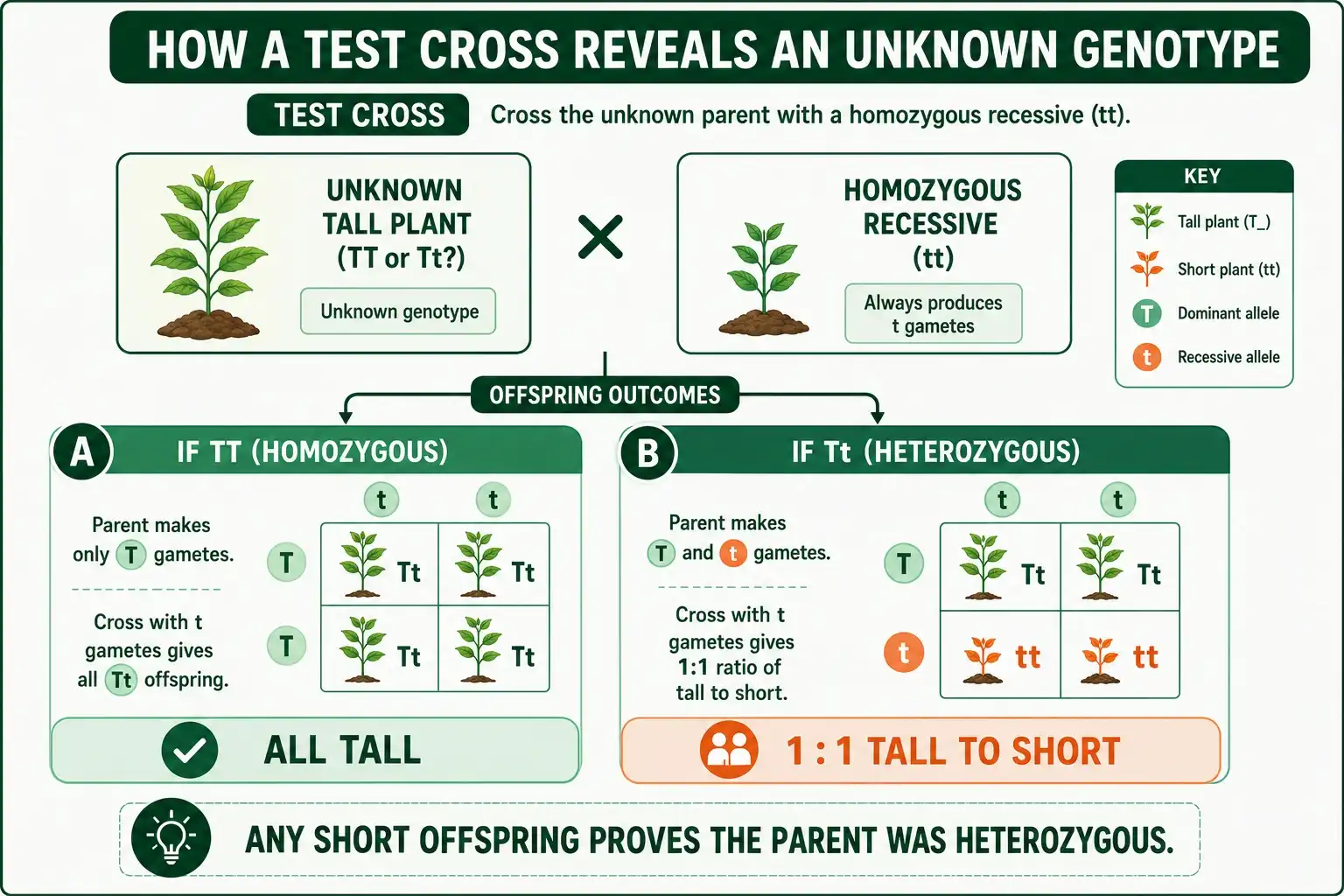 If every single offspring is tall, the tall parent was almost certainly homozygous (TT). This is the same logic Mendel used to probe his pea plants, and it remains a standard breeding tool. You can work through the offspring of any test cross with a test cross calculator to see the expected ratios directly.
Homozygous and Heterozygous in a Punnett Square
A Punnett square shows both genotypes naturally, and the classic monohybrid cross between two heterozygotes puts all three on display at once. Cross Bb with Bb and the four boxes come out as one BB, two Bb, and one bb.
Read that result by genotype and you get a 1:2:1 ratio: one homozygous dominant, two heterozygous, one homozygous recessive.
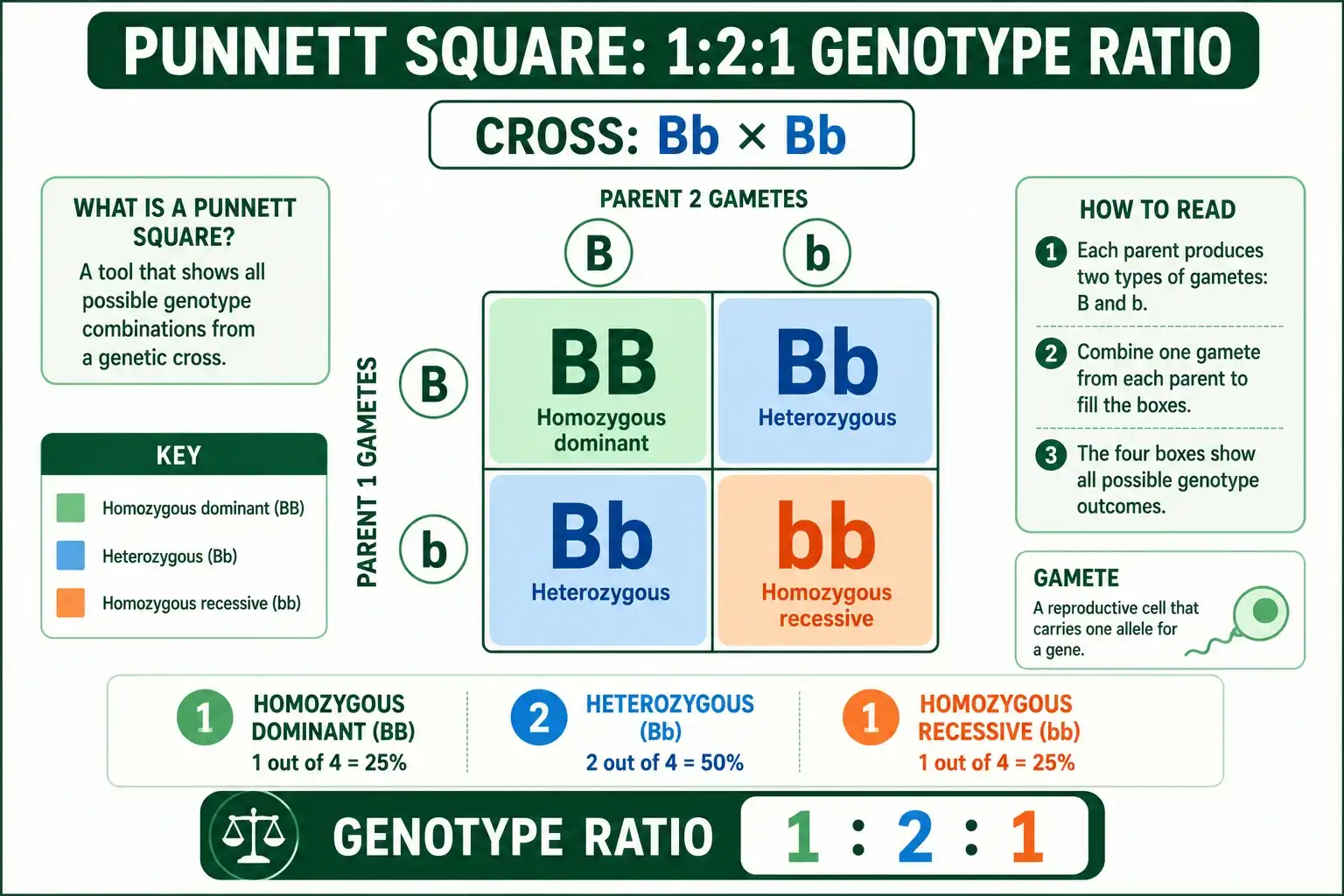 The heterozygotes are the most common outcome, appearing twice, because there are two ways to inherit one of each allele. You could receive the dominant allele from the first parent and the recessive from the second, or the other way around. Both routes land you at Bb.
This 1:2:1 genotype ratio is worth committing to memory, because it shows up constantly. Notice how it differs from the phenotype ratio of the same cross, which is 3:1. The phenotype ratio groups the BB and the two Bb boxes together, because all three look the same under simple dominance. So one square gives a 1:2:1 genotype ratio and a 3:1 phenotype ratio at the same time, and which one you report depends on whether the question asks about genotypes or appearances. The proportion of heterozygous offspring, exactly half in this cross, is often the figure you actually want when planning a breeding program or estimating a risk.
Homozygous and Heterozygous Examples
Concrete examples make the two genotypes easier to recognize. In each case below, notice how the homozygous and heterozygous versions either share a phenotype or differ, depending on how the alleles interact.
| Trait | Homozygous dominant | Heterozygous | Homozygous recessive |
|---|---|---|---|
| Eye color | BB, brown | Bb, brown | bb, blue |
| Pea plant height | TT, tall | Tt, tall | tt, short |
| Cystic fibrosis | CC, unaffected | Cc, healthy carrier | cc, affected |
| Snapdragon color | RR, red | Rr, pink | rr, white |
| Pea seed shape | RR, round | Rr, round | rr, wrinkled |
The eye color and pea height rows show simple dominance, where the homozygous dominant and the heterozygote look identical. Both BB and Bb give brown eyes, and both TT and Tt give tall plants, so appearance cannot separate them. Only the homozygous recessive stands out, with blue eyes or a short plant.
The cystic fibrosis row carries the most weight for human health. A homozygous recessive person (cc) has the condition, while a heterozygous person (Cc) is a perfectly healthy carrier who can still pass the allele on. The snapdragon row, by contrast, shows incomplete dominance, where the heterozygote is visibly pink and therefore easy to identify on sight. One quick scan of this table captures the whole lesson: a homozygous genotype expresses its matching pair, while a heterozygote's appearance depends entirely on how its two different alleles interact.
How Genetic Testing Reveals Zygosity
A test cross works beautifully for plants and lab animals, but you cannot run breeding experiments on people. For humans, zygosity is determined by reading the DNA directly through genetic testing.
Modern genetic tests examine the actual alleles at a specific gene, so they report homozygous or heterozygous status without any need to look at offspring. A test can show that a person carries two identical alleles, making them homozygous, or two different alleles, making them heterozygous. Crucially, this detects a hidden recessive allele that the person's phenotype would never reveal, which is the entire point of carrier screening before starting a family.
This direct reading is what makes carrier screening possible. Two prospective parents can each learn whether they are heterozygous carriers for conditions like cystic fibrosis or sickle cell anemia long before any child is conceived. If both turn out to be carriers, they can understand the one-in-four risk that a child will be homozygous recessive and affected. Genetic testing has essentially replaced guesswork with a precise readout of zygosity, turning a question that once required a test cross into a single laboratory result.
Why Zygosity Matters in Breeding and Agriculture
Beyond human health, the homozygous-heterozygous distinction drives plant and animal breeding. Breeders constantly choose between the reliability of homozygous lines and the vigor that heterozygous combinations can provide.
Homozygous, true-breeding lines are valuable because they are predictable. A homozygous dominant crop variety passes the same allele to every offspring, so the desired trait shows up consistently season after season. This is why seed companies invest heavily in developing pure, homozygous parent lines. The trade-off is that homozygous recessive genotypes can also fix harmful traits in place, with no dominant allele to compensate, which is one reason inbreeding can expose hidden weaknesses.
Heterozygous combinations tell the other half of the story. Crossing two different homozygous lines often produces heterozygous offspring that outperform both parents, a phenomenon called hybrid vigor. Much of modern hybrid corn relies on exactly this effect. Breeders therefore manage zygosity deliberately: they build homozygous lines for consistency, then cross them to create heterozygous hybrids when vigor is the goal. Understanding which genotype you are working with, and what it will pass on, is the foundation of every breeding decision.
The concept of a carrier is where homozygous and heterozygous genotypes matter most in human health. A carrier is a heterozygous individual who carries one recessive disease allele but shows no symptoms, because their dominant allele masks it. They are healthy, yet they can pass the recessive allele to their children.
Many serious inherited conditions follow this autosomal recessive pattern, including cystic fibrosis, sickle cell anemia, Tay-Sachs disease, and thalassemia. For these conditions, only the homozygous recessive genotype causes the disease. A heterozygous person is an unaffected carrier. The danger appears when two carriers have children together. Each carrier parent can pass either allele, so by the same 1:2:1 logic, about one in four of their children will be homozygous recessive and affected, two in four will be carriers like the parents, and one in four will carry no disease allele at all. This is exactly the kind of risk a carrier probability calculator is built to estimate.
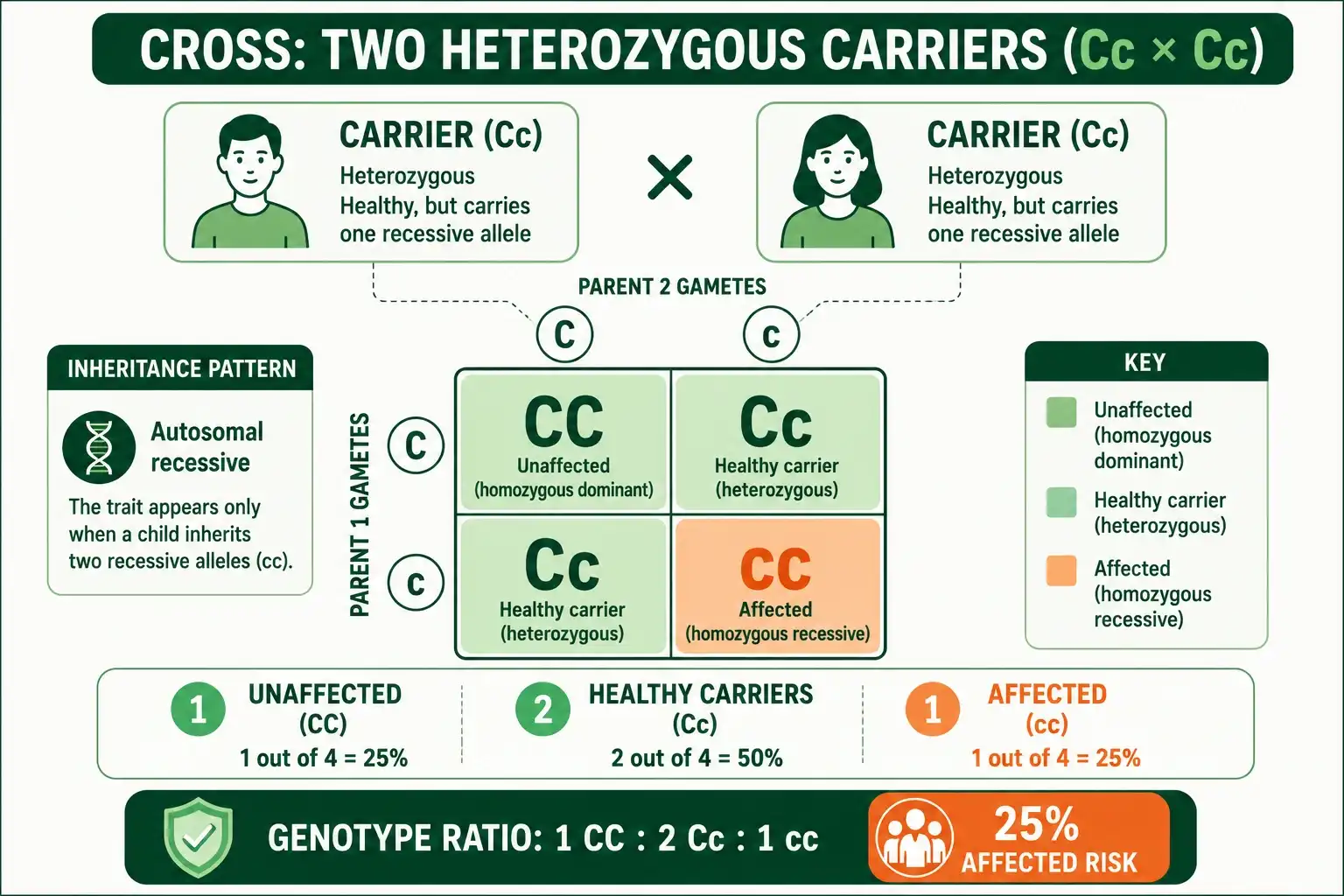
There is a fascinating twist with sickle cell anemia called heterozygote advantage. People who are homozygous recessive for the sickle allele have sickle cell disease, which is harmful. But heterozygous carriers, who carry one normal and one sickle allele, gain partial protection against malaria. In regions where malaria is common, this advantage helped the recessive allele persist in the population, because the heterozygous genotype was actually beneficial. It is a striking reminder that "recessive" does not mean "bad," and that the heterozygous state can carry hidden benefits as well as hidden risks.
Not every condition is recessive, though. Some disorders follow an autosomal dominant pattern, where a single copy of the mutated allele is enough to cause the condition. For these, a heterozygous individual is affected, not merely a carrier, because the dominant disease allele expresses even when paired with a normal one. Huntington's disease is a well-known example. So whether being heterozygous makes you a healthy carrier or an affected individual depends entirely on whether the disease allele is recessive or dominant.
Special Cases Beyond Simple Dominance
The neat rule that a heterozygote always shows the dominant trait holds only under simple dominance. Several common patterns break it, and recognizing them keeps you from misreading a genotype.
In incomplete dominance, neither allele fully masks the other, so the heterozygote shows a blended phenotype. A red snapdragon crossed with a white one gives pink heterozygotes. Here you can spot a heterozygote by sight, because Rr looks different from both RR and rr. In codominance, both alleles express fully and at the same time rather than blending. Human AB blood type is the textbook example, where a heterozygous person displays both the A and B markers at once. In both of these patterns, the heterozygous genotype produces its own distinct phenotype, which actually makes it easier to identify than under simple dominance.
A more advanced term is the compound heterozygote, used in medical genetics. This describes someone who carries two different mutated alleles of the same gene, rather than one normal and one mutated. Both copies are faulty, but in different ways, and the combination can still cause a recessive disease. Many real cystic fibrosis cases involve compound heterozygotes rather than two identical mutations.
Finally there is hemizygous, which applies to genes on the X chromosome in males. Because males have only one X chromosome, they carry just a single allele for X-linked genes rather than a pair. They are neither homozygous nor heterozygous for those genes; they are hemizygous. This single-allele situation is why X-linked recessive conditions like color blindness and hemophilia appear far more often in males, since there is no second allele to mask the recessive one. These sex-linked patterns follow their own rules, which sit outside the standard homozygous and heterozygous categories.
Common Mistakes to Avoid
A few recurring errors cause most of the confusion around these terms, and each is easy to fix once you see it.
The first is assuming a dominant phenotype means a homozygous dominant genotype. It does not. A dominant trait could come from either BB or Bb, and only a test cross or genetic test can separate them. The second is forgetting that homozygous comes in two forms. Both BB and bb are homozygous; the term does not mean dominant. Always specify homozygous dominant or homozygous recessive when it matters.
The third mistake is confusing a carrier with an affected individual. For a recessive condition, the heterozygous carrier is healthy and only the homozygous recessive person is affected. Flipping this leads to wrong risk predictions. The fourth is applying the "dominant masks recessive" rule everywhere. As the special cases show, incomplete dominance and codominance produce heterozygotes with their own visible phenotypes, so the rule has real exceptions. Keeping these distinctions straight is far easier when you can see the alleles laid out in a grid rather than juggling them in your head.
Bringing It Together
Homozygous and heterozygous come down to one question: are the two alleles the same or different? Homozygous means a matching pair, either two dominant or two recessive alleles, producing a predictable, true-breeding result. Heterozygous means a mismatched pair that usually shows the dominant trait while quietly carrying the recessive one. That hidden allele is what makes carriers possible, what a test cross reveals, and what drives the 1:2:1 genotype ratio you see in so many crosses.
The fastest way to see all of this in action is to lay out a cross and read the genotypes directly. You can generate any cross and see the homozygous and heterozygous outcomes side by side with the Punnett Square Calculator, which turns these definitions into concrete predictions you can actually use. For a precise, authoritative definition of the term, the NIH genetics glossary is a reliable reference to keep on hand.