ng/µL to nM Calculator for DNA, RNA, and Oligos

Convert nucleic acid mass concentration into molar concentration. Enter ng/µL, molecule length, and strand type to get nM, µM, pmol/µL, copies/µL, and dilution volumes. Use the result for primers, PCR products, qPCR standards, sequencing libraries, RNA guides, and cloning inserts.

Convert ng/µL into nM instantly

The calculator updates live. Basic mode gives the molarity result. Advanced mode adds exact molecular weight, copy number, reaction input, and working-stock dilution planning.

Choose the conversion mode

Basic mode answers the common stock-concentration question. Advanced mode adds exact molecular weight and dilution planning.

Load a common lab scenario

Enter concentration and molecule length

Use the measured mass concentration and the length that defines the molecule’s molecular weight.

Live molarity result

The result updates instantly as concentration, length, molecule type, or exact molecular weight changes.

Molar concentration

7,575.76 nM

This equals 7.5758 µM or 7.5758 pmol/µL.

Molecular weight used

6,600 g/mol

330 g/mol per nt

Copies per µL

4.562e+12

Useful for qPCR standards and template inputs.

Copies per reaction

4.562e+12

Based on 1 µL added.

Mass per reaction

50 ng

Corrected by usable molecule percentage.

Formula summary for this input

The same formula works for primers, amplicons, libraries, and RNA when the molecular weight matches the molecule.

Mass to molarity

nM = ng/µL × 1,000,000 ÷ MW

50 × 1,000,000 ÷ 6,600 = 7,575.76 nM

Moles per microliter

pmol/µL = nM ÷ 1,000

7,575.76 nM = 7.5758 pmol/µL

Molecule copies

copies/µL = nM × 6.022 × 10⁵

7,575.76 nM gives 4.562e+12 molecules/µL.

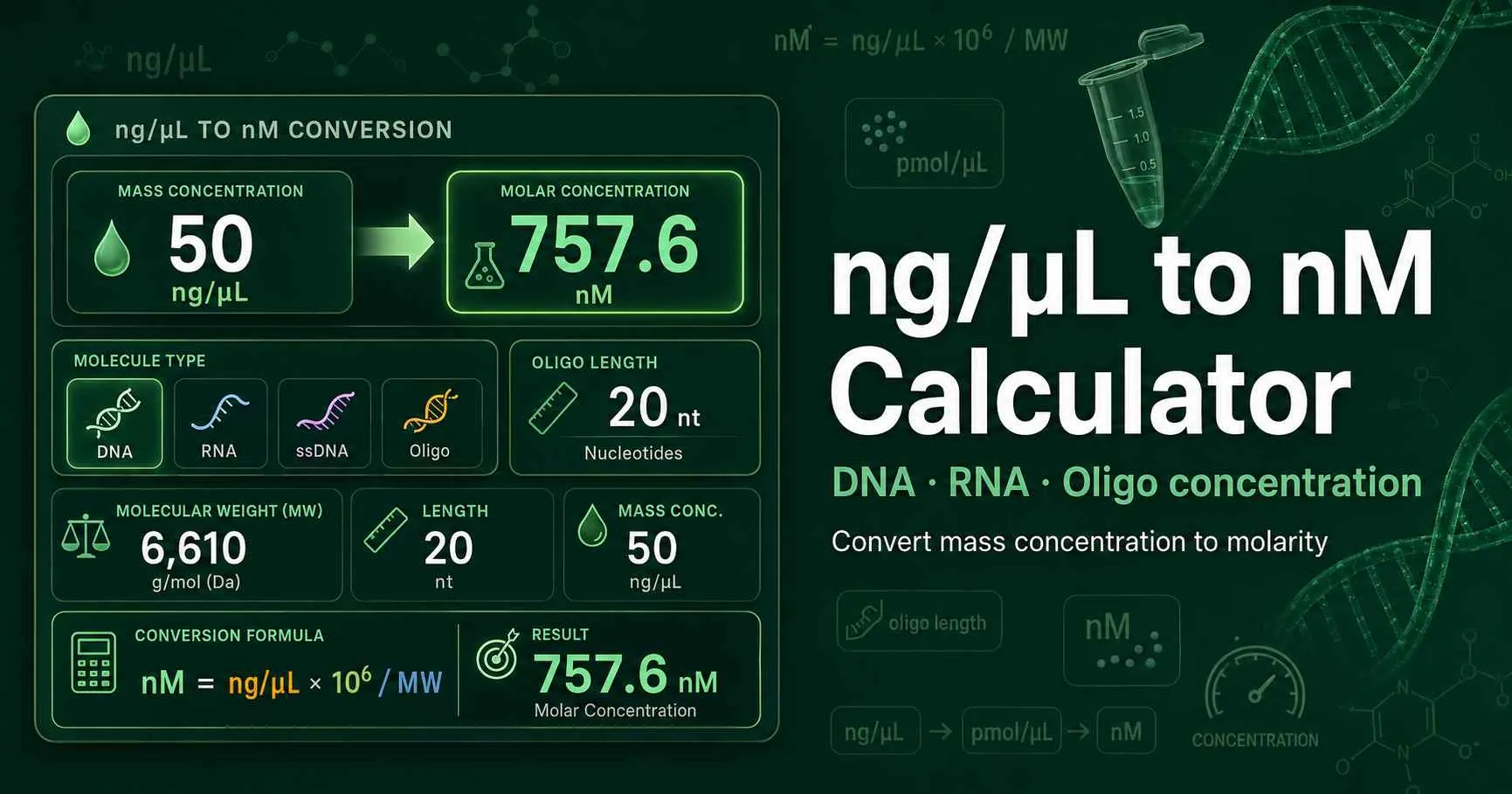
Diagram showing conversion of DNA concentration from ng per microliter to nanomolar using length, molecular weight, and molecule type
Figure 1. The conversion links mass concentration, molecular weight, and molecule count. Short primers contain more molecules per ng than long dsDNA libraries because their molecular weight is lower.

ng/µL to nM conversion answers a molecule-count question

Use this calculator when ng/µL alone does not answer the lab question. ng/µL reports mass per volume. nM reports molecule concentration. A 20 nt primer and a 350 bp sequencing library can share the same ng/µL value but contain very different numbers of molecules.

The conversion needs molecular weight. For quick estimates, many lab calculations use about 660 g/mol per base pair for dsDNA, about 330 g/mol per nucleotide for ssDNA, and about 340 g/mol per nucleotide for RNA. Exact molecular weight improves results for modified oligos, fluorophore-labelled probes, adapters, and vendor-supplied sequences.

Thermo Fisher provides nucleic-acid molecular-weight conversion tables for DNA and RNA, while IDT explains why oligo quantification often uses nmol for practical dilution and stock preparation. Review molecular-weight conversion tables.
What each input changes in the result

Each field controls one physical part of the conversion. Change length first when the nM result looks surprising. Long molecules always give fewer molecules per ng than short molecules.

Concentration

Sets the mass concentration in ng/µL.

Use the value from Qubit, NanoDrop, gel quantification, or supplier datasheet.

Length

Defines molecular weight from bp or nt count.

Use bp for dsDNA and nt for primers, probes, or RNA oligos.

Molecule type

Chooses dsDNA, ssDNA, or RNA average mass.

Pick the physical molecule you will pipette.

Exact MW

Overrides the average estimate.

Use for modified oligos and vendor-reported molecular weights.

Target nM

Plans a working stock from stock molarity.

Use for primer dilution, library pooling, and qPCR standards.

Formula for converting ng/µL to nM

Start with molecular weight. Then divide the mass concentration by that molecular weight. The unit shortcut below works because 1 ng/µL equals 0.001 g/L, and nM means nanomoles per litre.

Core equation

nM = ng/µL × 1,000,000 ÷ MW

Molecular weight

MW ≈ length × average unit mass

Molecule copies

copies/µL = nM × 6.022 × 10⁵

Use exact MW when precision matters. IDT notes that oligo analysis can report molecular weight, GC content, extinction coefficient, µg/OD, and nmol/OD for sequence-specific quantification. Check sequence-specific oligo properties.

Basic mode gives the answer; Advanced mode plans the experiment

Choose Basic mode when you need one molarity result. Choose Advanced mode when you must make a working stock or account for an exact molecular weight. This split keeps the calculator fast for students and useful for lab planning.

Basic workflow

  1. Enter concentration in ng/µL.
  2. Enter length in bp or nt.
  3. Select dsDNA, ssDNA, or RNA.
  4. Use the nM result for reaction setup.

Advanced workflow

  1. Turn on exact MW for modified molecules.
  2. Adjust usable molecule percentage when purity is lower.
  3. Enter a target nM and final volume.
  4. Prepare the stock dilution using the volume output.

Worked examples for primers and DNA libraries

Primer stock example: 50 ng/µL, 20 nt ssDNA

A 20 nt primer has an approximate molecular weight of 20 × 330 = 6,600 g/mol. The conversion gives 50 × 1,000,000 ÷ 6,600 = 7,576 nM. That equals 7.58 µM.

To make 100 µL of 500 nM working primer, use C1V1. Stock volume = 500 × 100 ÷ 7,576 = 6.60 µL. Add 93.40 µL nuclease-free water or TE buffer.

Library example: 4 ng/µL, 350 bp dsDNA

A 350 bp dsDNA library has an approximate molecular weight of 350 × 660 = 231,000 g/mol. The conversion gives 4 × 1,000,000 ÷ 231,000 = 17.3 nM.

This result explains why library size matters. A 250 bp library at the same 4 ng/µL would give a higher nM value because each molecule weighs less.

Use nM when molecule number controls the experiment

Use ng/µL when mass input matters. Use nM when molecule number matters. PCR primers, sequencing libraries, qPCR standards, ligation inserts, and synthetic adapters usually need molar thinking because reactions depend on how many molecules can anneal, amplify, ligate, or cluster.

Primer stocks

Use nM or µM to prepare equal-molecule primer working stocks.

Library pooling

Use nM to pool libraries with different average insert sizes.

qPCR standards

Use copies/µL to build copy-number standards.

Cloning inserts

Use molar amount when vector and insert lengths differ.

These tools continue the same workflow after you convert concentration into molarity.

ng/µL to nM FAQs

How do I convert ng/µL to nM for DNA?

Use nM = ng/µL × 1,000,000 ÷ molecular weight. For dsDNA, many quick lab calculations estimate molecular weight as length in base pairs × 660 g/mol. A 150 bp dsDNA amplicon at 10 ng/µL gives about 101 nM because 150 × 660 = 99,000 g/mol. Use exact molecular weight when you have a modified oligo, adaptor, or vendor-supplied value.

Why does length change the nM value?

nM measures molecules per volume, not mass per volume. A short 20 nt primer contains many more molecules than a 350 bp dsDNA library fragment at the same ng/µL value. Molecular weight increases as length increases, so the same mass concentration converts to a lower nM value for longer DNA. This is why library normalization and primer dilution both need length information.

Should I use dsDNA, ssDNA, or RNA in the calculator?

Choose dsDNA for PCR products, gBlocks, inserts, libraries, and double-stranded plasmid fragments. Choose ssDNA for primers, probes without RNA bases, adapters reported as single strands, and synthetic DNA oligos. Choose RNA for guide RNAs, RNA oligos, and transcript fragments. If the supplier gives exact molecular weight, use Advanced mode and enter that value directly.

Is 1 nM the same as 1 pmol/µL?

No. 1 nM equals 0.001 pmol/µL. A 1000 nM solution equals 1 pmol/µL. This relationship helps when you convert oligo stocks between molarity and amount added to a reaction. The calculator reports both units so you can move between primer stocks, qPCR standards, and ligation setups.

Can this calculator handle sequencing libraries?

Yes, use dsDNA and enter the average library size in base pairs. For example, a 350 bp library at 4 ng/µL converts to about 17.3 nM using the average dsDNA molecular weight. Library prep workflows often ask for nM because cluster generation and pooling depend on molecule number. Use the average fragment size from Bioanalyzer, TapeStation, or gel-based sizing.

Why does the calculator include a dilution planner?

Many users convert ng/µL to nM because they need a working stock, not just a number. Advanced mode calculates how much stock to pipette into buffer or water to reach a target nM concentration. It also warns when the required stock volume drops below 1 µL. That warning helps you avoid unreliable pipetting and choose an intermediate dilution.

Does purity affect the conversion?

The formula assumes the measured ng/µL value represents usable target molecule. Salts, degraded nucleic acid, adapter dimers, protein contamination, or inaccurate quantification can distort the practical concentration. Use the usable molecule correction when you know recovery or purity is below 100%. For critical qPCR standards or library pooling, confirm concentration with a method that matches the molecule type.