Founder Effect: Definition, Causes, and Examples
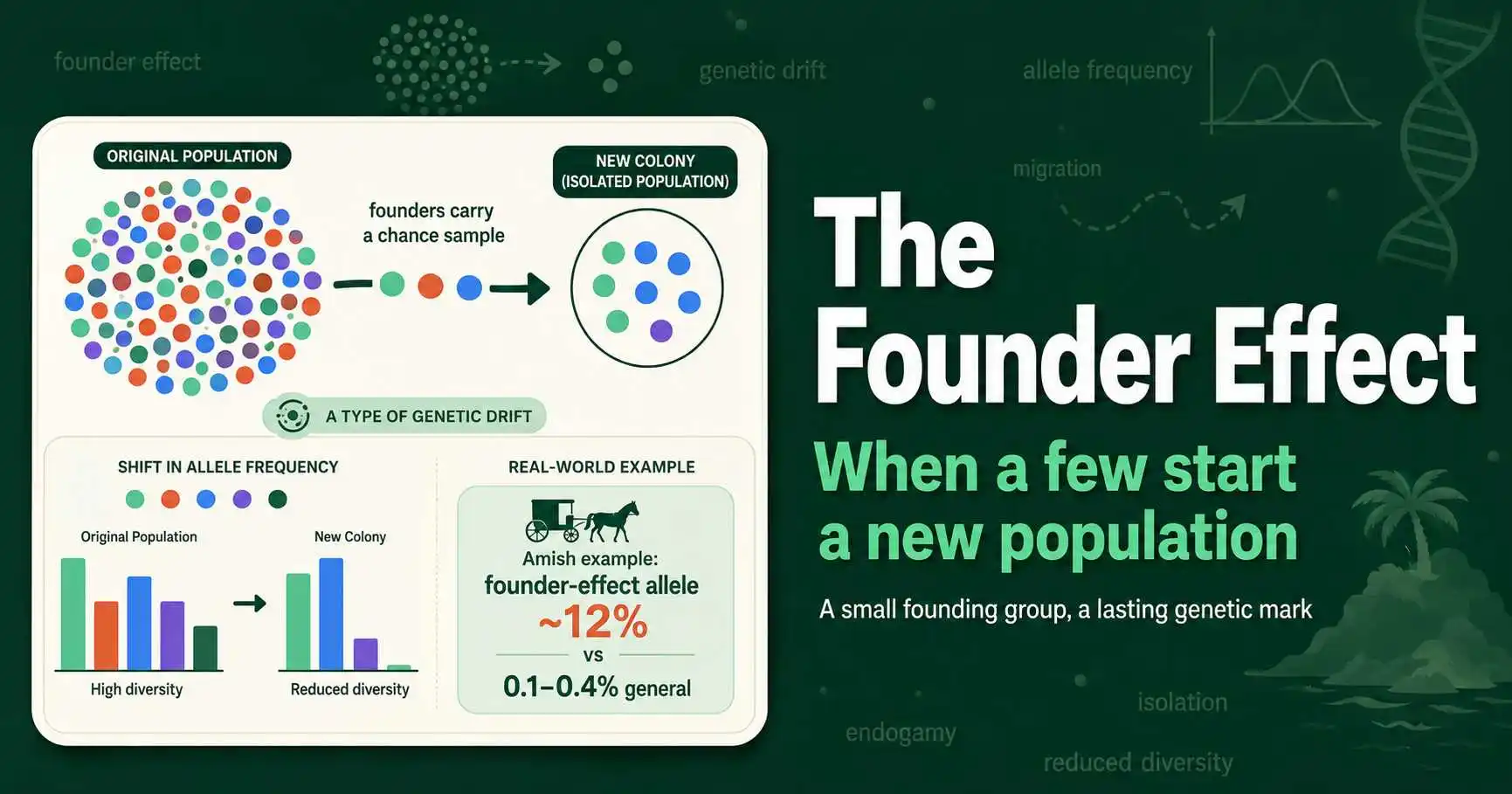
The founder effect is the loss of genetic variation that happens when a new population is started by a small number of individuals from a larger population. Those few founders carry only a small, non-representative sample of the original gene pool, so the new population can differ sharply from the source population it came from. The founder effect is a type of genetic drift, driven entirely by random chance rather than by which alleles happen to be beneficial. It often raises the frequency of rare alleles, including disease-causing ones, in the newly established population.
This guide explains the founder effect in plain terms, covers its causes, and works through the most famous real examples, from the Amish to the island of Pingelap. It also clears up the common confusion between the founder effect and a population bottleneck, two related forms of drift that people often mix up. Watching how a small founding group reshapes allele frequencies in a simulator makes the chance-driven nature of the effect easy to see. By the end, you will know exactly why a handful of founders can leave a permanent genetic mark.
What Is the Founder Effect?
The founder effect is the reduced genetic diversity that results when a new population is established by a very small group of individuals. The founders carry only a fraction of the genetic variation present in the original population, so the new group starts out genetically different and less diverse from the very beginning.
The concept was first fully described by the biologist Ernst Mayr in 1942, building on the earlier mathematical work of Sewall Wright on genetic drift. Mayr defined it as the establishment of a new population by a few founders carrying only a small fraction of the parent population's variation. In the most extreme case, a whole new population could trace back to a single fertilized female. The smaller the founding group, the more pronounced the effect.
The reason the founder effect matters is that it locks in a biased starting point. Because the founders are a random, non-representative sample, some alleles common in the source population may be missing entirely, while rare alleles the founders happened to carry may start at a much higher frequency. As the new population grows over generations, its genetic makeup reflects the founders rather than the original population. This is why the founder effect can make an isolated population genetically distinctive, sometimes with elevated rates of conditions that are rare elsewhere. The founder effect is one of the two classic forms of genetic drift, a process explained fully in our guide on what genetic drift is.
What Causes the Founder Effect?
The founder effect is caused by the random sampling of alleles that occurs when a small group breaks away to start a new population. The founders cannot carry every allele from the source population, so their gene pool is an incomplete and chance-determined slice of the original.
Migration and colonization are the usual triggers. The founder effect happens whenever a small group leaves a larger population to settle a new area, whether that means animals colonizing an island, plants spreading to a new region, or humans migrating to found an isolated community. The key ingredient is that the founding group is small, because small samples stray furthest from the original allele frequencies. A founding group of five individuals will misrepresent the source gene pool far more than a group of five hundred.
Isolation then preserves and amplifies the effect. Once the new population is established, limited gene flow with the outside keeps its distinctive allele frequencies in place. If the group also tends to mate within itself, a practice called endogamy, the founders' alleles become even more concentrated over generations. Many human founder populations, such as religious communities or geographically remote settlements, combine a small founding group with strong isolation and endogamy, which is exactly the recipe for a strong and lasting founder effect. Without ongoing isolation, gene flow from neighboring populations would gradually dilute the founder signature.
How Is the Founder Effect Different From a Bottleneck?
The founder effect and a population bottleneck are both forms of genetic drift, but they differ in how the small population arises. The founder effect happens when a few individuals leave to start a new population. A bottleneck happens when an existing population crashes in size due to a disaster.
The distinction comes down to migration versus catastrophe. In the founder effect, the small group is created by migration and colonization, splintering off to form a brand-new population somewhere else. In a bottleneck, no new population forms; instead, the original population is drastically reduced in place by an event like a flood, disease outbreak, or overhunting, leaving a small group of survivors. Both end up with a small gene pool that misrepresents the original, which is why both intensify drift.
There is also a difference in timing. The founder effect is essentially an instantaneous event, set in motion the moment the founders establish the new population. A bottleneck's effect persists as long as the population remains small, and the loss of variation deepens the longer the reduced size lasts. Despite these differences, the two often overlap and can be hard to separate in practice, since a bottleneck can leave a small fragmented group that then behaves like founders. Both demonstrate the same core principle: when very few individuals determine the next generation, chance dominates the genetics. The bottleneck case is covered in detail in our guide on the population bottleneck.
The Amish and Ellis-van Creveld Syndrome
The clearest example of the founder effect is the Old Order Amish of Pennsylvania, where a rare genetic disorder reaches strikingly high frequency. The Amish descend from a small group of German immigrants who settled in the United States in the 1700s, and one or more of those founders carried the allele for Ellis-van Creveld syndrome.
Ellis-van Creveld syndrome is a rare recessive disorder causing a form of dwarfism, extra fingers or toes known as polydactyly, and often abnormalities of the teeth, nails, and heart. The numbers tell the story. The allele occurs at a frequency of about 7 percent in the Pennsylvania Amish, compared to roughly 0.1 percent in the general population. That 0.1 percent also matches the allele frequency in the original European population the Amish came from, which confirms that the dramatic increase in the Amish is due to the founder effect, not selection.
Two features of Amish life make the effect especially strong and long-lasting. First, the community practices endogamy, meaning members marry within the group, which concentrates the founders' alleles. Second, gene flow is essentially one-directional: people may leave the community, but outsiders rarely join, so no new alleles enter the gene pool. The result is that the disease allele, present in just one or a few founders three centuries ago, has stayed elevated and even spread within the population. The Amish are also exceptionally valuable for genetic research, because they keep detailed genealogical records and have large families within a well-defined population.
More Famous Founder Effect Examples
Several other founder populations illustrate the same principle with their own distinctive conditions. These real cases make it clear that the founder effect is a widespread phenomenon, not a quirk of one community.
The Afrikaner population of South Africa is a classic example. It descends mainly from a small group of Dutch, German, and French settlers who arrived in 1652. Huntington's disease, a serious neurological disorder, is unusually common among Afrikaners, with over 200 affected individuals in more than 50 supposedly unrelated families traced back to a single common ancestor from the seventeenth century. One founder carrying the Huntington's allele seeded the elevated frequency seen today.
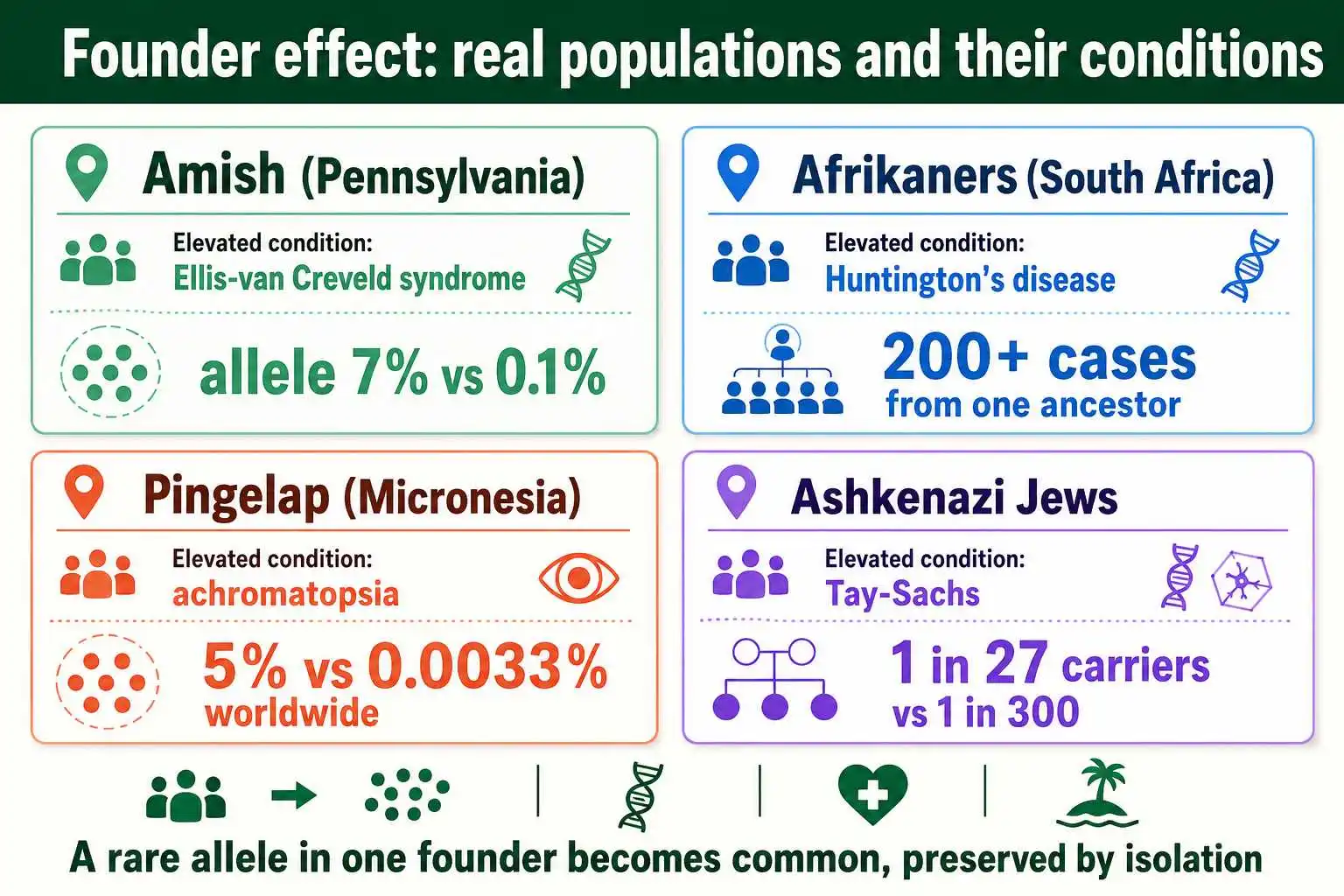
The island of Pingelap in Micronesia offers a dramatic case linked to a bottleneck. A typhoon around 1775 reduced the population to roughly 20 survivors, one of whom carried a recessive allele for achromatopsia, a form of complete color blindness. Today, achromatopsia affects about 5 percent of Pingelapese, compared to about 0.0033 percent worldwide. This case blends a bottleneck and a founder effect: the typhoon crashed the population, and the small group of survivors then acted as founders for everyone who came after, carrying the achromatopsia allele at a hugely elevated frequency. The Ashkenazi Jewish population shows a founder effect for Tay-Sachs disease, where roughly 1 in 27 are carriers compared to about 1 in 300 in many other groups. And the French Canadian population of Quebec, descended from a few thousand French settlers who arrived in the 1600s, carries elevated frequencies of several genetic conditions that are well documented thanks to the region's unusually complete genealogical records. In every case, the founders' chance genetic makeup, preserved by isolation, set the genetic course for generations.
Why Founder Populations Have More Genetic Disorders
Founder populations often show elevated rates of specific genetic disorders because a rare disease allele carried by a founder starts at a much higher frequency in the small new population. In a large population, one carrier among millions barely registers. Among a few dozen founders, that same carrier represents a large slice of the gene pool.
The mathematics is straightforward. Allele frequency is the proportion of all copies of a gene that are a particular variant. If one founder out of fifty carries a disease allele, that allele immediately starts at a frequency far higher than its level in the source population, simply because the denominator is so small. As the population grows from these founders, the allele is carried along at this elevated frequency, so the disorder appears far more often than elsewhere. The disease allele did not become more common because it was beneficial; it became common purely by the chance of which founders carried it.
Endogamy compounds the problem for recessive disorders. Because recessive conditions appear only when an individual inherits two copies of the allele, they require both parents to be carriers. In an isolated, intermarrying founder population, carriers are more likely to have children together, so the recessive condition surfaces more frequently. This is why founder populations are so often associated with specific recessive diseases. It is also why these populations are medically important, since understanding their elevated allele frequencies helps with genetic counseling and screening within those communities.
What the Founder Effect Means for Evolution
Beyond genetic disorders, the founder effect has a deeper significance for evolution, because it can set populations on new evolutionary paths. When a founding group starts with a biased sample of alleles, the new population begins evolving from a different genetic starting point than its source.
This matters most for isolated populations, such as those on islands. A founding group of birds blown to a remote island carries only a fraction of the mainland species' variation, and from that skewed starting point, the island population may evolve in its own direction. The founder effect can therefore be a first step toward the formation of new species, especially when combined with the different selective pressures of a new environment. Some biologists have argued that founder events played an important role in rapid speciation, though the strength of this idea is still debated.
The classic island setting shows why this is plausible. Islands are colonized by small founding groups that arrive by chance, often a few birds, insects, or seeds carried across the water. Each founding group brings a reduced and skewed sample of the mainland gene pool, so the island population begins genetically distinct from the start. Add the island's particular climate, food sources, and predators, and selection pushes the population further from its mainland relatives. Over enough generations, the combination of a founder-biased starting point and novel selection can produce a population so different that it can no longer interbreed with the source, a new species. The famous diversity of island species, from Galapagos finches to Hawaiian fruit flies, reflects this interplay of founder effects and local adaptation.
The founder effect also reduces a population's genetic diversity, which has lasting consequences. Lower diversity means less raw material for future adaptation and a greater risk from inbreeding, since the small founding pool makes related matings more likely over time. This connects the founder effect to conservation concerns, because newly established or reintroduced populations often pass through a founder-like phase with limited variation. Understanding the founder effect thus illuminates both how new populations form and why small, isolated populations face genetic challenges, themes explored further in our guide on genetic drift in conservation.
Seeing the Founder Effect in Numbers
A simple numerical illustration shows exactly how a founder allele jumps in frequency. The effect is purely about sample size, and small samples distort allele frequencies dramatically. Watching the numbers makes the chance mechanism concrete.
Imagine a large source population where a particular recessive allele has a frequency of 1 percent, or 0.01. In that population, the allele is rare and easy to overlook. Now suppose 25 individuals leave to found a new colony, and just one of them happens to carry a single copy of that allele. That one copy out of 50 total alleles, since each of the 25 founders has two, gives an allele frequency of 1 in 50, or 2 percent, in the new population. The frequency has doubled in a single founding event, not because the allele was favored, but because the small sample happened to include a carrier.
Now scale the effect. If two of the 25 founders carried the allele, its frequency would jump to 4 percent, four times the source level. And if the founding group were even smaller, say 10 individuals with one carrier, the frequency would be 1 in 20, or 5 percent, fifty times the source frequency. This is the heart of the founder effect: the smaller the founding group, the more a single carrier's alleles are magnified.
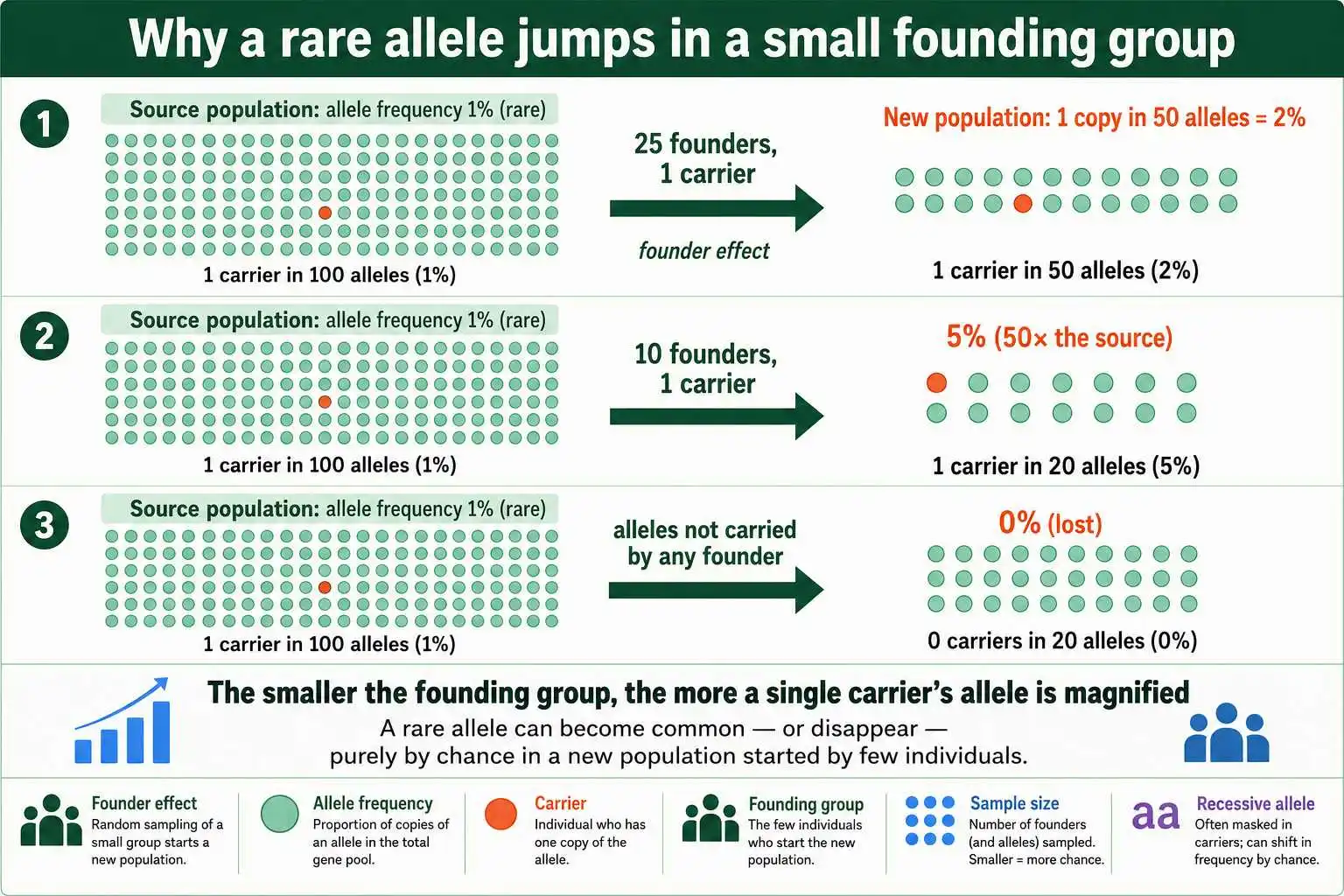 The same logic explains why alleles common in the source can vanish entirely from the founders, if none of the few founders happened to carry them. Chance, operating through small numbers, reshapes the entire genetic profile.
How Scientists Detect a Founder Effect
Scientists detect a founder effect by comparing a population's allele frequencies and genetic diversity to those of its presumed source population. A founder population typically shows lower overall diversity and elevated frequencies of specific alleles that trace back to the original founders.
One telltale sign is shared ancestral haplotypes. A haplotype is a set of DNA variants inherited together on the same chromosome. When many affected individuals in a population carry the identical disease-causing variant on the same surrounding stretch of DNA, it strongly suggests they all inherited it from a single common ancestor, a founder. This is exactly the pattern seen in the Afrikaner Huntington's cases, where over 200 affected people trace to one seventeenth-century progenitor. Identical haplotypes are a genetic fingerprint of common descent.
Detailed genealogical records strengthen the evidence further. Populations like the Amish and the French Canadians of Quebec keep extensive family histories, allowing researchers to trace specific alleles back through the generations to the founding individuals. This combination of genetic data and genealogy makes founder populations exceptionally valuable for studying inherited disease. By identifying the founder and the elevated allele, researchers can develop targeted carrier screening for that community, turning an understanding of the founder effect into practical medical benefit. The reduced diversity and elevated allele frequencies are measurable signatures that distinguish a founder population from a large, randomly mating one.
Frequently Asked Questions
What is the founder effect in simple terms?
The founder effect is the loss of genetic variation that happens when a small group starts a new population. The few founders carry only a limited, random sample of the original gene pool, so the new population is less diverse and can have very different allele frequencies from the source.
What causes the founder effect?
The founder effect is caused by the random sampling of alleles when a small group migrates and establishes a new population. Because the founders are few and non-representative, their gene pool misrepresents the source, and isolation afterward preserves and amplifies the distinctive allele frequencies.
What is the difference between the founder effect and a bottleneck?
The founder effect happens when a few individuals leave to start a new population, while a bottleneck happens when an existing population crashes in size. Both are forms of genetic drift that shrink the gene pool, but one involves migration and the other involves a catastrophe in place.
Why do founder populations have more genetic disorders?
Because a rare disease allele carried by a founder starts at a much higher frequency in the small new population than in the large source. Isolation and intermarriage then keep that allele common, so disorders rare elsewhere appear far more often in the founder population.
A Handful of Founders, A Lasting Mark
The founder effect is the loss of genetic variation that occurs when a small group establishes a new population, carrying only a chance sample of the original gene pool. As a form of genetic drift, it works by randomness rather than fitness, often raising the frequency of rare alleles, including disease-causing ones. The Amish, Afrikaners, Pingelapese, and other founder populations show the same pattern: a few founders, preserved by isolation, set the genetic makeup for everyone who follows.
The lasting insight is that history and chance, not just adaptation, shape a population's genetics. A single founder carrying a rare allele can make a condition common centuries later, simply because of who happened to be in the founding group. You can explore how founding group size affects allele frequencies with the genetic drift simulator, watching small founder populations diverge from their source by chance alone. For an authoritative overview of the founder effect and its examples, this reference from ScienceDirect is a thorough resource, and the MicrobeNotes guide to the founder effect offers a clear summary with examples.