Monohybrid Cross: How to Get the 3:1 and 1:2:1 Ratios
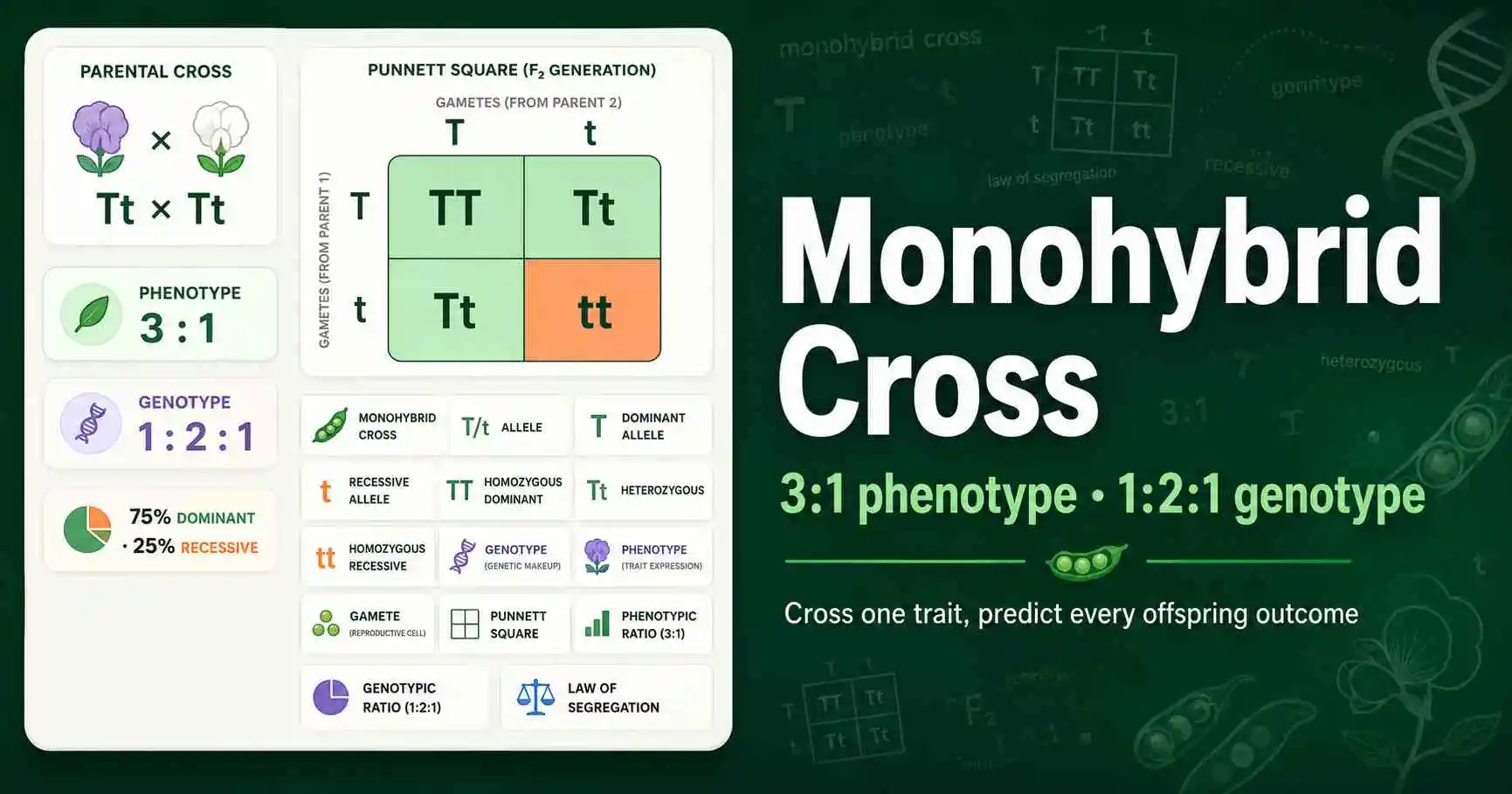
A monohybrid cross is a genetic cross that follows a single trait. When you cross two heterozygous parents, the offspring appear in a 3:1 phenotypic ratio, meaning three show the dominant trait for every one that shows the recessive trait. The genotypic ratio is 1:2:1, meaning one homozygous dominant, two heterozygous, and one homozygous recessive.
Those two numbers, 3:1 and 1:2:1, sit at the center of basic genetics. Almost every inheritance question you meet in school starts here. This guide explains both ratios, shows you exactly how to produce them, and answers the question most pages skip: why do they appear in the first place?
If the grid itself is still new to you, read what a Punnett square is first. To generate any cross without drawing it by hand, use the Punnett Square Calculator. Otherwise, let's break the ratios down.
What Is a Monohybrid Cross?
A monohybrid cross tracks one trait controlled by a single gene with two alleles. The name says it plainly: "mono" for one, "hybrid" for a cross between differing forms. You look at one characteristic, such as plant height or seed color, and ignore everything else.
This is the simplest cross in genetics, and it is the right place to start. Once the single-trait logic clicks, a two-trait dihybrid cross is just the same idea scaled up. Everything in this post uses one trait, so the math stays clean and the patterns stay visible.
Each parent carries two alleles for the trait. A capital letter marks the dominant allele, a lowercase letter the recessive one. The pair a parent carries is its genotype. When the parents reproduce, each passes one allele to each offspring, and the new pairings create the ratios we are about to map out.
The Two Ratios at a Glance
A standard monohybrid cross between two heterozygous parents produces two ratios from the same set of offspring. They describe different things, so keep them separate in your mind.
| Ratio type | Result | What it means |
|---|---|---|
| Phenotypic ratio | 3:1 | 3 offspring show the dominant trait, 1 shows the recessive trait |
| Genotypic ratio | 1:2:1 | 1 homozygous dominant, 2 heterozygous, 1 homozygous recessive |
The phenotypic ratio counts what you can see. The genotypic ratio counts the underlying allele combinations. Both come from the same four boxes of a Punnett square, just read in two different ways. Mixing them up is the single most common mistake students make, so we will keep returning to the difference.
Mendel's Pea Plant Experiment: Where the Ratios Came From
The 3:1 ratio is not an arbitrary rule. Gregor Mendel, an Austrian monk often called the father of genetics, discovered it in the 1860s by breeding thousands of pea plants and counting the results with unusual care. His pea experiments are the reason we know these numbers at all, and walking through them makes the ratios far easier to remember.
Mendel chose pea plants for good reasons. They grow fast, they have clear either-or traits like tall or short, and he could control which plants bred together. Let's follow one of his classic traits: plant height, where tall (T) is dominant over short (t).
The P Generation
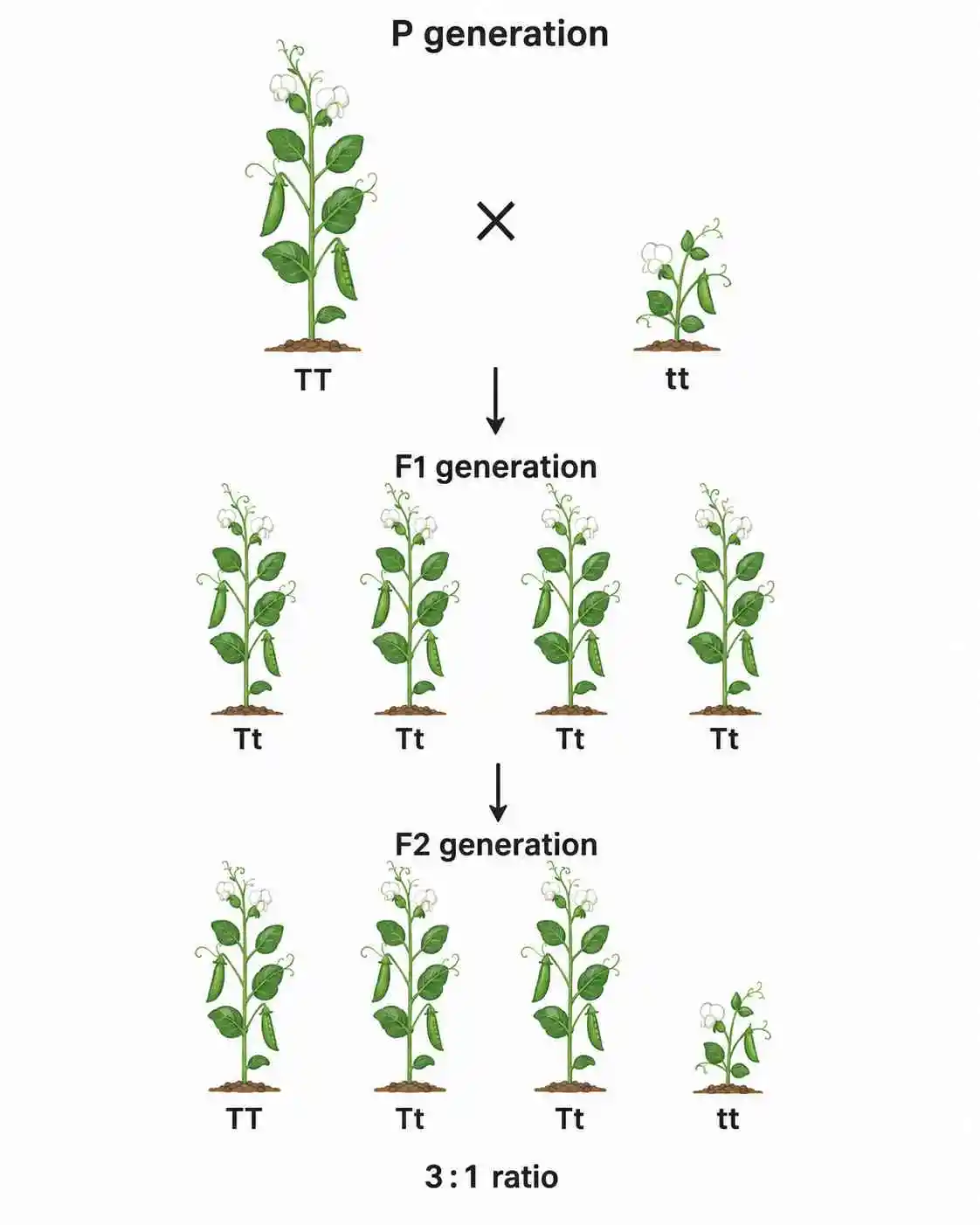
Mendel started with two true-breeding parents. True-breeding means each one was homozygous and always produced offspring like itself. He crossed a homozygous tall plant (TT) with a homozygous short plant (tt). Scientists call these starting plants the P generation, short for parental.
Each TT parent could only pass on a T allele. Each tt parent could only pass on a t allele. So every offspring received one T and one t, making them all Tt.
The F1 Generation
The first batch of offspring is the F1 generation, short for first filial. Every F1 plant had the genotype Tt, which makes it heterozygous. And here is the part that puzzled Mendel: all of them were tall.
The short trait had vanished. Not a single F1 plant was short, even though one parent was. The reason is dominance. Because T is dominant, a single T allele is enough to produce a tall plant, and it masks the recessive t hiding alongside it.
The F2 Generation
Mendel then let the F1 plants self-pollinate, crossing Tt with Tt. The offspring of this cross form the F2 generation, the second filial generation. This is where the short trait came roaring back.
Mendel counted his F2 plants and found that roughly three out of four were tall and one out of four was short. Across all seven traits he studied, he saw the same pattern: about 75 percent showed one form and 25 percent showed the other. That consistent 3:1 split in the F2 generation is the heart of the monohybrid cross. You can read the full account of these experiments in Biology LibreTexts.
How to Get the 3:1 Phenotypic Ratio
Now produce the ratio yourself. The F2 cross is Tt by Tt, and it gives the famous 3:1 split. Here is the process, the same method covered in detail in our guide to filling in a Punnett square step by step.
Start with the gametes. Each Tt parent makes two kinds of gamete, T and t, because the two alleles separate during gamete formation. Write one parent's gametes across the top of a 2x2 grid and the other parent's down the side.
Now fill the four boxes by combining the allele from each row with the allele from each column:
| T | t | |
|---|---|---|
| T | TT | Tt |
| t | Tt | tt |
Read the boxes by phenotype. The genotypes TT, Tt, and Tt all carry at least one dominant T, so all three are tall. Only tt is short. That gives three tall to one short, a 3:1 phenotypic ratio.
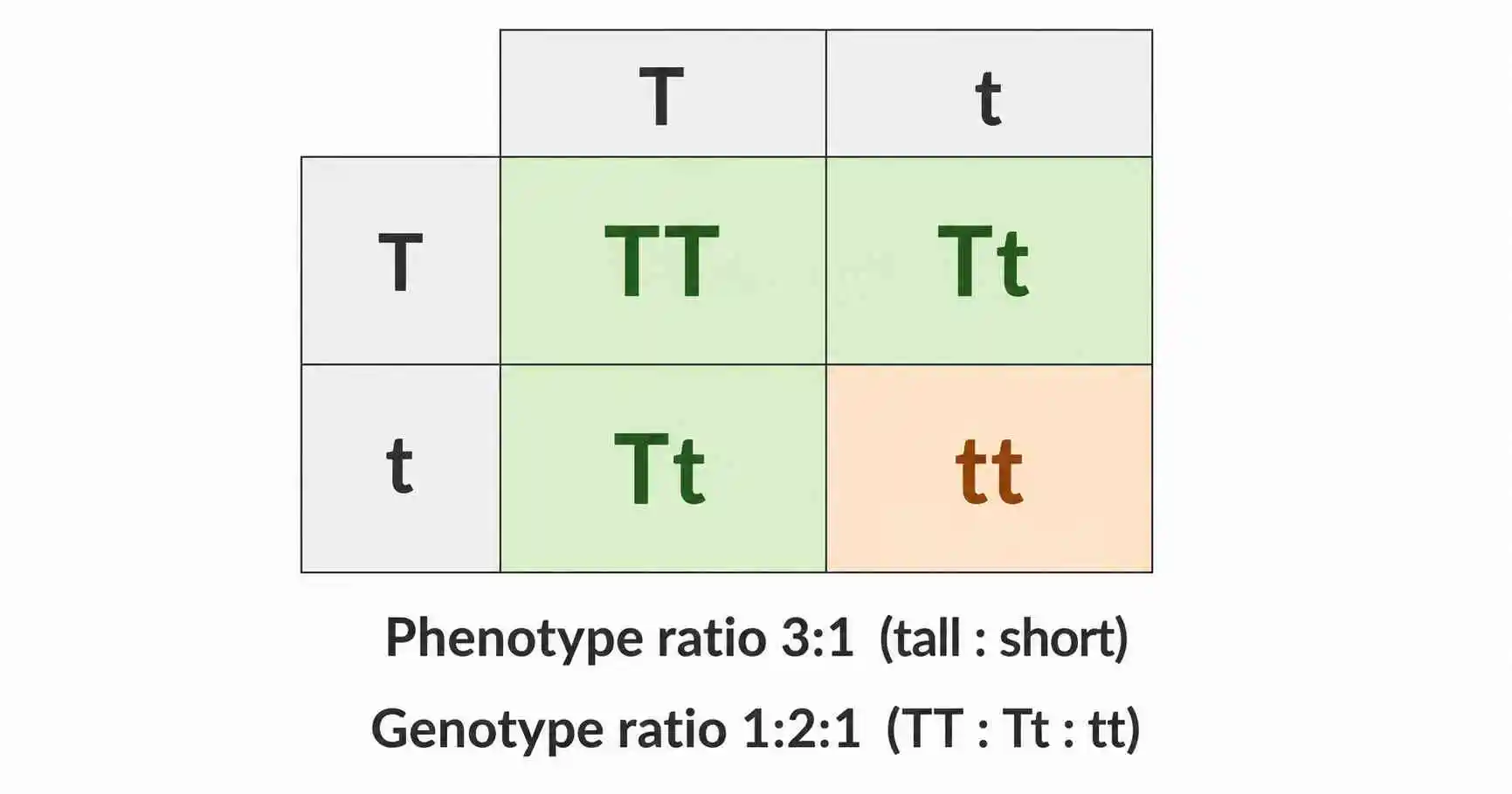
That is the whole trick. Two heterozygous parents, four boxes, three dominant phenotypes, one recessive. The ratio holds for any single trait that follows simple dominance, whether it is pea height, guinea pig coat color, or pea flower color.
How to Get the 1:2:1 Genotypic Ratio
Look at the exact same grid again, but this time count genotypes instead of visible traits. You do not redraw anything. You just read the boxes differently.
Tally the four boxes by their allele combinations. You have one TT, two Tt, and one tt. That is a 1:2:1 genotypic ratio: one homozygous dominant, two heterozygous, one homozygous recessive.
This is why the genotype-versus-phenotype distinction matters so much. The 3:1 phenotype and the 1:2:1 genotype describe the very same offspring. The phenotype ratio groups the two Tt plants and the one TT plant together because they all look tall. The genotype ratio keeps them separate because their allele pairs differ. When a question asks for a ratio, always check which one it wants.
Why Do These Ratios Happen? The Law of Segregation
Here is the mechanism most pages gloss over. The ratios are not luck. They follow directly from Mendel's first law, the law of segregation.
The law of segregation states that the two alleles for a trait separate during gamete formation, so each gamete carries only one allele. A Tt parent does not pass on "Tt." It passes on either T or t, each with a 50 percent chance. You can watch this separation play out in our law of segregation simulator.
Now combine two parents. Each contributes T or t at random, like flipping two coins. There are four equally likely outcomes: T from each parent (TT), T then t (Tt), t then T (Tt), and t from each (tt). Two of those four pairings produce a heterozygote, which is why Tt shows up twice and the genotype ratio lands at 1:2:1.
The phenotype ratio of 3:1 falls out of the same coin flips combined with dominance. Three of the four outcomes include at least one dominant allele, so three of four are tall. The numbers are fixed because the probabilities of each gamete are fixed. That is the real answer to "why 3:1," and it is worth understanding rather than memorizing.
Turning Ratios Into Percentages and Probability
Ratios and percentages say the same thing in different units, and exam questions ask for both. Converting between them takes one step: add the parts of the ratio, then divide each part by that total.
For the 3:1 phenotypic ratio, the parts add to four. Three out of four is 75 percent dominant, and one out of four is 25 percent recessive. For the 1:2:1 genotypic ratio, the parts add to four as well: 25 percent homozygous dominant, 50 percent heterozygous, and 25 percent homozygous recessive.
One caution matters here. These percentages are probabilities, not promises. A Tt by Tt cross gives each offspring a 75 percent chance of being tall, but a small family of four will not always split neatly into three tall and one short. The ratios only emerge clearly across many offspring, which is exactly why Mendel counted thousands of plants. To pull the odds for a specific outcome quickly, use the phenotype probability calculator, or the genotype frequency calculator when you need the genotype breakdown.
The Monohybrid Test Cross (1:1 Ratio)
Not every monohybrid cross gives 3:1. One important variation, the test cross, gives a 1:1 ratio instead, and it solves a real problem.
Imagine a tall pea plant. You can see it is tall, so you know it carries at least one T. But you cannot tell from looking whether its genotype is TT or Tt. The hidden recessive allele leaves no visible sign. A test cross reveals it.
To run one, cross the unknown plant with a homozygous recessive partner (tt). The recessive parent can only pass on t, so the offspring depend entirely on what the unknown parent contributes. Here is the cross for a Tt unknown:
| T | t | |
|---|---|---|
| t | Tt | tt |
| t | Tt | tt |
You get two Tt and two tt, a 1:1 ratio of tall to short. If even one short offspring appears, the unknown parent must have carried a hidden t, so its genotype is Tt. If the unknown had been TT, every offspring would have been tall. The test cross turns an invisible genotype into a visible result. Our test cross calculator handles this cross and reports the ratio for you.
When the Ratio Is Not 3:1
Simple dominance gives the clean 3:1 phenotype ratio, but not every trait plays by those rules. Two common patterns change the phenotype outcome while leaving the genotype ratio untouched.
In incomplete dominance, neither allele fully masks the other, so the heterozygote shows a blended trait. A red flower crossed with a white flower can produce pink. Here the phenotype ratio becomes 1:2:1, because each genotype now looks different. Notice that the genotype ratio is still 1:2:1, the same as always. Only the visible result changed.
In codominance, both alleles show fully at once rather than blending, like the red and white patches on a roan coat. Again the genotype ratio stays 1:2:1 while the phenotype ratio shifts. These patterns deserve their own discussion, but the takeaway here is simple: the 1:2:1 genotype ratio is the constant, and dominance decides what you actually see.
A quick worked example makes this concrete. Snapdragons show incomplete dominance for flower color. A red-flowered plant is RR, a white-flowered plant is rr, and the heterozygote Rr is pink. Cross two pink plants (Rr by Rr) and the grid gives one RR, two Rr, and one rr, the usual 1:2:1 genotypes. But now you count three phenotypes, not two: one red, two pink, one white. The phenotype ratio reads 1:2:1, matching the genotype ratio exactly, because every genotype produces a distinct look. Compare that with simple dominance, where the two heterozygotes would have hidden inside the dominant group. Same cross, same genotypes, different visible result.
Common Mistakes With Monohybrid Ratios
A few errors come up again and again, and all of them are easy to avoid once you know to watch for them.
The first is reporting the wrong ratio. When a question asks for the phenotypic ratio, give 3:1. When it asks for the genotypic ratio, give 1:2:1. Read the question and name which ratio you are using.
The second is expecting real offspring to match the ratio exactly. Ratios describe probability over many offspring, not a rule that every litter or family must obey. Three tall and one short is the expectation, not a guarantee.
The third is forgetting that the ratio depends on the parents. Two heterozygotes give 3:1. A heterozygote crossed with a homozygous recessive gives 1:1. The cross determines the ratio, so always start from the parent genotypes. When you have real counts and want to know whether they fit the expected ratio, run them through a chi-square calculator, which tests observed results against the prediction.
Frequently Asked Questions
Why is the monohybrid cross ratio 3:1?
The 3:1 ratio comes from crossing two heterozygotes. Each parent passes T or t with equal odds, giving four equally likely pairings. Three carry a dominant allele and show the dominant trait, while one is homozygous recessive.
What is the difference between the genotypic and phenotypic ratio?
The phenotypic ratio (3:1) counts visible traits. The genotypic ratio (1:2:1) counts allele combinations. Both come from the same Punnett square, but the phenotype ratio groups all dominant-looking genotypes together.
What is the F2 ratio in a monohybrid cross?
The F2 generation shows a 3:1 phenotypic ratio and a 1:2:1 genotypic ratio. It forms when the all-heterozygous F1 plants are crossed with each other.
What is a monohybrid test cross ratio?
A monohybrid test cross gives a 1:1 ratio. It crosses an organism of unknown genotype with a homozygous recessive partner to reveal whether the unknown carries a hidden recessive allele.
Is the monohybrid ratio always 3:1? No. The 3:1 ratio applies to two heterozygotes under simple dominance. Test crosses give 1:1, and patterns like incomplete dominance shift the phenotype ratio to 1:2:1.
Put the Ratios to Work
You now know both monohybrid ratios, where they come from, and how to produce them. The 3:1 phenotype and 1:2:1 genotype both fall out of one Tt by Tt cross, driven by the law of segregation and shaped by dominance. The test cross gives 1:1 and exposes hidden genotypes.
Practice a few crosses by hand so the logic sticks, then speed things up with the Punnett Square Calculator. When you are ready for two traits at once, move on to the dihybrid cross and the 9:3:3:1 ratio, which builds directly on everything here. For more background on Mendel's principles, the Nature Education overview is a strong next read.