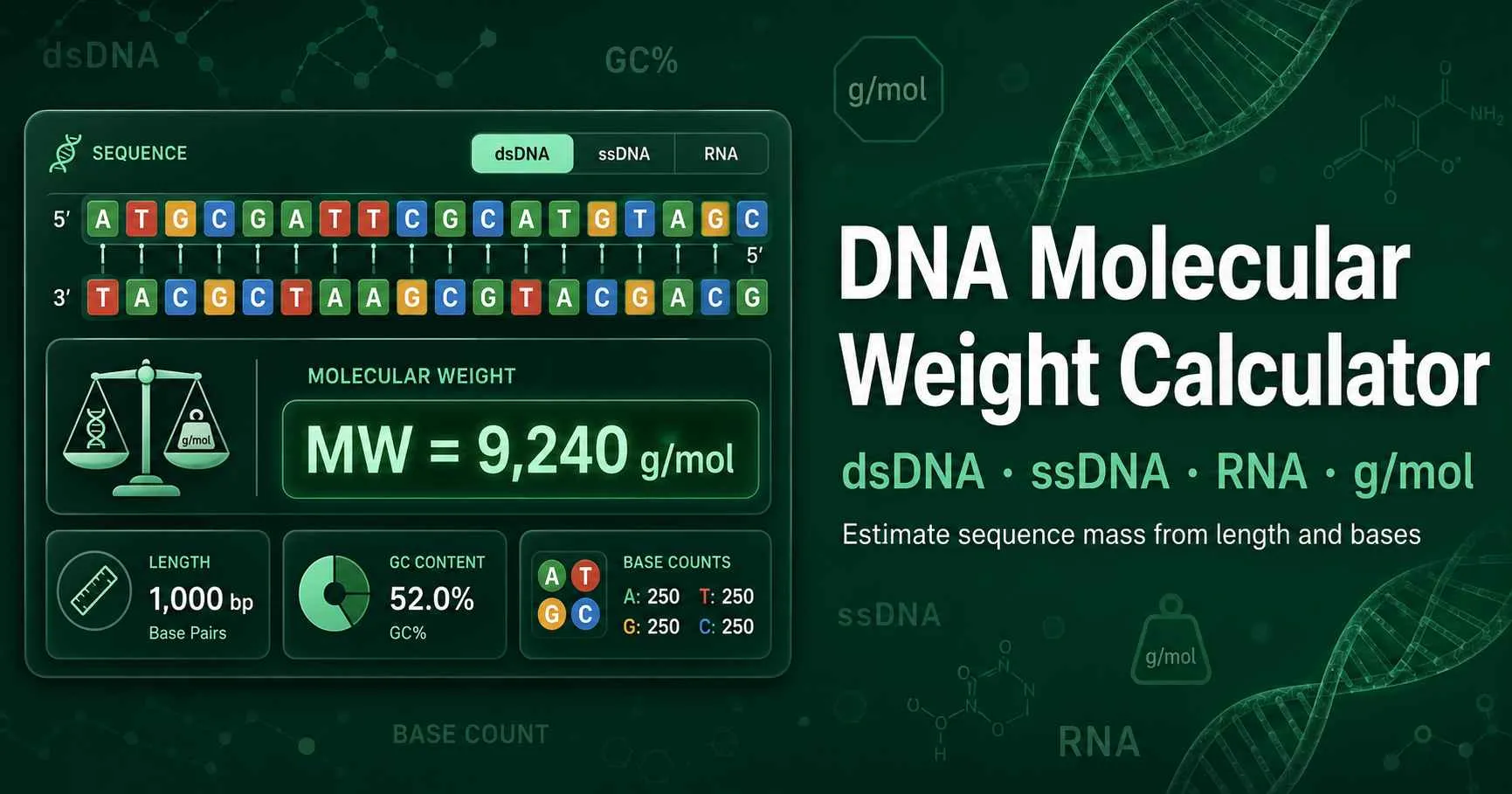
DNA Molecular Weight Calculator

Calculate DNA molecular weight from sequence, base counts, or molecule type. Use the result to convert ng/µL into nM, pmol, copies/µL, and reaction input mass. This tool helps students, PCR users, qPCR users, and cloning workflows connect sequence composition with lab-ready concentrations.

DNA molecular weight calculator for oligos, PCR products, and RNA

Start with Basic mode for sequence-to-molecular-weight conversion. Switch to Advanced mode when you need exact molecular weight overrides, target pmol planning, and full conversion outputs.

DNA molecular weight calculator inputs

Paste a sequence, choose the molecule type, and add concentration when you need molarity or copy-number outputs.

Lab conversion settings

Use these fields when you need nM, pmol, copy number, or reaction input mass.

Live result

Double-stranded DNA molecular weight = 87,616.9 g/mol

The sequence contains 142 base pairs with 49.3% GC content.

Nucleotide composition used for molecular weight calculationBase compositionATGCA: 35T: 37G: 35C: 35

Length

142

base pairs in the duplex

GC content

49.3%

G and C bases as a share of length

Concentration

114.13 nM

0.114 pmol/µL from 10 ng/µL

Copy number

6.873e+10/µL

molecules per microlitre from mass and MW

Mass, moles, and reaction setup

µg per nmol: 87.617 µg/nmol

pmol per µg: 11.413 pmol/µg

Total sample mass: 200 ng

Total sample amount: 2.283 pmol

Mass per reaction: 20 ng

Copies per reaction: 1.375e+11

Target amount planner

Use this output when an order form, ligation setup, or sequencing protocol asks for pmol instead of ng.

Mass needed

876.169 ng

for 10 pmol

Volume needed

87.617 µL

from your concentration input

DNA molecular weight calculator diagram showing base composition, nucleotide mass, GC content, ng per microlitre to nM conversion, and molecule copy number
Figure 1. A DNA molecular weight calculation links nucleotide identity, base composition, strand type, and measured concentration. The same sequence can support primer ordering, qPCR standard preparation, ligation planning, and copy-number dilution when the tool reports g/mol, nM, pmol, and copies/µL together.

DNA molecular weight tells you how much one mole of a sequence weighs

DNA molecular weight answers a direct lab question: how heavy is one mole of this sequence? The answer uses grams per mole, written as g/mol. Once you know that value, you can convert between mass, molarity, pmol, and molecule copy number.

Sequence composition matters because adenine, thymine, guanine, cytosine, and uracil have different molecular weights. A 20 nt primer with high G content weighs slightly more than a 20 nt primer with high C content. The difference looks small, but it changes nM concentration when you prepare short oligos or qPCR standards.

Use double-stranded DNA for PCR amplicons, plasmid fragments, restriction fragments, and genomic DNA regions. Use single-stranded DNA for primers, probes, adapters, and synthetic oligos. Use single-stranded RNA for transcripts, sgRNA, siRNA, and RNA standards.

DNA Molecular Weight Calculator components and what each input means

Each input changes a different part of the calculation. Use the table before you change advanced settings.

Tool componentWhat it controlsWhen to use it
Molecule typeChooses dsDNA, ssDNA, or ssRNA base masses.Use dsDNA for PCR products and ssDNA for primers.
Sequence inputCounts A, T, U, G, and C bases from pasted sequence.Use it when you know the exact sequence.
Base-count modeUses manual base counts instead of a sequence string.Use it for fragments reported only by composition.
ConcentrationConverts mass concentration into nM, pmol/µL, and copies/µL.Use it after Qubit, NanoDrop, or vendor concentration reports.
Exact MW overrideReplaces the base-composition estimate with a vendor value.Use it for labelled, phosphorylated, or chemically modified oligos.

DNA molecular weight formula used for sequence-based conversion

Single-stranded DNA molecular weight

The calculator multiplies each base count by its nucleotide mass, then adjusts the terminal chemistry. IDT lists molecular weight as one of the standard outputs in its OligoAnalyzer workflow, along with GC content, Tm, extinction coefficient, µg/OD, and nmol/OD.

Check IDT OligoAnalyzer reference

Mass to moles conversion

Moles equal mass divided by molecular weight. Thermo Fisher’s DNA and RNA molecular-weight tables show base-specific formulas for nucleic acid conversions, which supports the same sequence-composition approach used here.

Read Thermo Fisher MW conversions

Core conversion equations

moles = grams / molecular weight

pmol/µL = ng/µL × 1000 / MW

copies/µL = mol/µL × 6.02214076 × 10²³

DNA molecular weight examples for primers and qPCR standards

Example 1: 20 nt primer stock

A student enters the primer sequence ATGCGTACGTTAGCCTAGCA and chooses single-stranded DNA. The sequence has 20 nucleotides and 50% GC content. The calculator reports molecular weight in g/mol, then converts a 100 ng/µL primer stock into nM and pmol/µL.

That output answers the practical question: how much primer stock enters a PCR reaction? If the stock contains about 15 pmol/µL, then 1 µL adds about 15 pmol of primer. A PCR setup can then use the PCR Master Mix Calculator to place that volume into a full reaction table.

Example 2: 150 bp qPCR amplicon

A qPCR standard uses a 150 bp double-stranded DNA amplicon at 10 ng/µL. The calculator treats the sequence as dsDNA and reports molecular weight, nM concentration, and copies/µL. That copy number tells you how many template molecules enter each dilution step.

A copy-number dilution series needs both molecular weight and concentration. After calculating copies/µL here, use the DNA Copy Number Calculator when you want a target such as 10⁶, 10⁵, or 10⁴ copies/µL.

DNA molecular weight results and how to use each value

ResultMeaningBest use
g/molMass of one mole of the molecule.Convert between grams, moles, pmol, and ng.
nMNanomolar concentration from ng/µL and MW.Prepare primer, adapter, and qPCR working stocks.
copies/µLNumber of molecules in each microlitre.Plan qPCR standards, plasmid standards, and template dilution.
GC%Share of bases that are G or C.Check sequence composition before using the GC Content Calculator for deeper sequence analysis.

DNA molecular weight Basic mode versus Advanced mode

Use Basic mode for everyday sequence conversion

Basic mode gives length, GC content, molecular weight, nM, pmol/µL, and copies/µL from the fewest inputs. It suits classroom problems, primer checks, and quick PCR product calculations.

Use Advanced mode for modified oligos and ordering math

Advanced mode adds exact MW override, target pmol planning, full base-count reporting, and CSV export. Use it when a vendor gives a modified oligo molecular weight or when you need a record for a lab notebook.

DNA Molecular Weight Calculator FAQs

How do I calculate DNA molecular weight from a sequence?

Paste the DNA sequence and choose double-stranded DNA or single-stranded DNA. The calculator counts A, T, G, and C bases, then sums the base-specific molecular weights. Double-stranded DNA uses the entered strand and its complementary strand. This gives a base-composition estimate instead of a rough length-only estimate such as 660 g/mol per base pair.

What is the difference between ssDNA and dsDNA molecular weight?

Single-stranded DNA contains one nucleotide chain, so its molecular weight depends on the A, T, G, and C bases in that strand. Double-stranded DNA contains the sequence plus its complementary strand, so its molecular weight is roughly twice as large for the same entered length. PCR products, plasmids, and genomic fragments usually use the dsDNA setting. Primers and probes usually use the ssDNA setting unless the vendor reports a modified structure.

Can I use this calculator for RNA molecular weight?

Yes. Choose single-stranded RNA and use U instead of T in the sequence. RNA bases have different molecular weights because ribose contains a 2′ hydroxyl group and uracil replaces thymine. Use the RNA setting for transcripts, synthetic RNA oligos, guide RNAs, siRNAs, and in vitro transcription products. Use a vendor-reported exact MW when the RNA contains chemical modifications.

How do I convert ng/µL to nM for DNA?

Enter the sequence or base counts, then type the measured concentration in ng/µL. The calculator first converts ng/µL into grams per microlitre. It then divides by molecular weight to get moles per microlitre and reports the result as nM. This conversion helps with primer stocks, qPCR standards, NGS libraries, and ligation planning.

Why does GC content affect molecular weight?

G, C, A, and T do not have identical molecular weights. G contributes more mass than C, while A and T sit between those values. Two DNA fragments with the same length can therefore have slightly different molecular weights when their base compositions differ. The difference matters most for short oligos, modified primers, and precise molarity conversions.

Should I use average 660 g/mol per bp or exact base composition?

Use 660 g/mol per bp for a quick double-stranded DNA estimate when you only know length. Use exact base composition when you have the sequence and need better molarity, copy number, or ordering calculations. The exact method helps most with short PCR products, oligos, adapters, and synthetic fragments. Long genomic fragments usually tolerate the average estimate better because base differences average out.

Can this tool calculate copy number from molecular weight?

Yes. The calculator converts concentration and molecular weight into molecules per microlitre using Avogadro’s constant. That output helps you prepare qPCR standards, spike-in controls, sequencing libraries, and template dilution series. For qPCR standards, use the exact amplicon or plasmid length and confirm the measured concentration with a suitable quantification method.

What should I enter for modified oligos?

Use the Advanced mode and enter the exact molecular weight from your oligo supplier. Fluorophores, quenchers, phosphorothioate bonds, 5′ phosphate, locked nucleic acids, and other modifications change the final mass. The base-composition formula does not know those modifications unless you override the molecular weight. Keep the sequence in the tool so GC content and length remain visible.