What Is an Oligonucleotide?
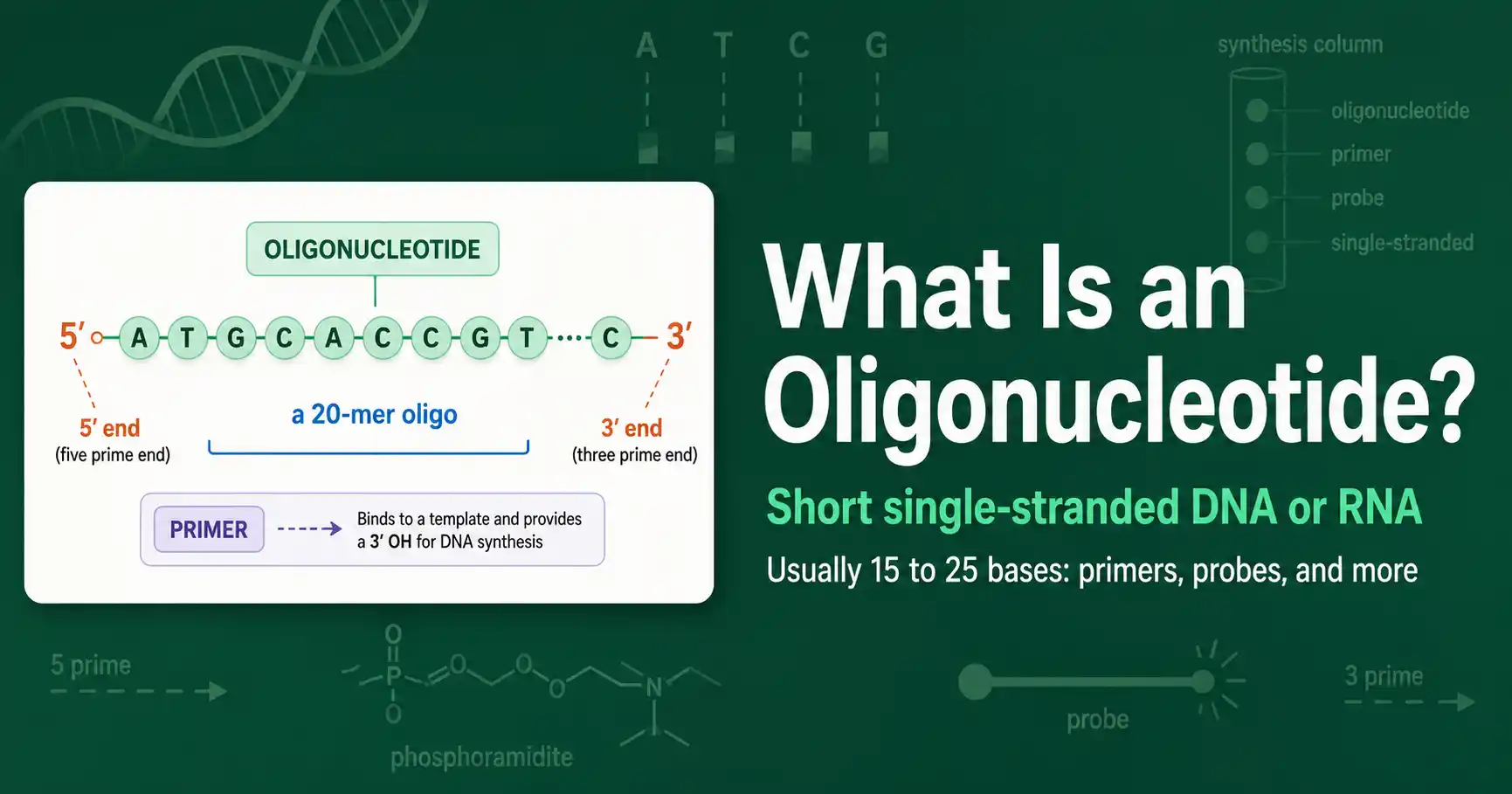
An oligonucleotide is a short, single-stranded piece of DNA or RNA, usually made synthetically in a lab. Most oligos used in molecular biology run about 15 to 25 bases long, though they range from 5 to over 120. They are the everyday workhorses of the lab: PCR primers, sequencing primers, and hybridization probes are all oligonucleotides.
This guide explains what an oligonucleotide is, how it is built, the units its length and amount come in, and where it gets used at the bench. It is the starting point for working with oligos, and it sets up the practical calculations in the rest of this series. To check the properties of a specific sequence as you read, our oligo analyzer computes them instantly.
The Short Definition
An oligonucleotide, or oligo, is a short chain of nucleotides, the building blocks of DNA and RNA. The word comes from the Greek "oligo," meaning few, so an oligonucleotide is literally a "few-nucleotide" molecule, in contrast to the millions of bases in a chromosome.
Each nucleotide in the chain carries one of the four bases. For DNA oligos these are adenine, thymine, cytosine, and guanine, written A, T, C, and G. For RNA oligos, uracil (U) replaces thymine. The sequence of these bases is what defines the oligo and what gives it its function, because that sequence determines which other piece of DNA or RNA it will pair with.
Two features set oligos apart from the DNA in a cell. They are short, tens of bases rather than millions, and they are usually single-stranded, a single chain rather than the familiar double helix. Being single-stranded is what lets an oligo seek out and bind its complementary sequence, which is the basis of nearly everything oligos are used for.
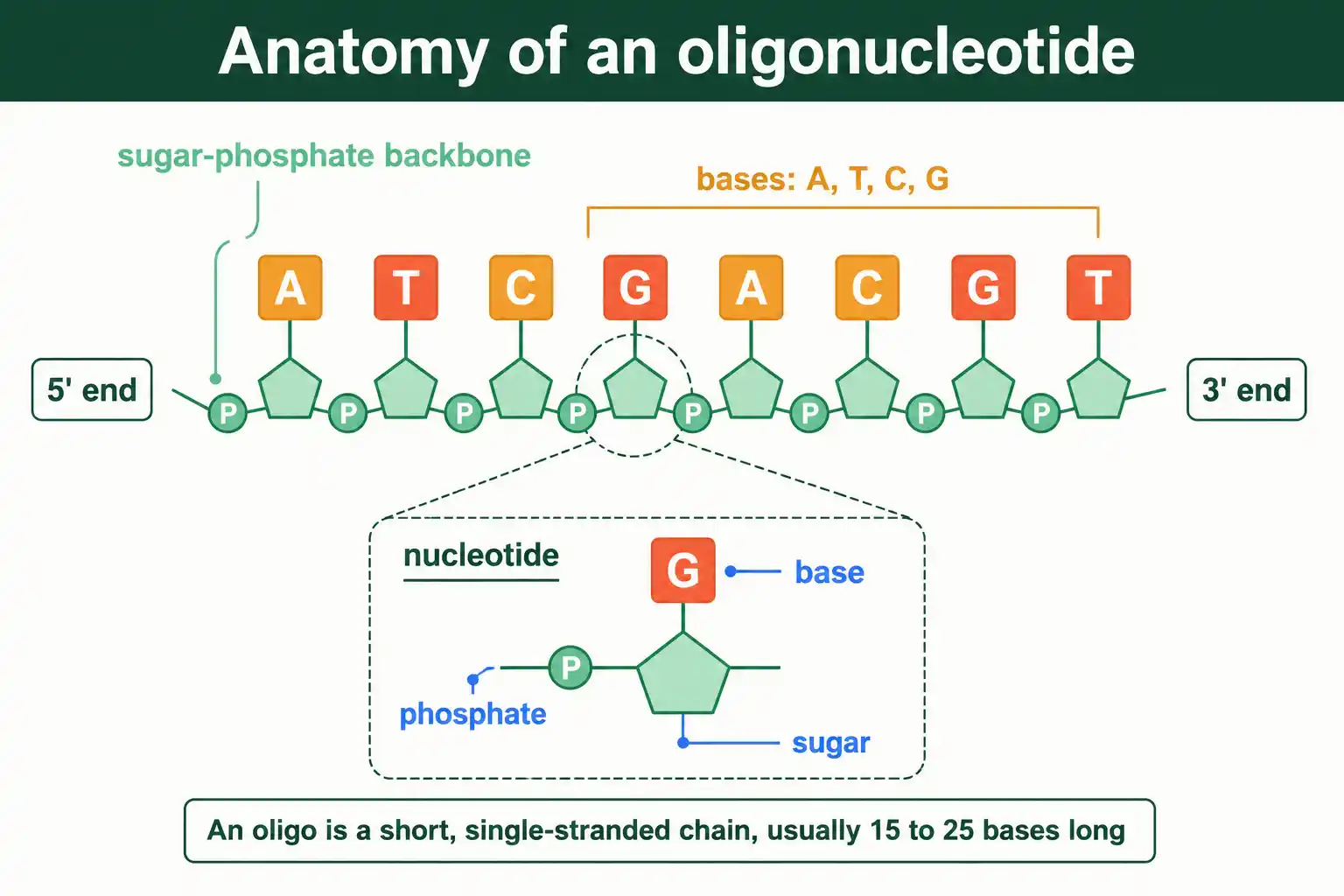
It helps to picture the chain itself. Each nucleotide has three parts: a sugar, a phosphate group, and one of the four bases. The sugar and phosphate of neighboring nucleotides link together to form the backbone, a repeating sugar-phosphate-sugar-phosphate rail, while the bases stick out from that rail like rungs. In an oligo, this backbone is a single rail rather than the two rails of a double helix, and the exposed bases are free to pair with a matching strand. The difference between a DNA oligo and an RNA oligo lies in the sugar: DNA uses deoxyribose, RNA uses ribose, which carries one extra oxygen and makes RNA less stable.
How Oligonucleotides Are Made
Oligonucleotides are made by chemical synthesis, not extracted from cells. The dominant method is solid-phase phosphoramidite synthesis, which builds the chain one base at a time on a solid support.
The process runs in repeated four-step cycles. Each cycle adds a single nucleotide to the growing chain, and the machine repeats the cycle once per base in the sequence you ordered. The chain is built in the 3' to 5' direction, the opposite of how a cell's enzymes copy DNA, and it grows while anchored to a solid bead, usually controlled-pore glass or polystyrene. The phosphoramidite chemistry behind this was developed by Marvin Caruthers and colleagues in the early 1980s, and it remains the standard because it is fast, accurate, and cheap. The Wikipedia overview of oligonucleotide synthesis covers the chemistry in more depth.
Synthesis has limits worth knowing. Each cycle is efficient but not perfect, so a small fraction of chains fail to extend at each step. Those small losses compound, which is why yield drops and errors rise as the oligo gets longer. This is the practical reason most oligos are short: a 20-base primer synthesizes cleanly, while a 150-base oligo is far harder to make in good yield. After synthesis, the oligo is cleaved from the support, deprotected, and usually desalted or purified before shipping.
For most routine oligos, standard desalting is enough, since it removes the small-molecule byproducts of synthesis. Longer oligos, probes, and any sequence where every molecule must be full-length benefit from extra purification such as HPLC or polyacrylamide gel purification, which removes the shorter failure products that accumulate during synthesis. The purification level is something you choose when ordering, and it trades cost and yield against purity.
Measuring Length and Amount
Oligonucleotides are described by two different numbers that beginners often confuse: length and amount. Keeping them straight is essential for using an oligo correctly.
Length is measured in bases, or nucleotides, abbreviated "nt" or "mer." A 20-base oligo is called a 20-mer. Length tells you about the sequence and how the oligo will behave, its melting temperature, its specificity, but it says nothing about how much you have.
Amount is measured in moles or mass. When you order an oligo, the yield is typically reported in nanomoles (nmol) of molecules and in optical density units (OD260), a measure based on how much ultraviolet light the sample absorbs. To turn these into a usable concentration in micromolar or nanograms per microliter, you have to do a short calculation, which the concentration guide in this series walks through step by step. The key point now is that a tube of oligo has both a length, fixed by the sequence, and an amount, which you convert into a working concentration before use.
What Oligonucleotides Are Used For
Oligonucleotides are everywhere in molecular biology because a short, custom, single-stranded sequence is exactly what so many techniques need. A few uses dominate.
The biggest is as PCR primers. The polymerase chain reaction needs two short oligos, typically 18 to 25 bases, that flank the target region and prime its amplification. Nearly every PCR run depends on a pair of custom oligos. Sequencing primers do the same job for reading a DNA sequence, providing the starting point a sequencing reaction extends from.
Oligos also serve as hybridization probes, labeled oligos that bind a specific target sequence to detect it, used in techniques from Southern blots to fluorescence in situ hybridization. They act as building blocks for gene synthesis, where overlapping oligos are assembled into much longer synthetic DNA. And modified oligos serve as therapeutics, including antisense oligonucleotides and small interfering RNAs that switch specific genes off. Across all of these, the principle is the same: the oligo's sequence is chosen to pair with a specific target, and that pairing does the work.
The list keeps growing as new methods appear. Oligos serve as the guide-RNA scaffolds and repair templates in CRISPR genome editing, as molecular barcodes that tag individual samples or cells in high-throughput sequencing, and as the capture probes that pull down target regions in targeted sequencing panels. Diagnostic tests, including many rapid pathogen assays, rely on oligo primers and probes to detect a specific genetic signature. What unites this expanding list is that each application needs a short, made-to-order sequence that recognizes one target among billions of bases, which is exactly what an oligo provides.
Oligo Modifications
Many oligos are chemically modified to do things a plain DNA strand cannot. Modifications are added during or after synthesis, and they greatly expand what oligos can do.
The most common modification is a label, such as a fluorescent dye on one end, which lets a probe be detected in real-time PCR or imaging. Another common class is backbone modifications, like phosphorothioate linkages, which replace an oxygen in the backbone with sulfur to make the oligo resist degradation by nucleases. This nuclease resistance is what makes therapeutic oligos stable enough to survive in the body. Other modifications add chemical groups for attaching the oligo to a surface, quenchers for probe designs, or altered bases that bind more tightly. The vendor guide from Integrated DNA Technologies on oligo modifications catalogs the common options. For most routine work, though, an unmodified oligo is all you need.
Reading an Oligo Sequence
An oligo sequence is always written in a specific direction, and getting that direction right matters at the bench. By convention, a sequence is written 5' to 3', left to right, the same direction a polymerase reads a template to build a new strand.
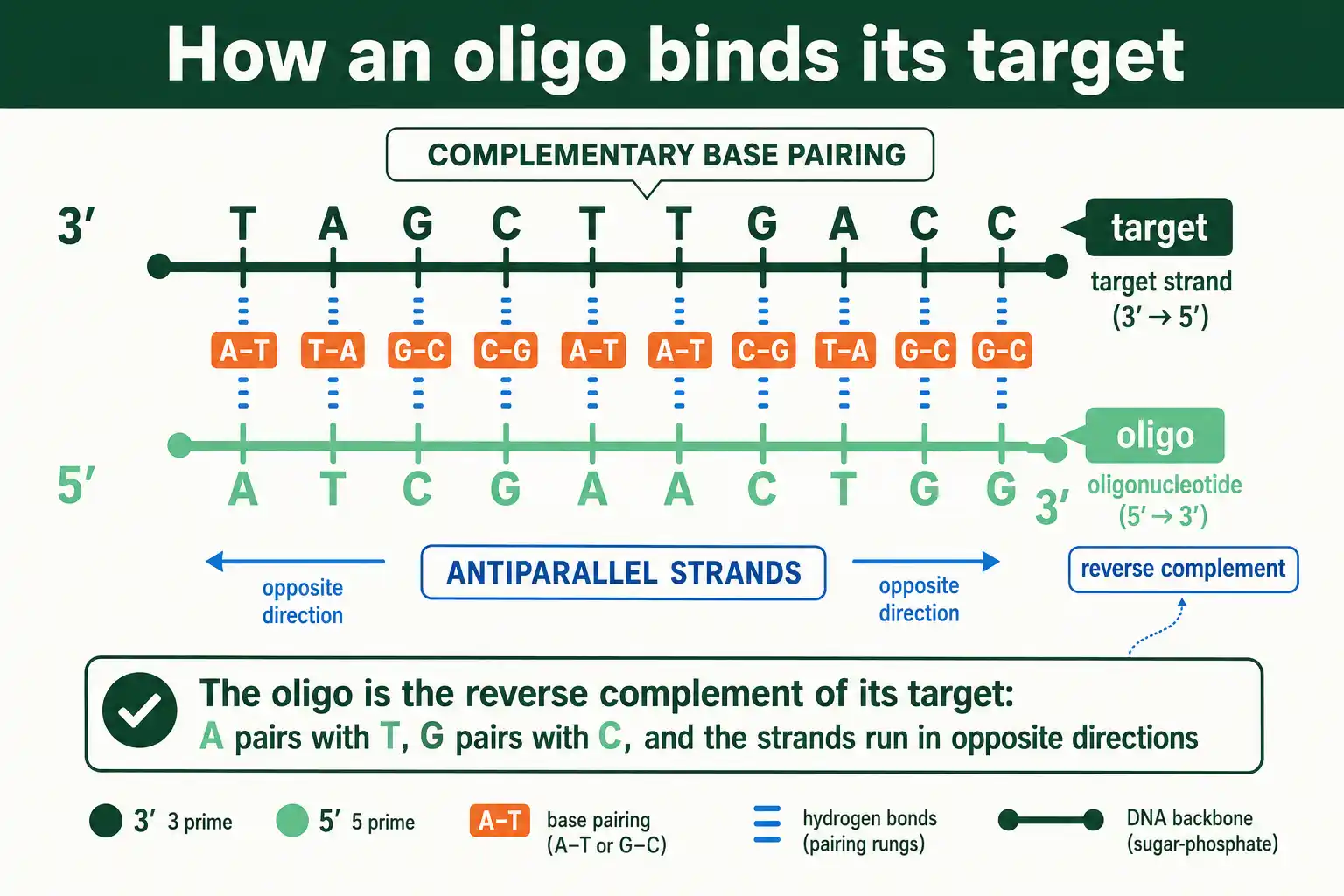
The 5' and 3' labels refer to carbon positions on the sugar backbone, and they give the strand its orientation. This matters because an oligo binds its target by complementary base pairing in an antiparallel arrangement: the oligo's 5' end aligns with the target's 3' end, and A pairs with T while G pairs with C. So to design an oligo that binds a given target, you take the target sequence, find its complement, and reverse it, producing the reverse complement. This step is so routine that it is usually automated; our reverse complement tool does it for any sequence in one step.
Direction also affects how modifications are described. A label noted as 5' sits on one specific end of the oligo, not the other, so a 5'-FAM probe and a 3'-FAM probe are different molecules. Keeping the 5'-to-3' convention straight prevents ordering the wrong sequence or placing a modification on the wrong end, both common and avoidable mistakes.
Frequently Asked Questions
What is the difference between an oligonucleotide and a primer?
A primer is a type of oligonucleotide. The word oligonucleotide refers to any short single-stranded DNA or RNA sequence, while a primer is an oligo used specifically to start DNA synthesis, as in PCR or sequencing. So all primers are oligonucleotides, but oligos are also used as probes, building blocks, and therapeutics, not just as primers.
How long is a typical oligonucleotide?
Most oligos used in molecular biology are 15 to 25 bases long, with PCR primers usually 18 to 25 bases. The full range runs from about 5 bases to over 120, but longer oligos are harder to synthesize in good yield, so short oligos are far more common in routine lab work.
Are oligonucleotides DNA or RNA?
They can be either. An oligonucleotide is any short single-stranded chain of nucleotides, so it may be DNA, with the bases A, T, C, and G, or RNA, with U replacing T. DNA oligos are the most common in everyday lab use, such as PCR primers, while RNA oligos appear in applications like small interfering RNA.
Putting Oligos to Work
An oligonucleotide is a short, single-stranded, usually synthetic piece of DNA or RNA, most often 15 to 25 bases long. It is made by solid-phase phosphoramidite synthesis one base at a time, defined by its base sequence, and described by both a length in bases and an amount in moles or mass. Those two numbers, length and amount, are the foundation of every practical calculation that follows.
Oligos earn their central place in the lab because a short custom sequence is exactly what PCR, sequencing, hybridization, gene synthesis, and oligo therapeutics all rely on. The next step is turning the amount a vendor ships into a working concentration, which our guide on how to calculate oligo concentration covers, followed by how to resuspend and dilute oligos for use at the bench.