How to Calculate Oligo Concentration
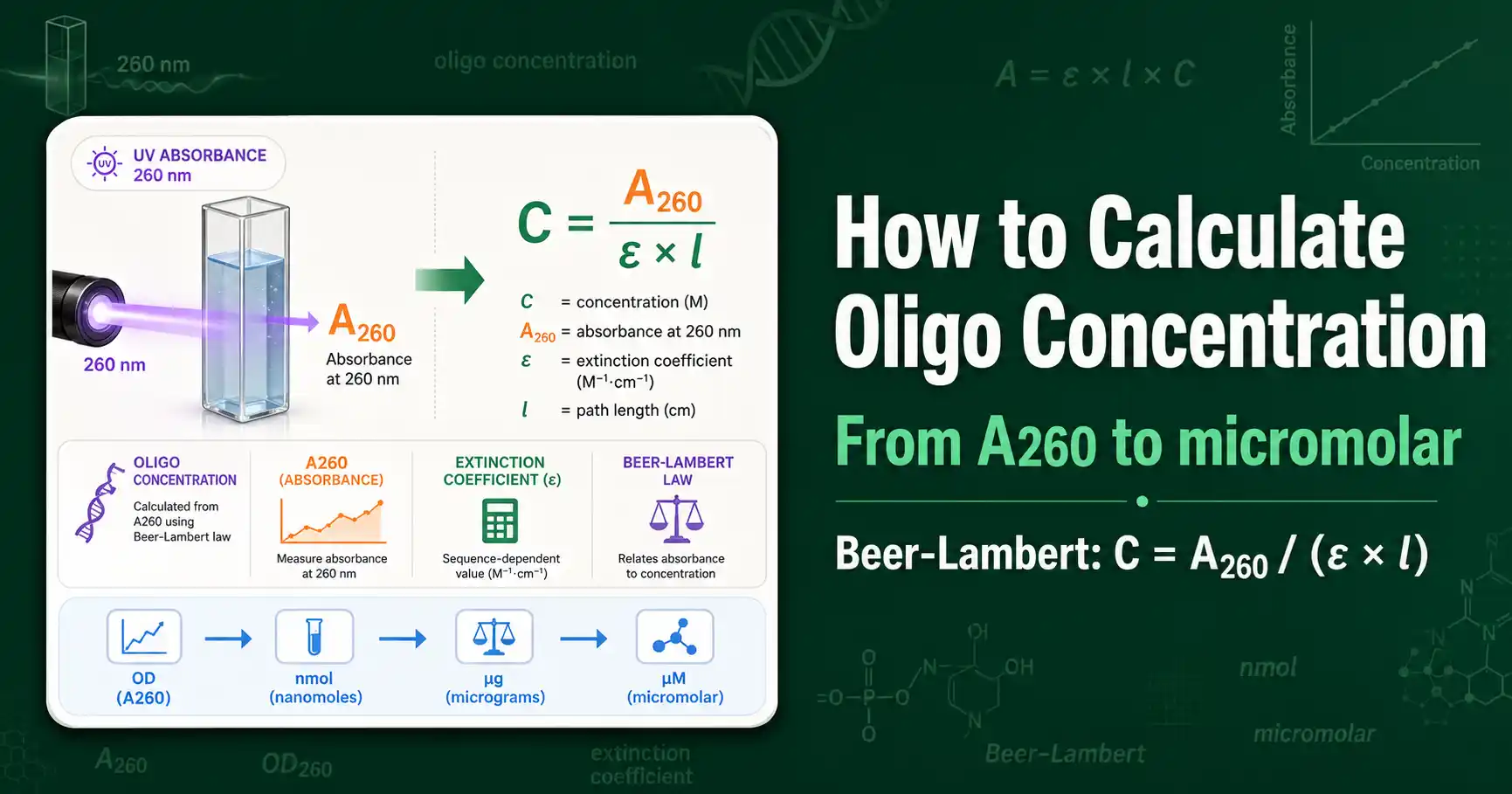
To calculate the concentration of an oligonucleotide, measure its absorbance at 260 nm and divide by the extinction coefficient and the path length, following the Beer-Lambert law. The result is the molar concentration. From there, simple conversions give you the amount in nanomoles, micrograms, or a working concentration in micromolar.
This guide walks through the whole process: reading the A260, finding the extinction coefficient, applying the Beer-Lambert law, and converting between every unit a vendor or protocol might use. It includes worked examples with real numbers. For the concept of an oligo's length versus its amount, our explainer on what an oligonucleotide is sets it up.
The Core Equation
Oligo concentration comes from the Beer-Lambert law, which links absorbance to concentration. The equation is short:
C = A260 / (ε × l)
Here C is the molar concentration in moles per liter, A260 is the absorbance measured at 260 nm, ε is the molar extinction coefficient in liters per mole per centimeter, and l is the path length of the cuvette in centimeters, almost always 1 cm. With a standard 1 cm path, the equation simplifies to concentration equals A260 divided by the extinction coefficient.
The logic is intuitive. DNA and RNA absorb ultraviolet light at 260 nm, and the more oligo in the sample, the more light it absorbs. The extinction coefficient is the conversion factor that says how strongly a particular oligo absorbs, so dividing the measured absorbance by it returns the concentration. Everything else in this guide is either finding that extinction coefficient or converting the result into other units.
Step 1: Measure the Absorbance at 260 nm
The starting point is an A260 reading from a spectrophotometer. You place the oligo solution in the instrument and record how much 260 nm light it absorbs.
One detail controls accuracy here: the reading must fall in the instrument's linear range. The Beer-Lambert law holds only when absorbance is roughly 1.0 or below, with many sources extending it to about 1.2. Above that, the relationship between absorbance and concentration stops being linear, and the calculated concentration is wrong. If a stock reads too high, dilute it by a known factor, measure the dilution, then multiply the result back by that factor. Always record the dilution factor, because forgetting it is one of the most common quantification errors.
Check purity at the same time. The ratio of absorbance at 260 nm to 280 nm, the A260/A280 ratio, indicates contamination. A clean DNA oligo reads about 1.8, and a value well below that suggests protein or other contaminants are inflating the reading. The A260/A280 purity ratio is a standard quick check before trusting a quantification.
Step 2: Find the Extinction Coefficient
The extinction coefficient, ε260, is unique to every oligo because it depends on the exact sequence. This is the step that trips people up, so it is worth understanding rather than guessing.
Each base absorbs 260 nm light differently, and neighboring bases influence one another, so an oligo's absorbance depends on both its base composition and the order of those bases. The accurate way to capture this is the nearest-neighbor model, which sums contributions from each adjacent pair of bases rather than treating bases in isolation. The nearest-neighbor method is the standard, with an average error around 4 percent, and it is what quality tools use. You can get the exact extinction coefficient for any sequence by entering it into an oligo analyzer, which applies the nearest-neighbor model so you do not have to look up and sum the values by hand.
A rough shortcut exists for quick estimates. A simple approximation sums per-base contributions, and an even rougher rule of thumb says one A260 unit of single-stranded DNA is about 33 micrograms per milliliter. This rule is fine for a back-of-the-envelope check, but it can be off by a wide margin for short oligos, where base composition matters most, so use the sequence-specific coefficient for anything that counts.
Step 3: Convert Between Units
Once you have the concentration, you will often need it in a different unit. Vendors report yield in OD260 and nanomoles; protocols ask for micromolar or nanograms per microliter. A few clean conversions move between them.
The reason so many units exist is that they answer different questions. OD260 is what the spectrophotometer measures directly. Nanomoles count molecules, which is what you care about when a reaction needs a certain number of primer copies. Micrograms and nanograms per microliter measure mass, which is what you care about when loading a gel or a sequencing prep. Micromolar expresses molecules per volume, the working unit for setting up reactions. Moving between them is just arithmetic, but each conversion needs the right bridge: the extinction coefficient links OD to moles, and the molecular weight links moles to mass.
To get the amount in nanomoles from an OD260 value, divide the OD by the extinction coefficient and scale: nmol equals OD260 divided by ε260, times ten to the sixth. To convert that amount to micrograms, multiply by the molecular weight: µg equals molecular weight times nmol, times ten to the minus three. And to express a concentration in micromolar, divide the amount in nanomoles by the volume in milliliters, since one nanomole in one milliliter is one micromolar. These three conversions cover almost every unit change you will meet at the bench.
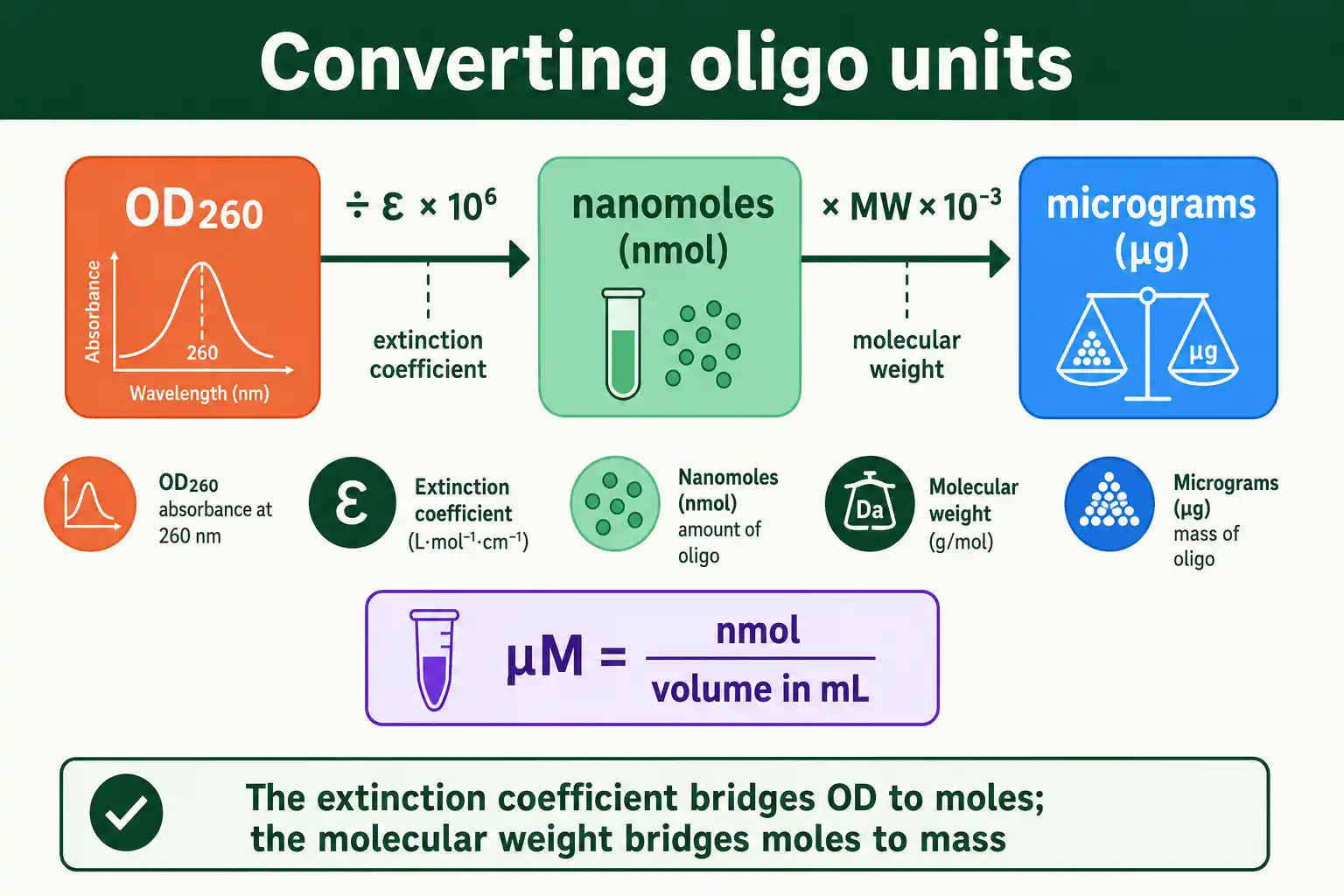
The relationships are worth keeping in one place. The table summarizes them.
| To find | Formula |
|---|---|
| Molar concentration | C = A260 / (ε × l) |
| Amount in nanomoles | nmol = (OD260 / ε260) × 10⁶ |
| Mass in micrograms | µg = MW × nmol × 10⁻³ |
| Concentration in µM | µM = nmol / volume in mL |
| Quick estimate (ssDNA) | 1 A260 ≈ 33 µg/mL |
Worked Example: From OD260 to Micrograms
Numbers make the process concrete. Take a real primer, the M13 Forward sequence, with an extinction coefficient ε260 of 182,800 liters per mole per centimeter and a molecular weight of about 5,559 grams per mole. Suppose you have 1 OD260 unit of it.
Start with the amount in nanomoles. Apply the formula: nmol equals OD260 divided by ε260, times ten to the sixth, which is 1.0 divided by 182,800, times 1,000,000. That works out to about 5.47 nanomoles. So 1 OD260 unit of this primer contains roughly 5.47 nmol of oligo.
Now convert to micrograms. Multiply the molecular weight by the nanomoles and scale: µg equals 5,559 times 5.47, times ten to the minus three, which is about 30.4 micrograms. So 1 OD260 unit of M13 Forward is about 5.47 nmol, or 30.4 µg. Notice the rule-of-thumb estimate of 33 µg per OD is close but not exact, off by a couple of micrograms, which shows why the sequence-specific coefficient matters when precision counts.
Worked Example: Making a Working Concentration
The most common real task is turning a tube of dried oligo into a stock of known micromolar concentration. Say a vendor ships 10 nmol of a primer as a dried pellet, and you want a 100 µM stock.
The math is direct. To reach 100 µM, you need the right volume, because micromolar equals nanomoles divided by milliliters. Rearranged, the volume in milliliters equals nanomoles divided by the desired micromolar: 10 nmol divided by 100 µM gives 0.1 mL, or 100 microliters. So adding 100 µL of buffer to the 10 nmol pellet yields a 100 µM stock. A widely used shortcut follows from this: resuspending an oligo in a microliter volume equal to ten times its nanomole amount always gives a 100 µM stock.
This is exactly the calculation behind preparing stocks, and it connects to the next step of actually resuspending the pellet. Our oligo concentration calculator handles these conversions for any values, and the practical mechanics of getting a pellet into solution follow in the resuspension guide.
Worked Example: Estimating the Extinction Coefficient
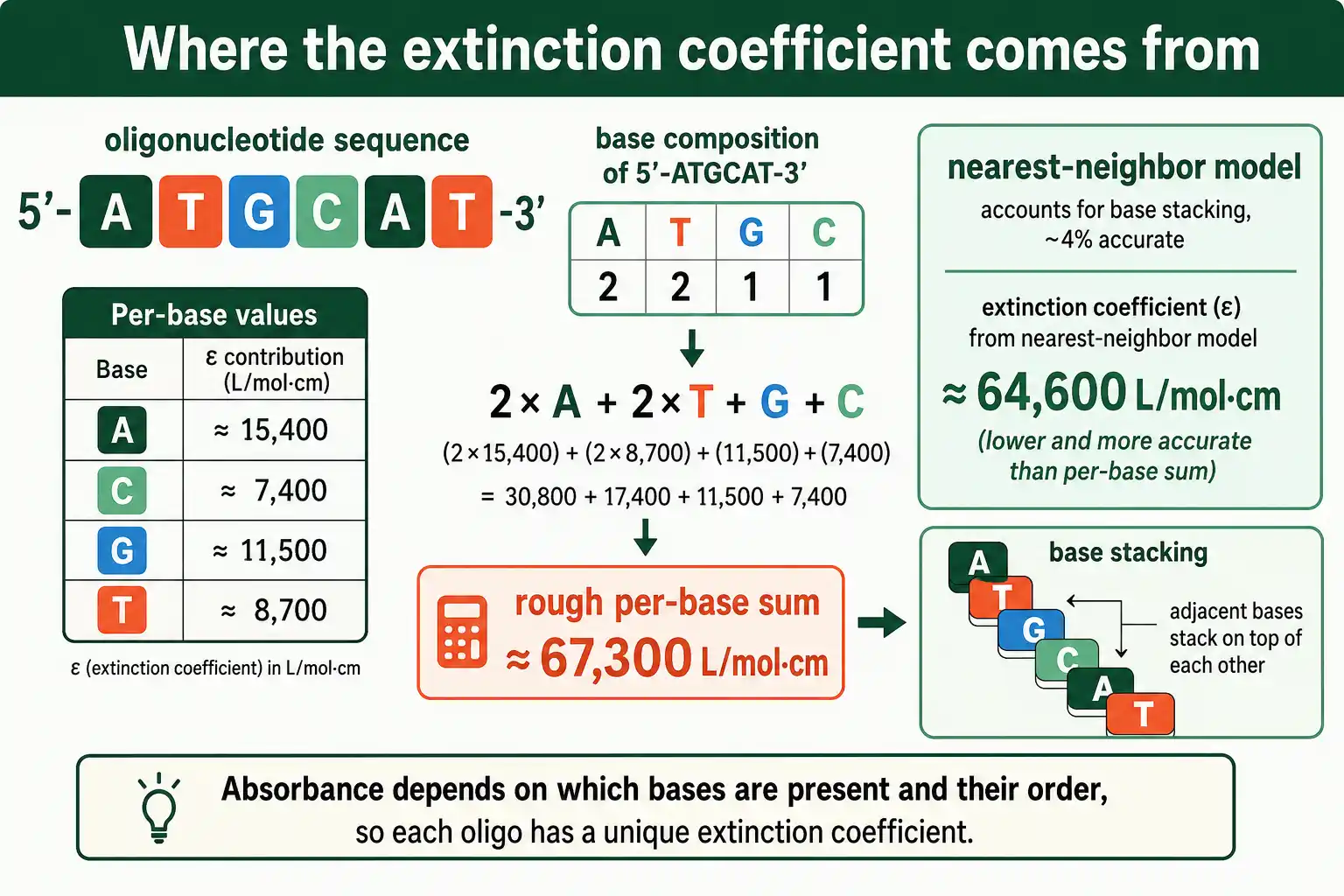
It helps to see roughly where an extinction coefficient comes from, even though a tool does the precise version. The simplest approximation just adds up a per-base contribution for every base in the sequence, using approximate molar values of about 15,400 for adenine, 7,400 for cytosine, 11,500 for guanine, and 8,700 for thymine, in liters per mole per centimeter.
Take a short 6-base oligo, 5'-ATGCAT-3'. Counting bases gives two A, two T, one G, and one C. The rough sum is two times 15,400, plus two times 8,700, plus 11,500, plus 7,400, which totals about 67,300 liters per mole per centimeter. This per-base sum is quick, but it overestimates, because it ignores the fact that stacked neighboring bases absorb less together than they would apart. The nearest-neighbor model corrects for that stacking, which is why it lands a few percent lower and is the method to trust for real work. The takeaway is that you can sanity-check a coefficient by hand, but you should not rely on the per-base sum for a final number.
Converting to Nanograms per Microliter
Many protocols, especially for sequencing and library prep, ask for concentration in nanograms per microliter rather than micromolar. Converting between them needs the molecular weight, because mass and moles are different quantities.
The link is the molecular weight. To go from micromolar to nanograms per microliter, multiply the micromolar concentration by the molecular weight and divide by 1,000, since one micromole of a substance weighs its molecular weight in micrograms. For example, a 100 µM stock of an oligo with a molecular weight of 6,000 is 100 times 6,000 divided by 1,000, which is 600 nanograms per microliter. To go the other way, from nanograms per microliter back to micromolar, divide by the molecular weight and multiply by 1,000. Because the molecular weight depends entirely on the sequence, two oligos at the same micromolar concentration can have quite different mass concentrations, which is exactly why protocols specify which unit they mean.
How the A260 Is Measured
The absorbance reading itself can come from different instruments, and the choice affects accuracy for oligos. Knowing the options prevents a misread before any math begins.
The classic instrument is a cuvette spectrophotometer, which reads a sample in a 1 cm quartz cuvette and needs a few hundred microliters. It is reliable but sample-hungry. Microvolume spectrophotometers, the NanoDrop style, read a 1-to-2 microliter drop held between two surfaces, which is ideal for precious oligo stocks, and they normalize the short path back to a 1 cm equivalent automatically. Both rely on the same Beer-Lambert relationship, so both report a concentration the same way.
There is one important limitation for oligos. UV absorbance at 260 nm cannot tell single-stranded oligo from free nucleotides, degraded fragments, or contaminating nucleic acid, because everything with bases absorbs at 260 nm. For most synthesized oligos this is fine, since the sample is clean. But when an oligo is part of a complex mixture, fluorescence-based methods that use a dye binding only the molecule of interest give a more specific reading, as Thermo Fisher's comparison of nucleic acid quantification methods explains. For routine oligo work, though, the A260 reading and the Beer-Lambert law are the standard and are entirely sufficient.
Common Mistakes
A handful of errors account for most wrong oligo concentrations. Knowing them protects every measurement.
The first is ignoring the linear range. An A260 above about 1.2 breaks the Beer-Lambert law, so a too-concentrated sample must be diluted before reading. The second is forgetting the dilution factor after doing that, which understates the real concentration. The third is using a generic extinction coefficient instead of the sequence-specific one, which can introduce large errors for short oligos. The fourth is mixing up molecular units, reporting nanomoles when a protocol wants micromolar, or grams when it wants moles.
A final subtle point: the path length matters. Standard cuvettes use a 1 cm path, but many microvolume spectrophotometers use a much shorter path and then normalize the reading to a 1 cm equivalent. If your instrument does not normalize automatically, you must include the actual path length in the Beer-Lambert equation, or every concentration will be off by the same factor.
Frequently Asked Questions
How do you convert OD260 to concentration for an oligo?
Divide the OD260 by the oligo's extinction coefficient to get the molar concentration, following the Beer-Lambert law with a 1 cm path length. To get the amount in nanomoles, use nmol equals OD260 divided by ε260, times ten to the sixth. The extinction coefficient must be sequence-specific, calculated by the nearest-neighbor model, for an accurate result.
What does 1 OD260 unit of oligo equal?
It depends on the sequence, but as a rough rule one A260 unit of single-stranded DNA is about 33 micrograms per milliliter. In moles, 1 OD260 unit equals the OD divided by the extinction coefficient, times ten to the sixth nanomoles. For a typical 18-to-20-base primer this is usually a few nanomoles and tens of micrograms.
Why is the extinction coefficient different for every oligo?
Because absorbance depends on both which bases are present and the order they sit in. Each base absorbs 260 nm light differently, and neighboring bases affect one another, so two oligos of the same length but different sequence absorb differently. The nearest-neighbor model captures this by summing contributions from each adjacent base pair.
Getting the Number Right
Calculating oligo concentration comes down to the Beer-Lambert law: measure the A260, divide by the sequence-specific extinction coefficient and the path length, and you have the molar concentration. From there, three conversions give you nanomoles, micrograms, or a working micromolar concentration, covering every unit a protocol or vendor uses.
The accuracy hinges on two things: keeping the absorbance in the linear range below about 1.2, and using the nearest-neighbor extinction coefficient rather than a generic estimate. Get those right and the rest is arithmetic. With a concentration in hand, the next practical step is putting the oligo into solution at a known strength, which our guide on how to resuspend and dilute oligos walks through.