GC Content and Melting Temperature
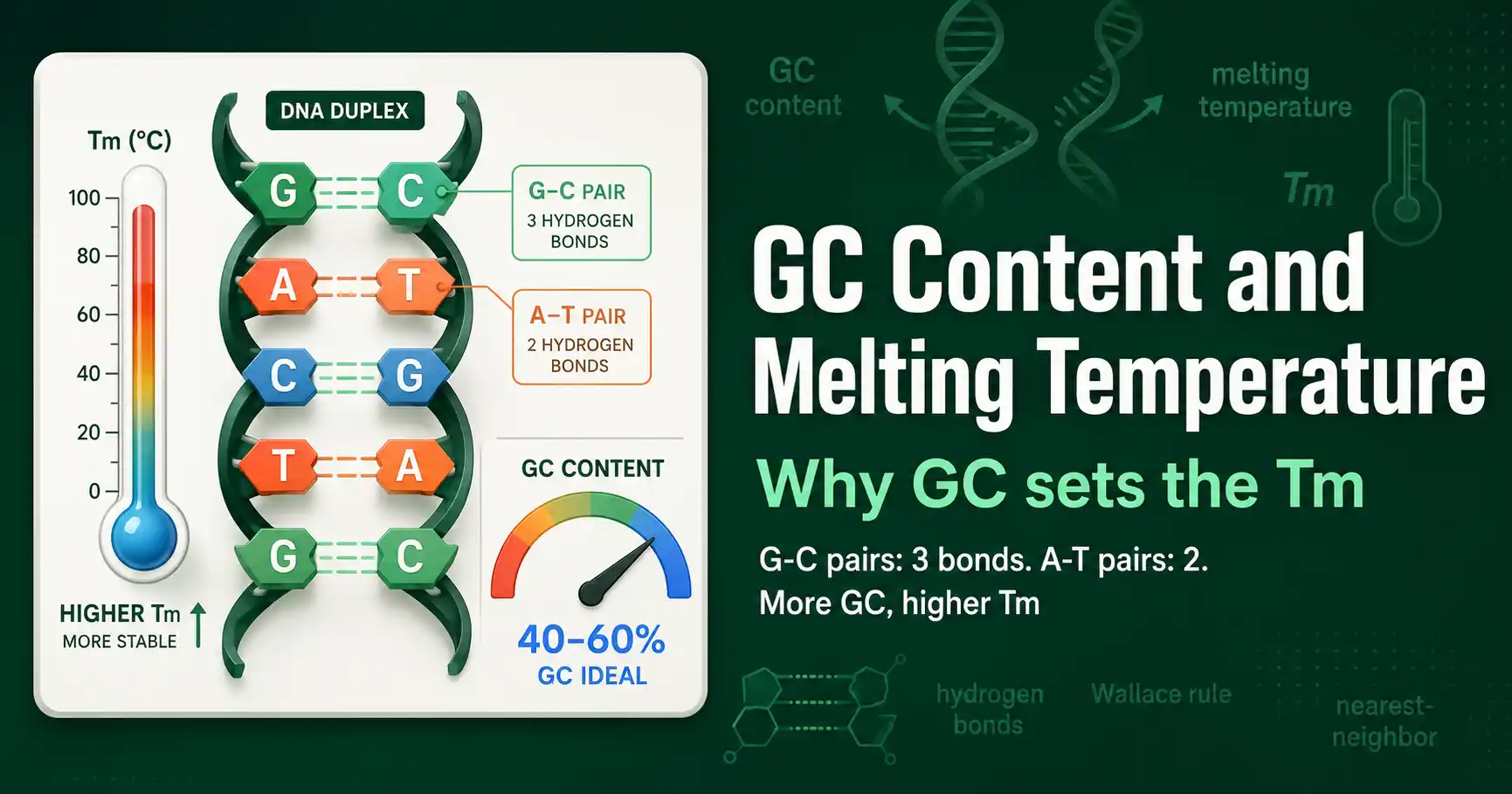
GC content is the percentage of bases in a sequence that are guanine or cytosine, and it largely determines the melting temperature, the temperature at which half of a DNA duplex separates into single strands. Higher GC content means a higher melting temperature, because G-C base pairs are held together by three hydrogen bonds while A-T pairs have only two. These two numbers, GC content and melting temperature, govern how an oligo behaves in almost every reaction.
This guide explains both. It covers what GC content is and how to calculate it, why it drives the melting temperature, the main Tm formulas from the simple Wallace rule to the accurate nearest-neighbor model, and worked examples for each. For the molecule itself, our explainer on what an oligonucleotide is sets it up.
What GC Content Is
GC content is the fraction of a sequence made up of G and C bases, written as a percentage. It is one of the most basic and useful descriptors of any DNA sequence.
The calculation is simple. Count the G and C bases, divide by the total number of bases, and multiply by 100. A 20-base oligo with 10 G or C bases has a GC content of 50 percent. That single number captures something important, because the GC pairs and the AT pairs behave differently, so the ratio between them shapes how the whole sequence behaves.
For oligos used as primers, a GC content of 40 to 60 percent is the usual target. Too low, and the oligo binds weakly and has a low melting temperature; too high, and it binds too tightly and is prone to forming secondary structures. The Wikipedia article on GC content covers its broader significance across genomes, but for oligo work the 40-to-60-percent window is the practical rule. You can get the GC content of any sequence instantly from our GC content calculator.
Why GC Content Sets the Melting Temperature
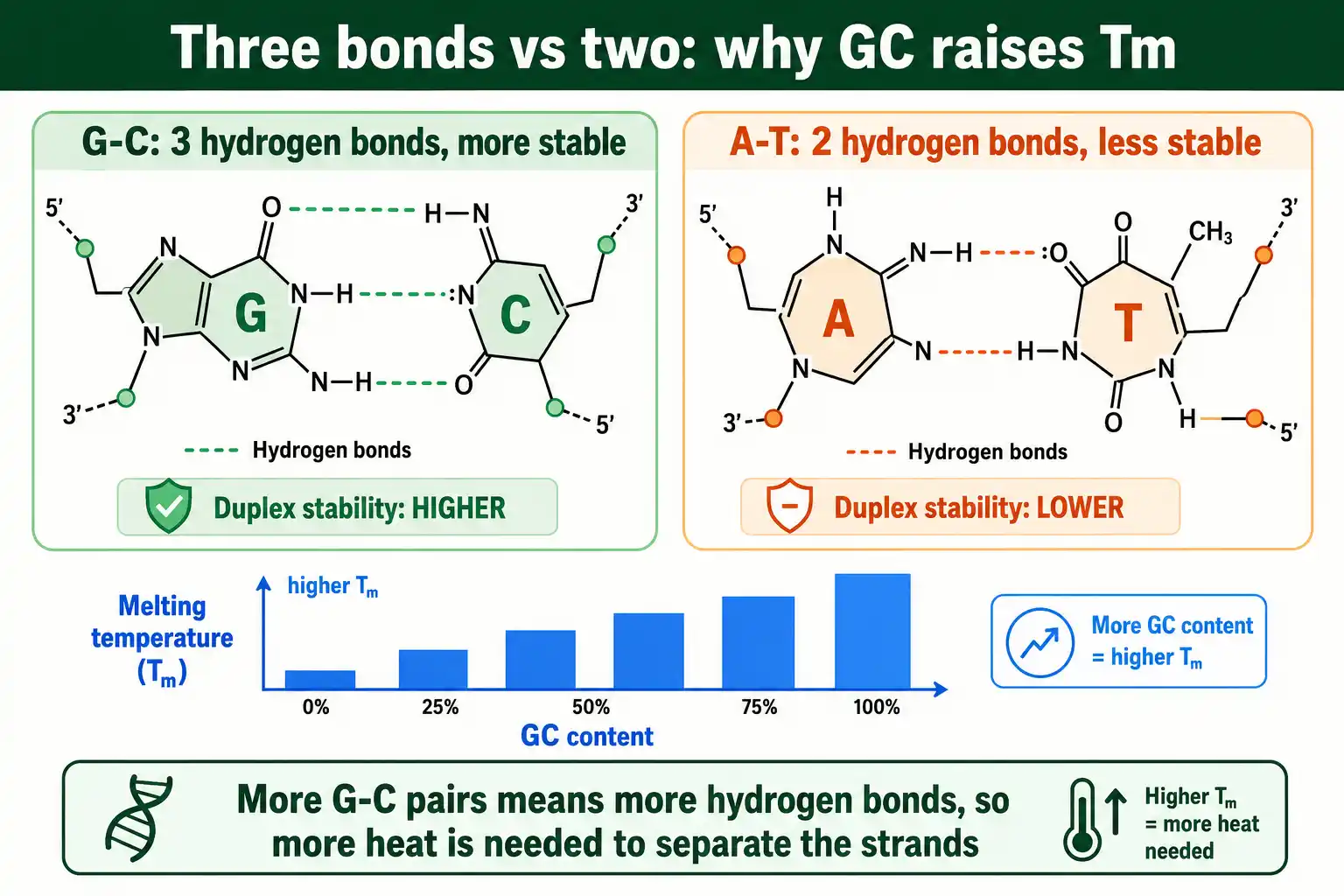
The melting temperature, or Tm, is the temperature at which half of a DNA duplex has separated into single strands. GC content is the single biggest sequence factor that sets it, and the reason comes down to hydrogen bonds.
A G-C base pair is held together by three hydrogen bonds, while an A-T base pair has only two. More hydrogen bonds mean a more stable pairing, so a sequence rich in G-C pairs takes more heat to pull apart. Each G-C pair contributes more to duplex stability than each A-T pair, which is why GC content tracks so closely with melting temperature: more G and C, higher Tm.
This matters because Tm sets the temperatures a reaction runs at. In PCR, the annealing step is typically run 3 to 5 degrees Celsius below the primer's Tm, so primers bind their targets but not random sequences. Get the Tm wrong and the whole reaction can fail, either because primers will not bind or because they bind nonspecifically. So GC content is not an abstract property; it directly determines the temperature you set on the thermocycler.
The Tm Formulas
There are several ways to calculate Tm, ranging from quick rules to accurate thermodynamic models. Which one to use depends on the oligo's length and how much precision you need.
The simplest is the Wallace rule, also called the 2-plus-4 rule, for short oligos of about 14 bases or fewer. It assigns 2 degrees to each A or T and 4 degrees to each G or C: Tm = 2(A+T) + 4(G+C). It is easy to do in your head and fine for short primers, but it ignores sequence context and salt, so it is only a rough guide.
For longer oligos, above about 14 bases, a better basic formula is Tm = 64.9 + 41 × (G+C − 16.4) / N, where N is the total length. This accounts for length and GC content together. More accurate still is the salt-adjusted formula, Tm = 81.5 + 16.6 × log[Na+] + 0.41 × (%GC) − 675 / N, which adds a correction for the salt concentration, since higher salt stabilizes the duplex and raises the Tm.
The most accurate method is the nearest-neighbor model, which treats the sequence as a series of overlapping base pairs and sums experimentally measured thermodynamic values for each. This captures the effect of base order, not just composition, which the simpler formulas miss entirely. The widely used parameters were unified by John SantaLucia in a 1998 paper on nearest-neighbor thermodynamics, and they are what professional tools and primer-design software use. Rather than compute the thermodynamics by hand, you can get the nearest-neighbor Tm and GC content for a sequence from an oligo analyzer, which applies these parameters automatically.
Comparing the Formulas
The formulas trade simplicity against accuracy. The table lays them out.
| Method | Formula | Best for |
|---|---|---|
| Wallace rule | Tm = 2(A+T) + 4(G+C) | Short oligos ≤14 bases, quick estimates |
| Basic | Tm = 64.9 + 41 × (G+C − 16.4) / N | Oligos >14 bases |
| Salt-adjusted | Tm = 81.5 + 16.6 × log[Na+] + 0.41 × (%GC) − 675/N | Accounting for buffer salt |
| Nearest-neighbor | Sum of ΔH and ΔS over adjacent base pairs | Accurate design, any length |
The practical takeaway from the table is that the quick rules are fine for a first look, but design decisions should use a nearest-neighbor calculation. Two oligos with identical base composition but different base order can have melting temperatures that differ by several degrees, and only the nearest-neighbor model captures that difference. For matching the Tm of a primer pair, where a few degrees matters, use the accurate method.
Worked Example: The Wallace Rule
Numbers make the formulas concrete. Take the 20-base primer AAGGCAAGTTGTTACCAGCA. First count the bases: it has 10 A or T bases and 10 G or C bases, so its GC content is 10 divided by 20, or 50 percent.
Apply the Wallace rule: Tm = 2 times the A+T count, plus 4 times the G+C count. That is 2 times 10, plus 4 times 10, which is 20 plus 40, or 60 degrees Celsius. So the Wallace rule estimates this primer's Tm at 60 degrees. Quick and easy, but remember this primer is 20 bases, above the rule's ideal range of 14 or fewer, so the estimate is rough.
Worked Example: The Basic Formula
Use the length-aware formula on a 25-base oligo with 13 G or C bases. Its GC content is 13 divided by 25, or 52 percent.
Apply Tm = 64.9 + 41 × (G+C − 16.4) / N. Plug in the numbers: 64.9 + 41 × (13 − 16.4) / 25. The bracket is 13 minus 16.4, which is negative 3.4. So it becomes 64.9 + 41 × (−3.4 / 25), which is 64.9 + 41 × (−0.136), or 64.9 minus 5.6, giving about 59.3 degrees Celsius. So the basic formula estimates this 25-mer's Tm at about 59 degrees. Notice how the formula uses the full length N, which the Wallace rule ignores, making it more reliable for longer oligos.
Worked Example: The Salt-Adjusted Formula
Salt concentration shifts the Tm, so the salt-adjusted formula matters when precision counts. Take the same 25-base oligo, 52 percent GC, in a buffer with a sodium concentration of 50 millimolar, which is 0.05 molar.
Apply Tm = 81.5 + 16.6 × log[Na+] + 0.41 × (%GC) − 675 / N. The salt term is 16.6 times the log of 0.05, and the log of 0.05 is about negative 1.3, so that term is about negative 21.6. The GC term is 0.41 times 52, which is about 21.3. The length term is 675 divided by 25, which is 27. Putting it together: 81.5 minus 21.6 plus 21.3 minus 27, which is about 54.2 degrees Celsius. Notice this comes out a few degrees lower than the basic formula's 59 degrees for the same oligo, because the basic formula assumes a higher standard salt level. Raising the salt would raise the Tm, which is exactly why the salt term belongs in an accurate estimate.
What Else Affects the Melting Temperature
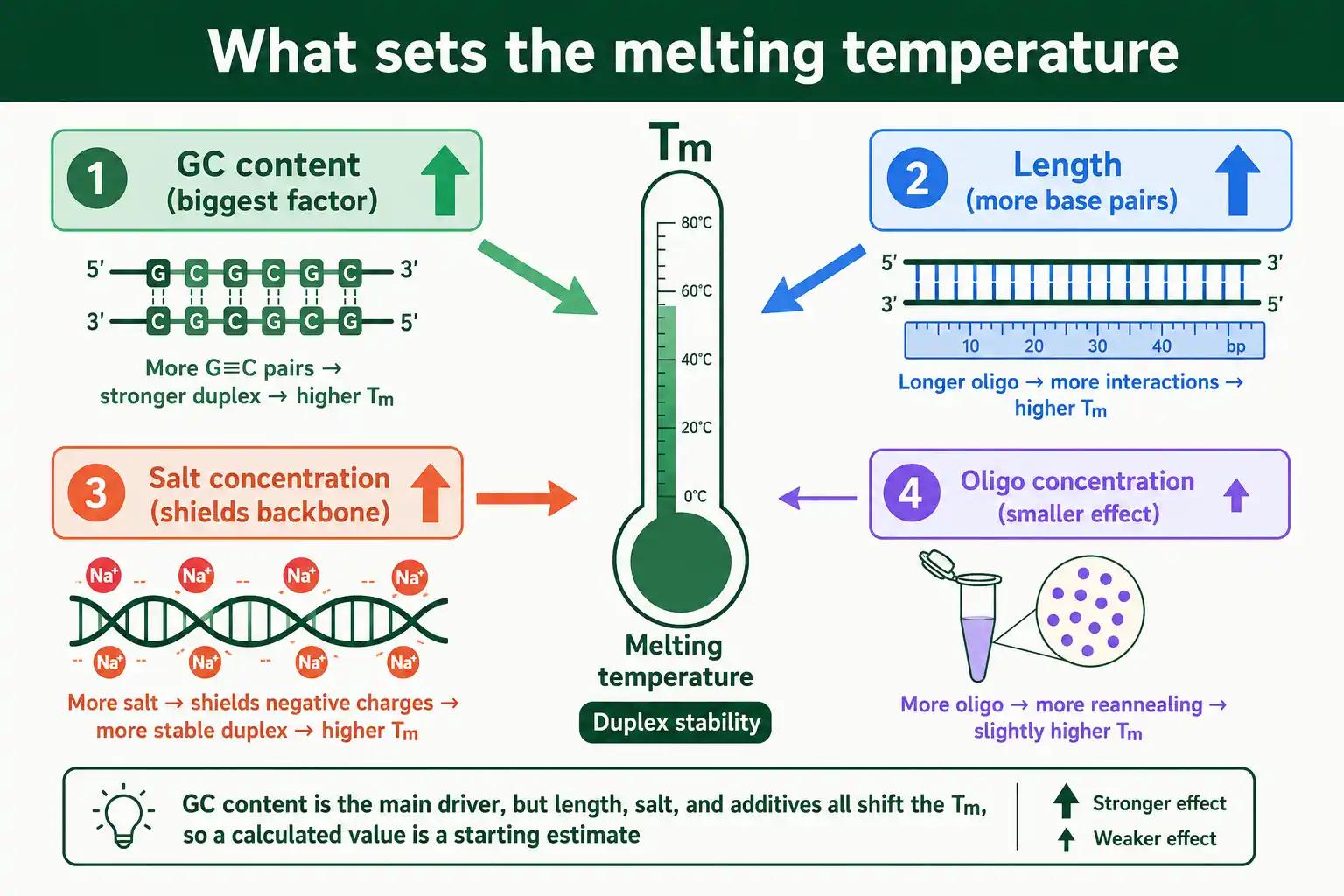
GC content is the biggest sequence factor, but it is not the only thing that sets Tm. Several other factors shift it, and overlooking them causes the gap between a calculated Tm and what actually happens in the tube.
Length matters: a longer duplex has more base pairs holding it together, so longer oligos have higher melting temperatures at the same GC content. Salt concentration matters, as the worked example showed, because positive ions shield the negatively charged backbone and stabilize the duplex, so higher salt raises Tm. Oligo concentration has a smaller effect, since melting depends on strands finding each other. And additives used in PCR, like magnesium and cosolvents such as DMSO, shift the effective Tm, which is why a calculated value is a starting point rather than a guarantee. The comparison of basic, salt-adjusted, and nearest-neighbor Tm methods lays out which factors each method accounts for. The practical lesson is that any Tm formula makes simplifying assumptions, so treat the number as a well-grounded estimate and confirm it empirically when a reaction is sensitive.
Putting Tm to Work
Tm and GC content guide several practical decisions, beyond just setting the annealing temperature. They are worth knowing as a set of rules of thumb.
Match the Tm of primer pairs. Forward and reverse primers should have melting temperatures within about 2 to 3 degrees of each other, so they anneal at the same temperature. A large Tm mismatch means one primer works while the other does not. Add a GC clamp, a G or C among the last few bases at the 3' end, to stabilize the critical end where extension begins, though more than two or three Gs or Cs there can cause mispriming. And avoid GC extremes overall, since very low GC gives weak, low-Tm binding while very high GC promotes secondary structure and stubborn melting. These guidelines all flow from the same physics: GC content sets stability, and stability sets behavior.
Frequently Asked Questions
How does GC content affect melting temperature?
Higher GC content raises the melting temperature. G-C base pairs form three hydrogen bonds while A-T pairs form only two, so GC-rich sequences are more stable and take more heat to separate. This is why GC content is the main sequence factor in every Tm formula, and why GC-rich primers anneal at higher temperatures.
What is the formula for primer melting temperature?
For short oligos of 14 bases or fewer, the Wallace rule is Tm = 2(A+T) + 4(G+C). For longer oligos, the basic formula Tm = 64.9 + 41 × (G+C − 16.4) / N accounts for length, and the salt-adjusted version adds a salt correction. The most accurate method is the nearest-neighbor model, which sums thermodynamic values over adjacent base pairs.
What is a good GC content for a primer?
A GC content of 40 to 60 percent is ideal for PCR primers. This range gives stable, specific binding without the problems of extremes: too low a GC content makes binding weak and lowers the Tm, while too high a GC content raises the risk of secondary structures and nonspecific binding.
The Two Numbers That Matter Most
GC content and melting temperature are the two properties that most define how an oligo behaves. GC content is the percentage of G and C bases, easy to calculate, and the main driver of melting temperature, because G-C pairs with their three hydrogen bonds are more stable than two-bond A-T pairs. Higher GC means higher Tm.
The Tm formulas run from the quick Wallace rule for short oligos, through the length-aware and salt-adjusted formulas, to the accurate nearest-neighbor model that captures base order and is the right choice for design. With GC content and Tm in hand, the natural next step is designing primers that put these properties to use, which our guide on PCR primer design guidelines covers in full.