Hardy-Weinberg Practice Problems With Answers
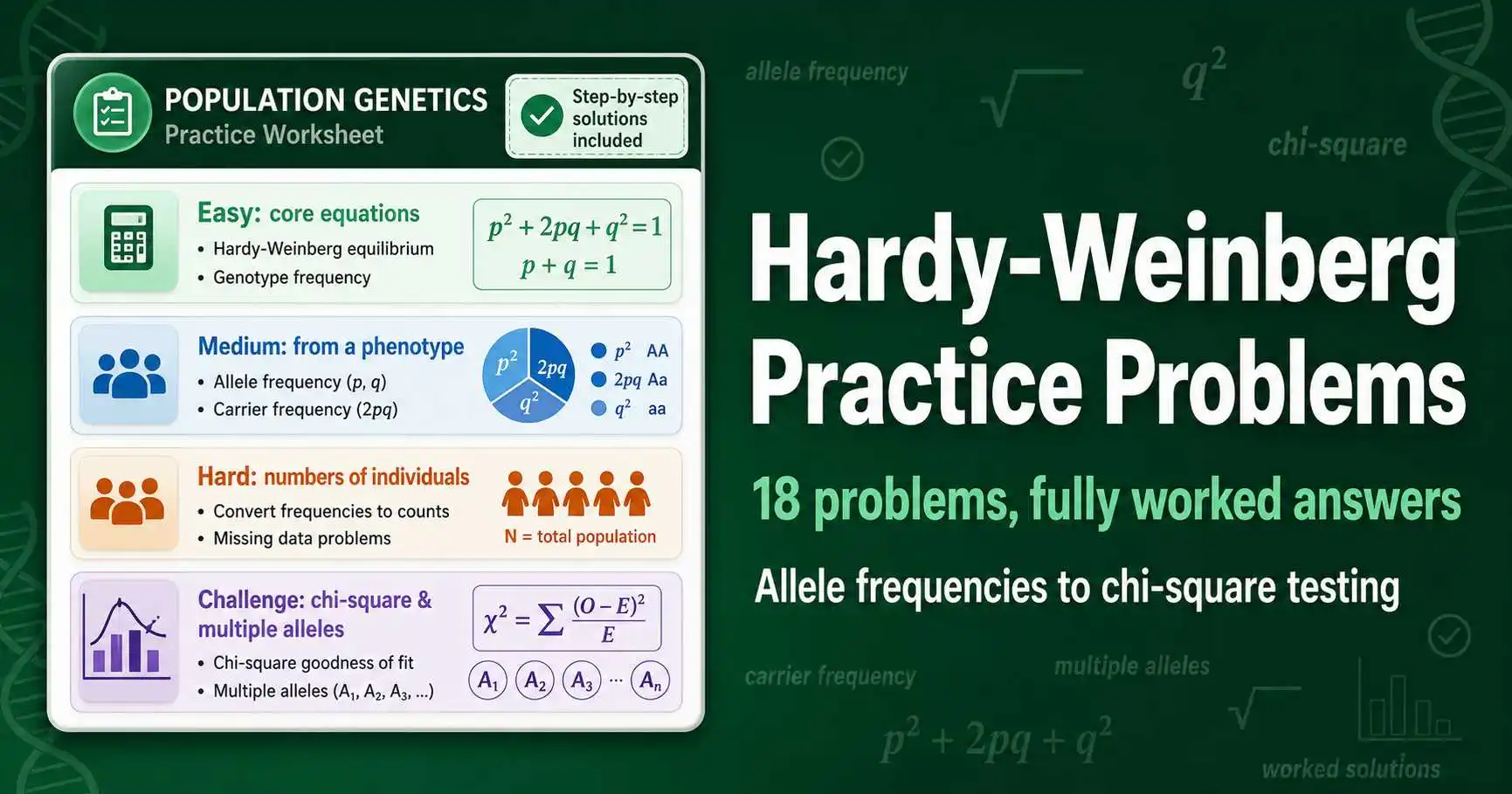
This is a complete set of Hardy-Weinberg practice problems with fully worked answers, arranged from easy to hard. Each problem includes the question, a step-by-step solution, and the final frequencies, so you can check your method as well as your answer. The set moves through allele frequencies from genotype counts, genotype frequencies from an allele frequency, calculations from a recessive phenotype, carrier frequency, numbers of individuals, the dominant-phenotype variation, the chi-square equilibrium test, and multiple alleles, covering everything a population genetics course is likely to ask.
Work each problem yourself first, then read the solution to confirm your reasoning. The goal is not just the right number but the right method, since exams reward clear working. If you need to review the equations before you start, our guide on using the Hardy-Weinberg equation covers the procedure step by step.
How to Use This Practice Set
These problems build in difficulty, so working through them in order is the most effective approach. The early problems reinforce the two core equations, the middle problems add the standard phenotype-to-frequency method and carrier calculations, and the later problems bring in statistical testing and multiple alleles. By the end you will have practised every common Hardy-Weinberg question type.
For each problem, follow a disciplined method: identify what you are given, choose the right equation, and work toward what the question asks. Most problems start from either an allele frequency or a recessive phenotype frequency, so recognizing your entry point is half the battle. Keep the two equations clearly separated in your mind: p + q = 1 deals with allele frequencies, while p² + 2pq + q² = 1 deals with genotype frequencies. The worked solutions model this layout so you can compare your approach step by step.
One reminder that prevents many errors: the recessive phenotype frequency equals q², not q. You must take the square root before using it as an allele frequency. Whenever you finish a problem, verify that your three genotype frequencies sum to 1, which is the single best check against arithmetic slips. With these habits in place, the problems below become a matter of method rather than guesswork.
A final orientation before you begin: the problems are grouped by type and difficulty, but the underlying skill set is small. There are really only a few moves, taking a square root, applying p + q = 1, squaring a value, doubling a product, and multiplying by a population size. Almost every problem is a different arrangement of these same moves. Once you see that, the variety stops being intimidating, because you are not learning fifteen separate techniques but rather practising when to apply each of a handful of operations. Pay attention to the first line of each solution, where the entry point is chosen, since selecting the right starting move is what makes the rest fall into place.
Easy Problems: The Core Equations
These first problems use the two equations directly, with no tricky steps. Make sure you are fully confident with them before moving on, since everything else builds on this foundation.
Problem 1. In a population, the frequency of the dominant allele A is 0.7. Assuming Hardy-Weinberg equilibrium, find the frequencies of the AA, Aa, and aa genotypes.
Solution. Since p equals 0.7, q equals 1 minus 0.7, which is 0.3. Now apply the genotype equation. The AA frequency is p², which is 0.7 squared, or 0.49. The Aa frequency is 2pq, which is 2 times 0.7 times 0.3, or 0.42. The aa frequency is q², which is 0.3 squared, or 0.09. Check: 0.49 plus 0.42 plus 0.09 equals 1, confirming the answer.
Problem 2. In a population, the genotype frequencies are AA equals 0.49, Aa equals 0.42, and aa equals 0.09. Find the frequencies of the A and a alleles.
Solution. Use the relationship that an allele frequency equals its homozygote frequency plus half the heterozygote frequency. So p equals 0.49 plus half of 0.42, which is 0.49 plus 0.21, giving 0.70. And q equals 0.09 plus half of 0.42, which is 0.09 plus 0.21, giving 0.30. Confirm: p plus q equals 0.70 plus 0.30, which is 1.
Problem 3. If the recessive allele frequency q is 0.2 in a population at equilibrium, what percentage of the population is heterozygous?
Solution. Since q equals 0.2, p equals 0.8. The heterozygous frequency is 2pq, which is 2 times 0.8 times 0.2, giving 0.32. So 32 percent of the population is heterozygous. Remember that an allele frequency equals its homozygote frequency plus half the heterozygote frequency, the relationship used when counting alleles directly from genotypes.
Medium Problems: Starting From a Phenotype
These problems give you the recessive phenotype frequency and ask you to work back to the alleles and other genotypes. This is the single most common Hardy-Weinberg question type, so master the q² starting point.
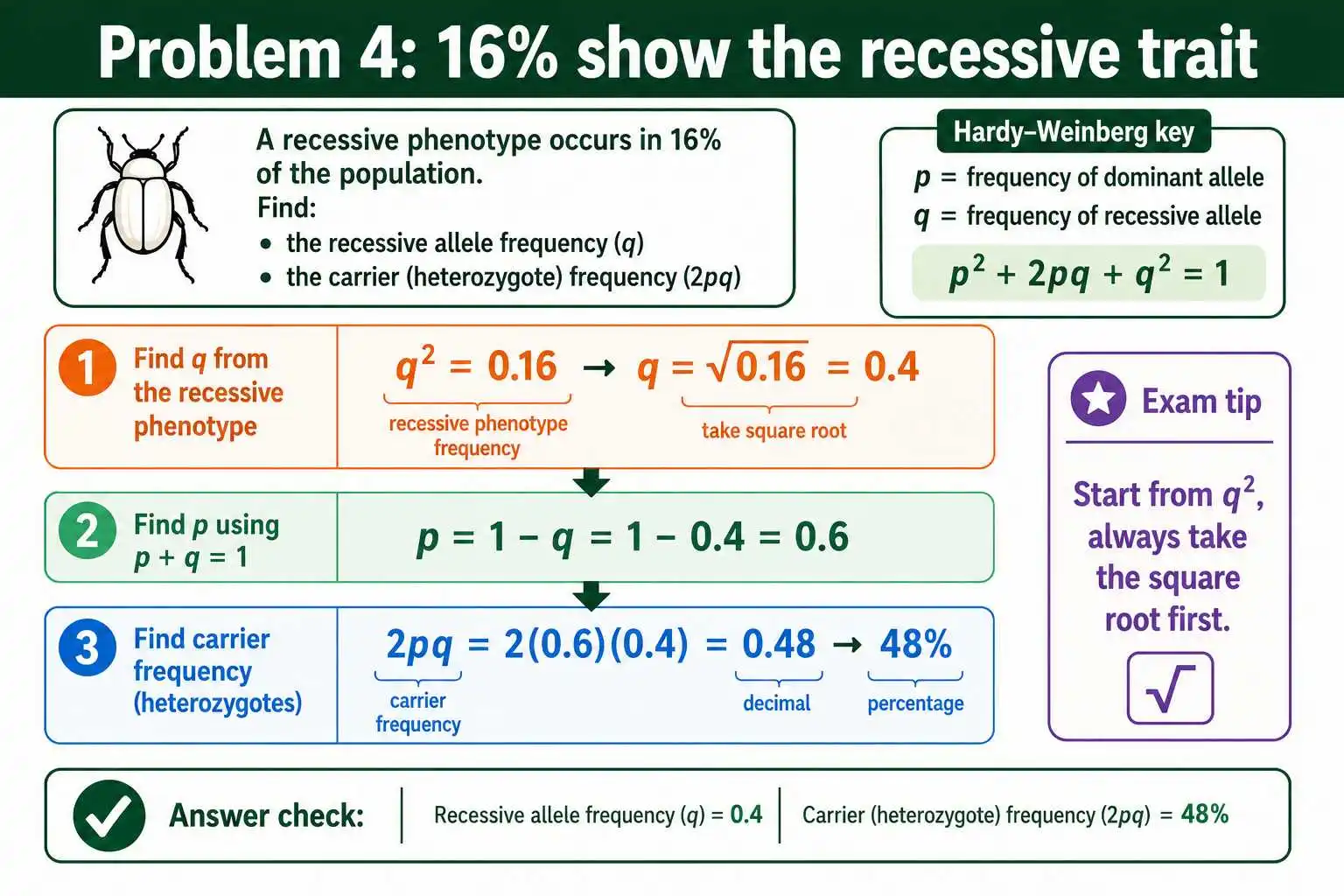
Problem 4. In a population, 16 percent of individuals show a recessive trait. Find the frequency of the recessive allele and the percentage of carriers.
Solution. The recessive phenotype frequency is q², so q² equals 0.16. Take the square root: q equals 0.4. Then p equals 1 minus 0.4, which is 0.6. The carrier frequency is 2pq, which is 2 times 0.6 times 0.4, giving 0.48. So the recessive allele frequency is 0.4 and 48 percent of the population are carriers.
Problem 5. A recessive disorder affects 1 in 2,500 people. Calculate the carrier frequency.
Solution. Affected individuals are homozygous recessive, so q² equals 1 divided by 2,500, which is 0.0004. The square root gives q equals 0.02. Then p equals 0.98. The carrier frequency 2pq is 2 times 0.98 times 0.02, giving 0.0392, or about 1 in 25. So roughly 1 in 25 people carries the allele, far more than the 1 in 2,500 affected. Carrier calculations are explored fully in our guide on Hardy-Weinberg carrier frequency.
Problem 6. In a population at equilibrium, 36 percent of individuals show the dominant phenotype. What is the frequency of the recessive allele?
Solution. This is the dominant-phenotype variation. The dominant phenotype includes both AA and Aa, so it equals p² plus 2pq. The recessive phenotype is the complement: 1 minus 0.36, which is 0.64, and this equals q². Take the square root: q equals 0.8. So the recessive allele frequency is 0.8. Always convert to q² first, since it is the only term you can square-root directly.
Harder Problems: Numbers of Individuals
These problems ask for actual counts of individuals rather than frequencies. The method is the same, with one extra step at the end: multiply each frequency by the population size.
Problem 7. In a population of 1,000 people, the recessive allele frequency q is 0.3. How many individuals of each genotype are expected?
Solution. With q equal to 0.3, p equals 0.7. The genotype frequencies are p² equals 0.49, 2pq equals 0.42, and q² equals 0.09. Multiply each by 1,000: AA is 490 individuals, Aa is 420 individuals, and aa is 90 individuals. Check: 490 plus 420 plus 90 equals 1,000, the full population.
Problem 8. On an island, 4 percent of 5,000 cats have a recessive coat trait. How many cats are expected to be carriers?
Solution. The affected frequency is q², so q² equals 0.04. The square root gives q equals 0.2. Then p equals 0.8. The carrier frequency 2pq is 2 times 0.8 times 0.2, giving 0.32. Multiply by the population: 0.32 times 5,000 equals 1,600 carrier cats. So 1,600 of the 5,000 cats are expected to be carriers.
Problem 9. In a population of 800 plants at equilibrium, the dominant allele frequency is 0.9. How many plants are expected to be homozygous recessive?
Solution. With p equal to 0.9, q equals 0.1. The homozygous recessive frequency is q², which is 0.1 squared, or 0.01. Multiply by 800: 0.01 times 800 equals 8 plants. So only 8 of the 800 plants are expected to be homozygous recessive, illustrating how rare the recessive phenotype is when the allele is uncommon.
Advanced Problems: Testing for Equilibrium
These problems ask whether a population is actually in Hardy-Weinberg equilibrium, using a chi-square test to compare observed genotype counts with expected counts. This is the most involved problem type.
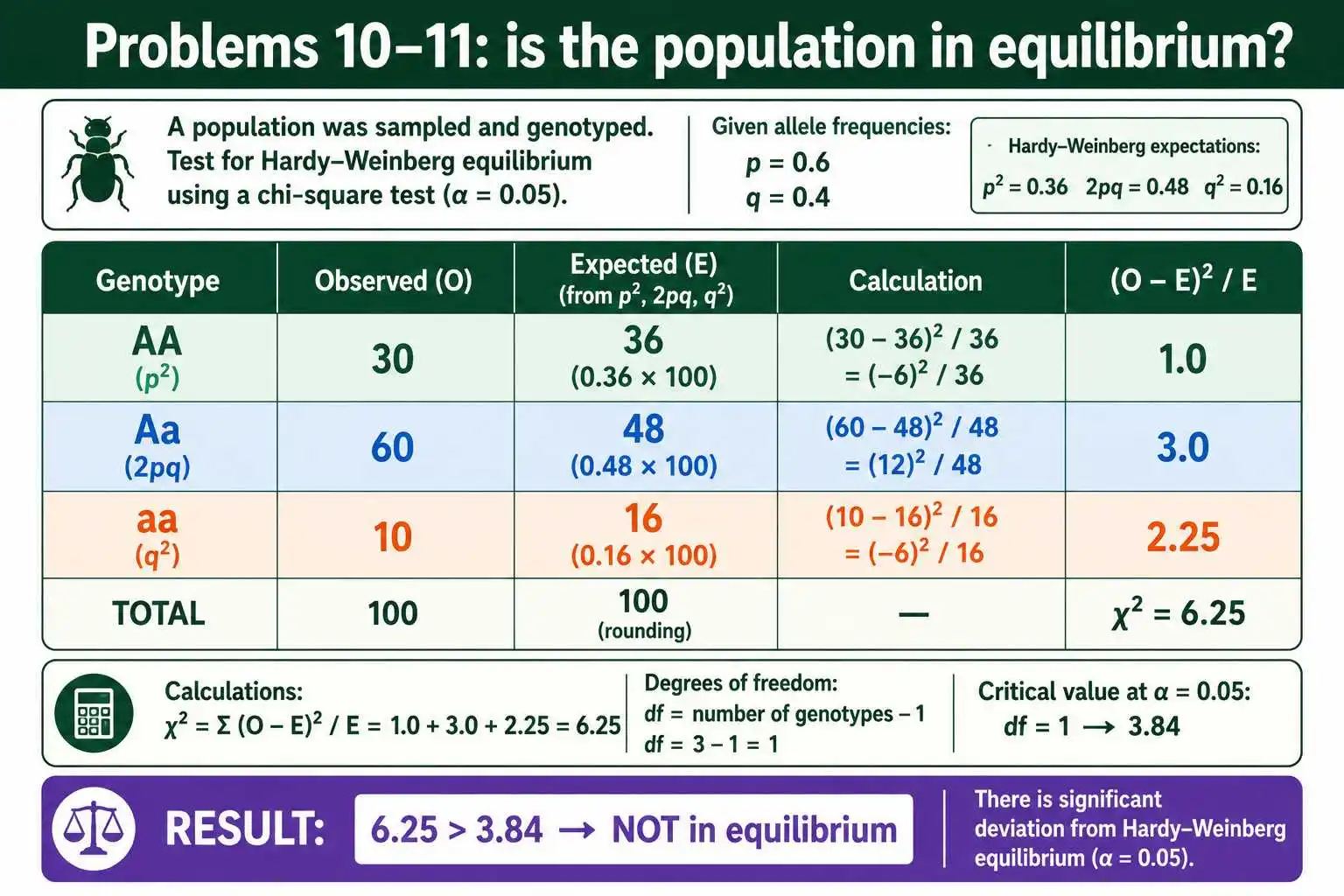
Problem 10. A population of 100 individuals has observed genotypes of 30 AA, 60 Aa, and 10 aa. Calculate the allele frequencies, then the expected counts under equilibrium.
Solution. First find the allele frequencies from the observed data. The A alleles number 2 times 30 plus 60, which is 120, out of 200 total, so p equals 0.6. Then q equals 0.4. The expected genotype frequencies are p² equals 0.36, 2pq equals 0.48, and q² equals 0.16. Multiply by 100 for expected counts: 36 AA, 48 Aa, and 16 aa. Compare with the observed 30, 60, 10.
Problem 11. Using the observed and expected counts from Problem 10, calculate the chi-square statistic and state whether the population is in equilibrium.
Solution. The chi-square statistic is the sum of (observed minus expected) squared, divided by expected. For AA: (30 minus 36) squared over 36 equals 36 over 36, which is 1.0. For Aa: (60 minus 48) squared over 48 equals 144 over 48, which is 3.0. For aa: (10 minus 16) squared over 16 equals 36 over 16, which is 2.25. The total is 1.0 plus 3.0 plus 2.25, giving 6.25. With one degree of freedom, the critical value is 3.84. Since 6.25 is greater than 3.84, the population is not in Hardy-Weinberg equilibrium.
 The full method appears in our guide on testing Hardy-Weinberg with chi-square.
Problem 12. A population has observed genotypes of 320 MM, 160 MN, and 20 NN. Calculate the allele frequencies and confirm whether the genotype counts are consistent with equilibrium expectations.
Solution. The M alleles number 2 times 320 plus 160, which is 800, out of 2 times 500, which is 1,000 total, so the M frequency is 0.8 and the N frequency is 0.2. Expected frequencies are 0.64 MM, 0.32 MN, and 0.04 NN. For 500 individuals, that is 320, 160, and 20 expected, which exactly match the observed counts. The chi-square statistic is therefore 0, so this population is in perfect Hardy-Weinberg equilibrium for this gene.
Challenge Problems: Multiple Alleles
These final problems extend Hardy-Weinberg to genes with more than two alleles, where the genotype equation expands accordingly. They are the most advanced type and reward careful tracking of each allele.
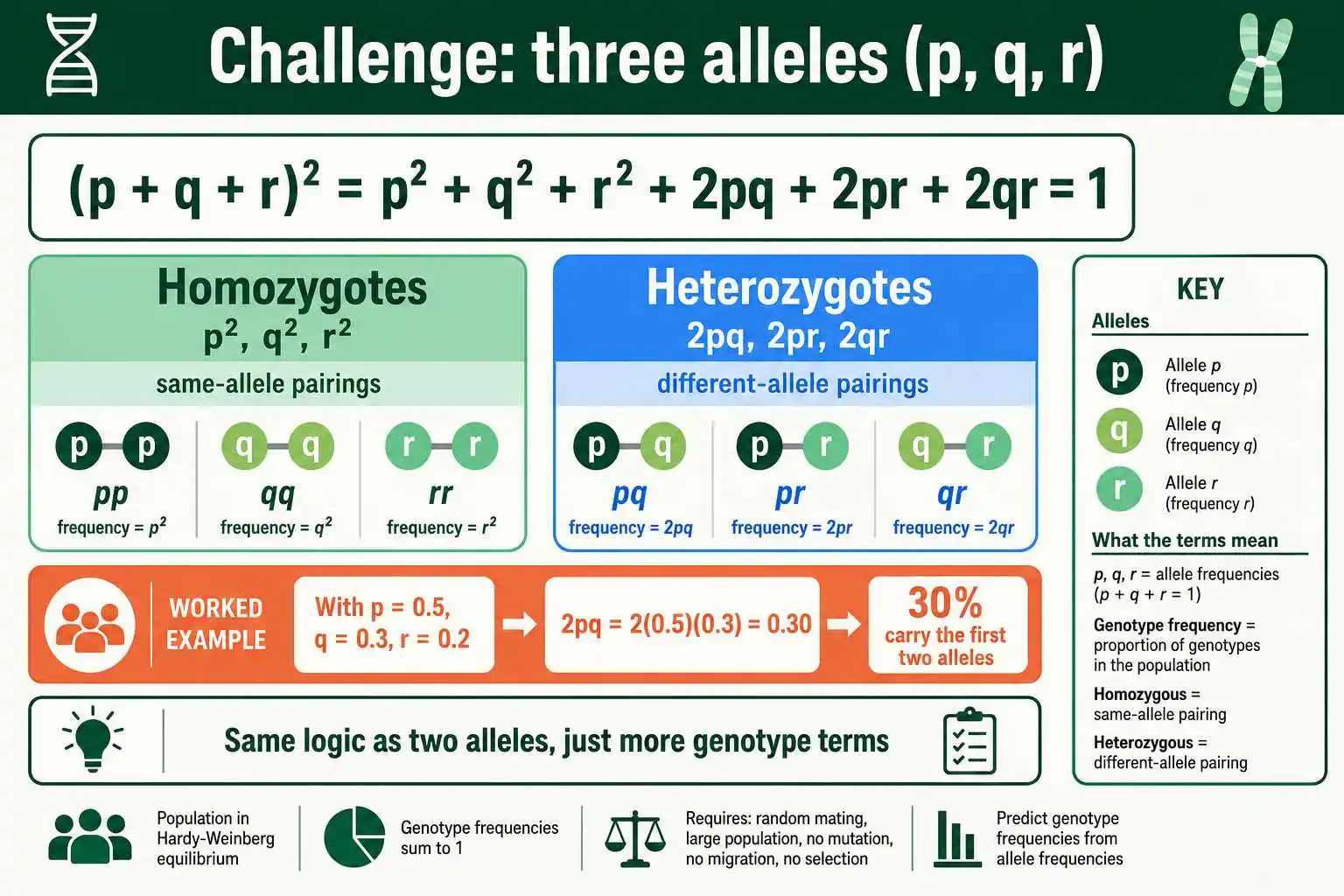
Problem 13. A gene has three alleles with frequencies p equals 0.5, q equals 0.3, and r equals 0.2. What is the expected frequency of heterozygotes carrying the first two alleles?
Solution. For three alleles, the genotype frequencies come from expanding (p + q + r)². The heterozygote combining the first two alleles has frequency 2pq, which is 2 times 0.5 times 0.3, giving 0.30. So 30 percent of the population is expected to carry one of each of the first two alleles. The factor of 2 applies just as in the two-allele case.
Problem 14. Using the same three alleles, what is the total frequency of all homozygotes?
Solution. The homozygote frequencies are p², q², and r². So p² equals 0.25, q² equals 0.09, and r² equals 0.04. The total frequency of all homozygotes is 0.25 plus 0.09 plus 0.04, which is 0.38. So 38 percent of the population is homozygous for one of the three alleles, and the remaining 62 percent is heterozygous.
Problem 15. In the ABO blood group, the frequency of the i allele (recessive, type O) is 0.6. If type O individuals are ii, what percentage of the population has type O blood?
Solution. Type O individuals are homozygous for the i allele, so their frequency is the square of the i allele frequency. That is 0.6 squared, which is 0.36. So 36 percent of the population is expected to have type O blood. This uses the same q² logic as a two-allele recessive phenotype, applied to the recessive allele of a multiple-allele system. Multiple-allele systems are covered for crosses in our guide on multiple alleles.
Bonus Problems: Applying the Results
These final problems go a step beyond calculation, asking you to apply Hardy-Weinberg results to a practical question. They reflect how the principle is used in real genetics and public health.
Problem 16. A recessive disorder affects 1 in 10,000 people. Two random individuals from this population have a child. What is the approximate probability that the child is affected, assuming the population is in equilibrium?
Solution. First find the carrier frequency. The affected frequency is q², so q² equals 0.0001 and q equals 0.01, giving p of about 0.99. The carrier frequency 2pq is about 0.0198, roughly 1 in 50. For a child to be affected, both parents must be carriers and both must pass the recessive allele. The chance both parents are carriers is about 0.0198 times 0.0198, and if both are carriers a Punnett square gives a 1 in 4 chance the child is affected. Multiplying, the probability is approximately 0.0198 times 0.0198 times 0.25, which is about 0.0000098, or roughly 1 in 102,000. This matches the expectation that random matings rarely produce affected children for a rare allele. Combined carrier-and-offspring risk is the kind of calculation handled by a carrier probability calculator.
Problem 17. In a population, the frequency of a recessive allele is 0.5. What percentage of the population shows the recessive phenotype, and how does this compare to a population where the recessive allele frequency is 0.1?
Solution. When q equals 0.5, the recessive phenotype frequency q² is 0.25, so 25 percent show the recessive trait. When q equals 0.1, q² is 0.01, so only 1 percent show it. This comparison illustrates an important point: as the recessive allele becomes rarer, the recessive phenotype becomes disproportionately rarer, because squaring a small number produces a much smaller result. Halving an allele frequency more than halves the phenotype frequency.
Problem 18. A population at equilibrium has a heterozygote frequency of 0.5. What are the allele frequencies?
Solution. This problem works backward from 2pq. We need 2pq equals 0.5, so pq equals 0.25. Combined with p plus q equals 1, this means p and q are the two values that multiply to 0.25 and sum to 1. Solving, p equals q equals 0.5, since 0.5 times 0.5 is 0.25. So both allele frequencies are 0.5. This is the special case where the heterozygote frequency reaches its maximum possible value, which occurs precisely when the two alleles are equally common.
Common Pitfalls to Watch For
As you work through these problems, a few recurring errors are worth guarding against. Spotting them in your own work is the fastest way to improve accuracy.
The first and most damaging is forgetting the square root when starting from a phenotype. The recessive phenotype frequency is q², so you must take its square root to find the allele frequency q before doing anything else. The second is confusing the two equations, applying p + q = 1 when you need the genotype equation or vice versa. The third is forgetting the factor of 2 in the heterozygous term, writing pq instead of 2pq, which halves your carrier estimate.
Two more pitfalls appear in the harder problems. When a question asks for a number of individuals, students sometimes report the frequency instead, forgetting the final step of multiplying by the population size. And in chi-square problems, the most common error is using two degrees of freedom instead of one; for a two-allele system, the degrees of freedom is 1, because estimating the allele frequency from the data costs an extra degree of freedom. Running the sum check, confirming the genotype frequencies total 1, catches most calculation errors before they cost you marks.
Frequently Asked Questions
How do I start a Hardy-Weinberg problem?
Identify what you are given. If you have the recessive phenotype frequency, set it equal to q² and take the square root to find q. If you have an allele frequency, go straight to the genotype equation. Recognizing your starting point determines the whole solution path.
What is the most common mistake in these problems?
Treating the recessive phenotype frequency as q instead of q². The recessive phenotype corresponds to the homozygous recessive genotype, so its frequency is q², and you must take the square root before using it as an allele frequency.
How do I find the number of individuals rather than the frequency?
Calculate the genotype frequency as usual, then multiply by the total population size. For example, if the carrier frequency is 0.32 in a population of 5,000, the number of carriers is 0.32 times 5,000, which is 1,600.
How do I test whether a population is in equilibrium?
Calculate the allele frequencies from the observed genotype counts, use them to find expected counts, then compute a chi-square statistic. Compare it to the critical value of 3.84 at one degree of freedom. A larger value means the population deviates from equilibrium.
Drill Until the Method Is Automatic
You now have fifteen worked Hardy-Weinberg problems covering every common type, from the core equations through phenotype-based calculations, carrier frequency, counts of individuals, the chi-square equilibrium test, and multiple alleles. The key in every case is the same disciplined method: identify what you are given, choose the right equation, take the square root of q² when starting from a phenotype, and verify that the genotype frequencies sum to 1.
Return to these problems until the method is automatic, then test yourself with new numbers. You can generate and check any calculation with the Hardy-Weinberg allele frequency calculator, which is a fast way to create extra practice and confirm your working. For more practice problems with video solutions, the Pearson genetics population genetics resources are a useful free supplement to this set, and for additional fully worked examples across every problem type, the University of Arkansas population genetics answer set offers detailed solutions you can study for extra depth.