How to Resuspend and Dilute Oligos
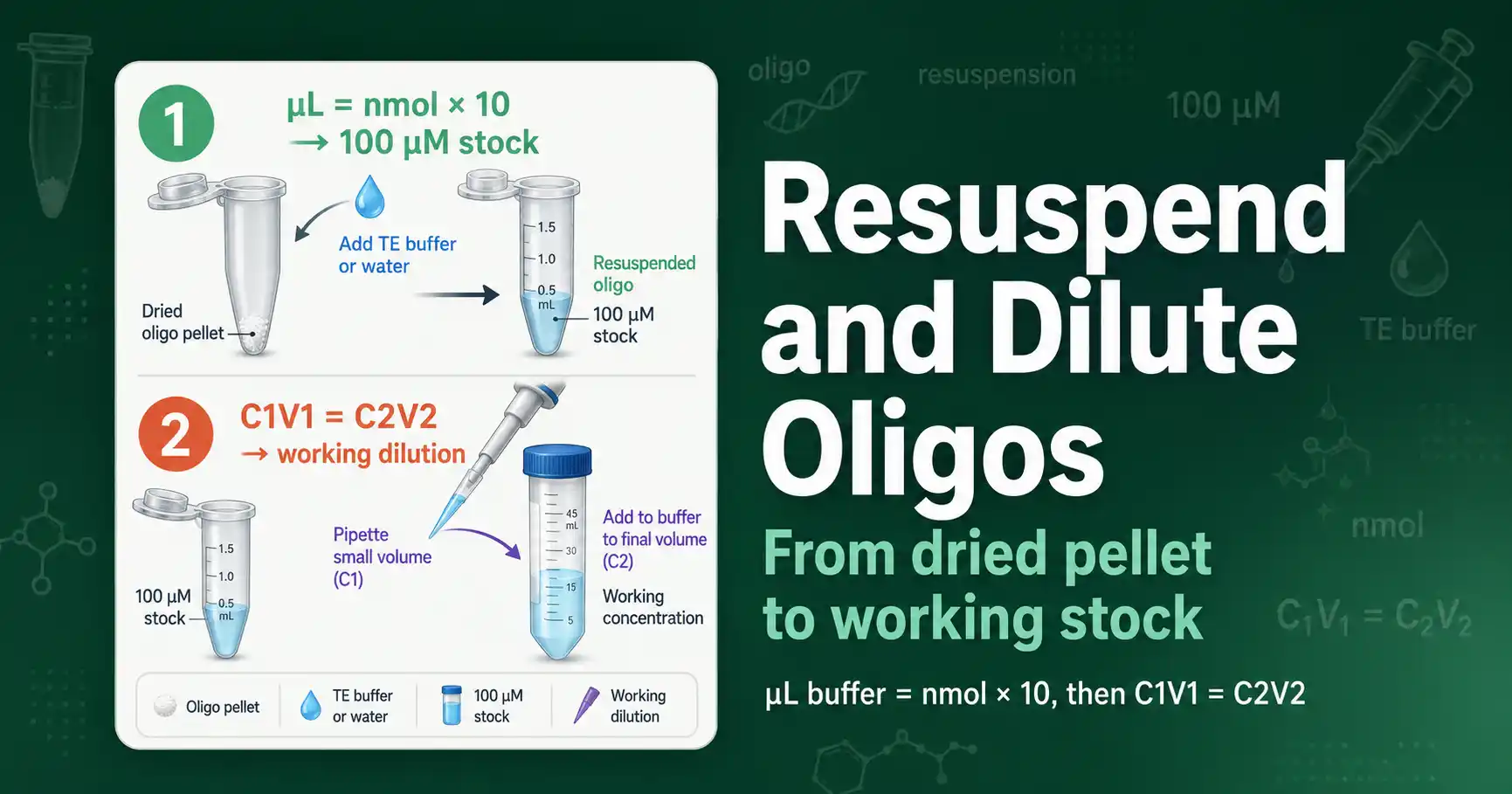
To resuspend a dried oligo, add a volume of buffer in microliters equal to ten times the number of nanomoles in the tube, and you get a 100 micromolar stock. To dilute that stock to a working concentration, use C1V1 = C2V2 to find how much stock and how much diluent to mix. Those two steps cover almost everything you do with a fresh oligo.
This guide is the practical bench companion to the calculations. It covers spinning down and resuspending the pellet, choosing a buffer, making a 100 µM stock, diluting to working strength, and storing oligos so they last. For turning a vendor's yield into a concentration first, see our guide on how to calculate oligo concentration.
Step 1: Spin Down Before You Open
Before anything else, spin the tube. Oligos ship as a dried pellet or thin film at the bottom of the tube, and that pellet can dislodge during shipping and end up stuck in the cap.
A brief centrifuge spin, just a few seconds, pulls the dried oligo back to the bottom of the tube. Skipping this step risks losing material the moment you open the cap, which throws off every concentration that follows. So always spin first, then open. This single habit prevents one of the most common and avoidable causes of a low-yield oligo.
Step 2: Choose a Buffer
Resuspend oligos in TE buffer or nuclease-free water, not plain water from the tap or even regular distilled water. The buffer choice affects how long the oligo survives.
The standard choice is TE buffer: 10 mM Tris at pH 8.0 with a small amount of EDTA, typically 0.1 to 1 mM. The Tris holds a slightly basic pH, and the EDTA chelates the metal ions that nucleases need to work, so TE protects the oligo from both acid damage and enzymatic degradation. Nuclease-free or molecular-biology-grade water is acceptable, especially when EDTA would interfere with a downstream reaction, but it is not ideal for long-term storage because high-grade water can be slightly acidic, and acidic conditions slowly degrade DNA through depurination. The LGC Biosearch guidance on resuspension buffers lays out the trade-offs. For RNA oligos, use an RNase-free buffer, and for fluorescent oligos, store them in slightly basic TE and protect them from light.
It is worth understanding why water is discouraged for storage even though it works fine for immediate use. DNA slowly loses purine bases through a reaction called depurination, and this happens faster in acidic conditions. Ultrapure water often sits slightly acidic because dissolved carbon dioxide forms carbonic acid, so an oligo left in water for months can accumulate damage that a buffered, slightly basic solution would prevent. For an oligo you will use within a day, water is perfectly acceptable; for a stock you want to keep for a year, TE is the safer choice. This is why most suppliers ship a recommendation for TE buffer even though they will resuspend in water on request.
Step 3: Make a 100 µM Stock
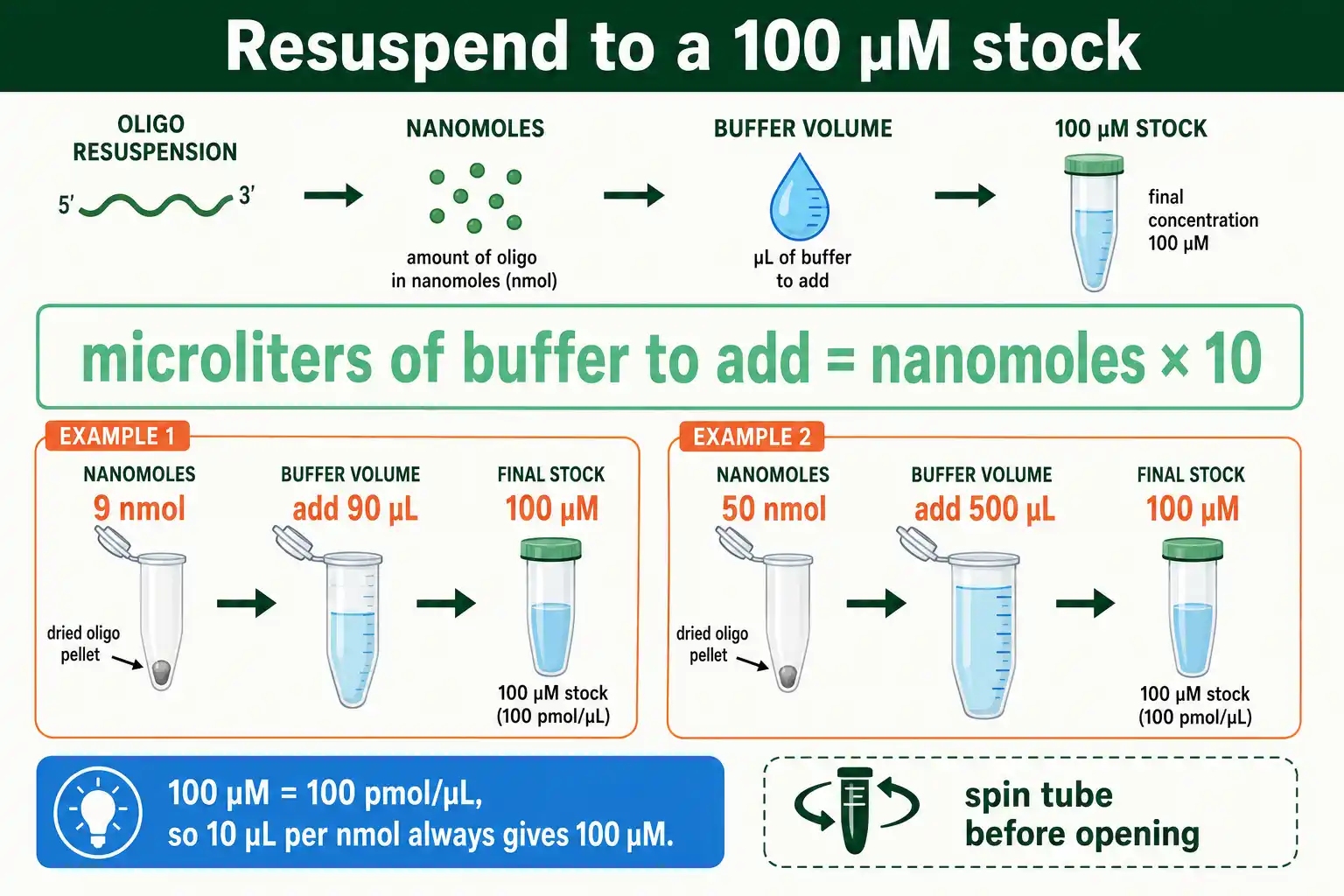
The standard first move is to resuspend the oligo to a 100 µM stock, because it is easy to calculate and convenient to dilute later. The rule for hitting 100 µM is simple.
Take the number of nanomoles in the tube, listed on the tube label and the spec sheet, and multiply by ten. That product is the number of microliters of buffer to add. So an oligo with 9 nmol needs 90 µL of buffer for a 100 µM stock; one with 50 nmol needs 500 µL. The reason this works is that 100 µM equals 100 picomoles per microliter, so adding ten microliters per nanomole always lands at 100 µM regardless of the oligo. Our oligo resuspension calculator does this for any yield and target concentration, and you can also resuspend to a different stock concentration if your workflow calls for it.
After adding buffer, let the oligo dissolve fully. Vortex the tube to mix, then spin briefly to collect the liquid. Giving it a few minutes, or a gentle warming, helps a stubborn pellet go fully into solution, which matters because an incompletely dissolved pellet reads as a falsely low concentration.
Step 4: Dilute to a Working Concentration
Most reactions use a much lower concentration than a 100 µM stock, so you dilute a portion of the stock to a working strength. The tool for this is the dilution equation C1V1 = C2V2.
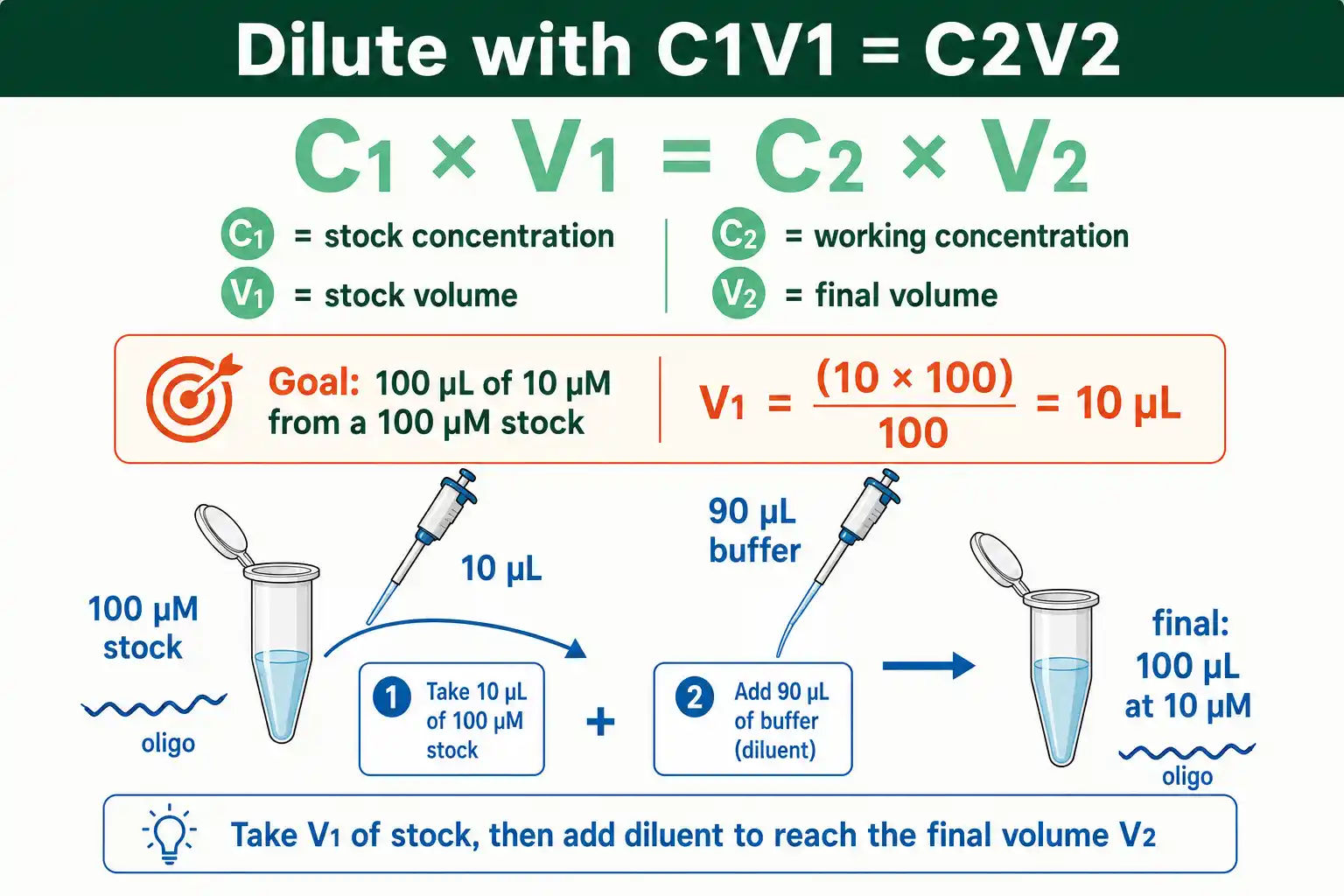
The equation says the concentration of the stock times the volume you take equals the concentration of the working solution times its total volume. In practice you know three of the four values and solve for the fourth, usually the volume of stock to use: V1 = (C2 × V2) / C1. Take that volume of stock, then add diluent to reach the final volume.
A worked example makes it clear. Say you have a 100 µM stock and need 100 µL of a 10 µM working solution. Solve for V1: 10 µM times 100 µL, divided by 100 µM, gives 10 µL. So you pipette 10 µL of stock into a new tube and add 90 µL of buffer to reach 100 µL total. That is a 10-fold dilution, which makes sense going from 100 µM to 10 µM. Our oligo dilution calculator solves C1V1 = C2V2 for any combination, and the same math powers general-purpose tools like our serial dilution calculator when you need a series of steps.
Typical working concentrations are worth knowing. PCR primers are usually used at a final concentration around 0.1 to 0.5 µM in the reaction, and stored as 5 to 10 µM working stocks. qPCR probes often run at 100 to 500 nM. Always check the protocol, since the right working concentration depends entirely on the application. Before diluting, it is worth confirming the oligo's properties, since you can check a sequence's length, GC content, and melting temperature in an oligo analyzer to be sure you are diluting the oligo you think you are.
Step 5: Store Oligos Properly
How you store oligos determines how long they stay usable, and a few habits protect them for years. The enemies are nucleases, freeze-thaw cycles, and for some oligos, light.
Store oligo stocks frozen. A 100 µM stock in TE keeps at minus 20 degrees Celsius for a year or more, and minus 80 is better for very long-term storage or for RNA. The single most useful habit is to aliquot: split the stock into several small working tubes so you thaw only one at a time. Each freeze-thaw cycle slightly degrades an oligo, so a stock thawed dozens of times degrades far faster than one thawed twice. The IDT tips on resuspending and storing oligos reinforce aliquoting as the key to longevity.
Label every tube with the name, concentration, buffer, and date, because an unlabeled tube of clear liquid is useless within a week. For fluorescent oligos, use amber tubes or wrap them in foil to prevent photobleaching of the dye. These steps cost a few minutes and save the expense of reordering degraded oligos.
Troubleshooting Common Problems
A few problems come up again and again when resuspending and diluting oligos. Each has a quick fix.
The pellet will not dissolve. Some oligos, especially long or GC-rich ones, resist going into solution. Vortex thoroughly, spin down, and let the tube sit for several minutes; gentle warming to around 50 to 55 degrees Celsius for a couple of minutes helps stubborn cases. An undissolved pellet is the most common reason a freshly made stock reads low, because some of the oligo is still stuck at the bottom rather than in solution.
The concentration reads lower than expected. Besides an undissolved pellet, the usual culprits are losing dried material when opening an unspun tube, or pipetting error in a small-volume dilution. Spin before opening, and when a dilution calls for a tiny stock volume, scale both volumes up so you are pipetting at least a few microliters, which pipettes handle more accurately than sub-microliter amounts.
The oligo stops working after a while. This is usually degradation from repeated freeze-thaw or from storage in plain water. The fix is preventive: aliquot the stock, store in TE, and keep working dilutions separate from the master stock. The Eurogentec reconstitution and storage guidance gives concentration and temperature recommendations for DNA, RNA, and dye-labeled oligos.
A useful rule throughout is to make changes you can undo. Resuspending to a concentrated stock and diluting down is reversible in the sense that you always have concentrated material in reserve; over-diluting a whole tube is not, since you cannot easily reconcentrate it. Keep the master stock concentrated and dilute small portions as needed.
Resuspension and Dilution at a Glance
The whole workflow fits in a short reference. The table summarizes the key numbers.
| Task | What to do |
|---|---|
| Before opening | Spin the tube briefly to collect the pellet |
| Buffer | TE (10 mM Tris, EDTA, pH 8.0) or nuclease-free water |
| 100 µM stock | Add µL of buffer = nmol × 10 |
| Working dilution | Solve V1 = (C2 × V2) / C1 |
| Primer working stock | Typically 5 to 10 µM |
| Storage | Aliquot, freeze at -20°C (-80°C for RNA) |
The two formulas do the heavy lifting. The 10-times-nanomoles rule gets you a 100 µM stock, and C1V1 = C2V2 gets you any working dilution from it. Everything else, spinning, buffer choice, aliquoting, is good technique that keeps the numbers honest and the oligo intact.
Frequently Asked Questions
How do you resuspend an oligo to 100 µM?
Multiply the number of nanomoles in the tube by ten, and add that many microliters of buffer. For example, a tube with 20 nmol needs 200 µL of TE buffer or nuclease-free water for a 100 µM stock. This works because 100 µM equals 100 picomoles per microliter, so ten microliters per nanomole always gives 100 µM.
Should I resuspend oligos in water or TE buffer?
TE buffer is the better choice for storage. It holds a slightly basic pH and contains EDTA, which protects the oligo from acid degradation and from nucleases. Nuclease-free water is acceptable, especially when EDTA would interfere downstream, but it is not ideal for long-term storage because slightly acidic water can slowly degrade DNA.
How do I dilute an oligo to a working concentration?
Use C1V1 = C2V2. Solve for the stock volume needed: V1 = (C2 × V2) / C1, where C1 is the stock concentration, C2 is the working concentration, and V2 is the final volume. Pipette that volume of stock into a tube and add diluent to reach the final volume. For example, to make 100 µL of 10 µM from a 100 µM stock, mix 10 µL of stock with 90 µL of buffer.
From Tube to Bench-Ready
Resuspending and diluting an oligo is a two-formula job. Add microliters of buffer equal to ten times the nanomoles to make a 100 µM stock, then apply C1V1 = C2V2 to dilute that stock to whatever working concentration your reaction needs. Spin the tube before opening, use TE buffer or nuclease-free water, and let the pellet dissolve fully so your concentrations are accurate.
Good storage keeps the work intact: aliquot the stock, freeze it, and protect fluorescent oligos from light. With the oligo in solution at a known concentration, the properties that govern how it behaves in a reaction, its GC content and melting temperature, come next, covered in our guide on GC content and melting temperature.