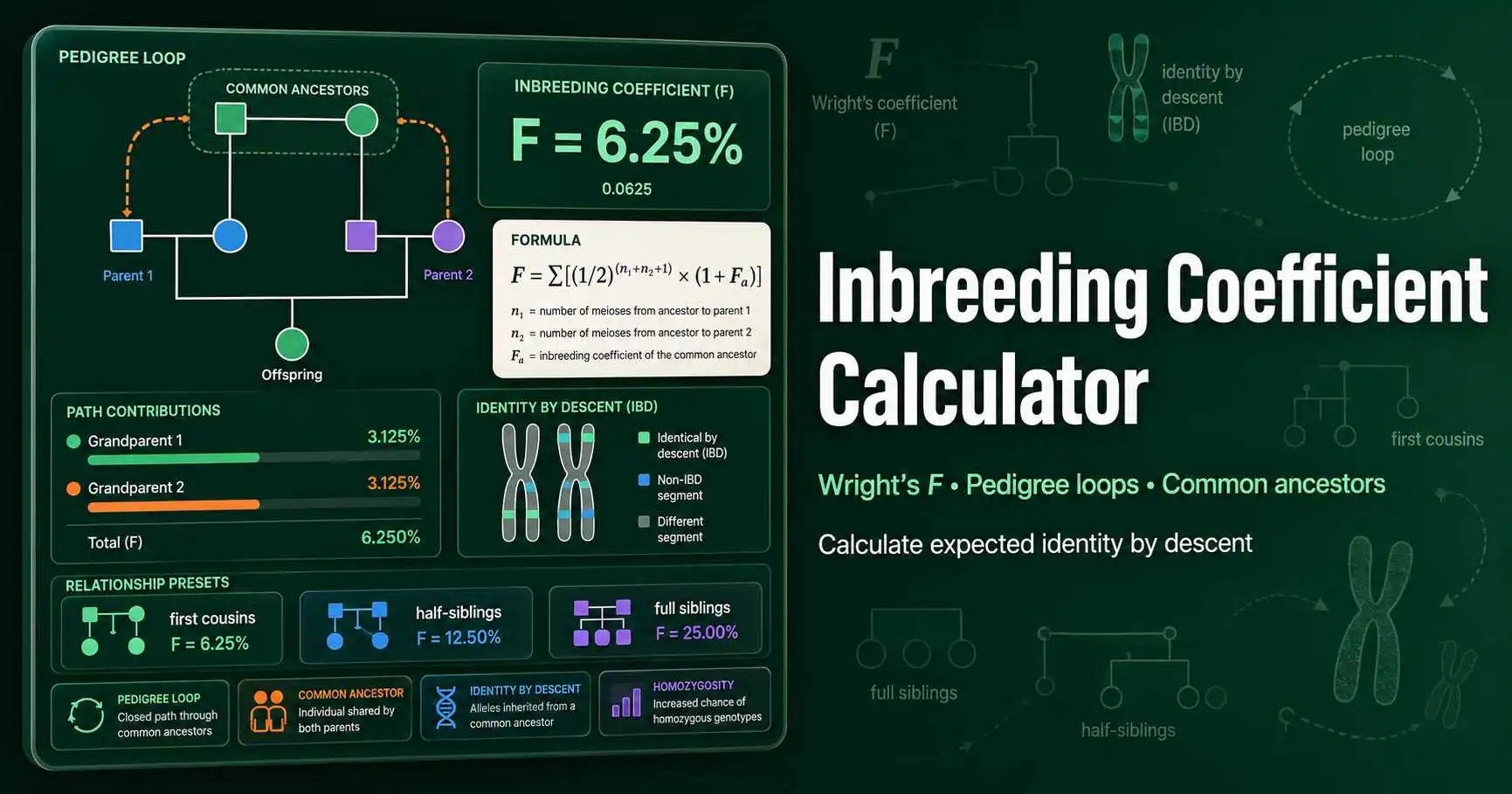
Inbreeding Coefficient Calculator

Calculate Wright’s inbreeding coefficient F from common ancestor paths in a pedigree. The calculator helps students, breeders, and conservation genetics learners estimate expected identity by descent for offspring from first cousins, full siblings, half-siblings, parent–offspring matings, and custom loops.

Live inbreeding coefficient calculator for pedigree loops

Select a relationship preset or enter each common ancestor loop. The result updates immediately with F as a percentage, decimal value, and path-by-path contribution.

Choose a pedigree relationship

Start with a common mating pattern, then edit the loop paths when your pedigree has a different structure.

First cousins

Two shared grandparents, with two generations from each parent to each common ancestor.

Common ancestor loop paths

Each row represents one independent path through a common ancestor shared by the two parents.

Loop path 1

Contribution: 3.1250%

Loop path 2

Contribution: 3.1250%

Pedigree loop preview

The diagram shows how both parents can trace back to the same ancestor, creating identity-by-descent risk.

Pedigree loop diagram for Wright inbreeding coefficientFirst cousinsShared ancestors create loop paths through both parents.CAP1P2XOffspring F6.25%

Wright path formula

FX = Σ [(1/2)n₁+n₂+1 × (1 + FA)]

n₁ and n₂ count generations from each parent to the common ancestor. FA is that ancestor’s own inbreeding coefficient.

Live result

F = 6.250%

This value matches or approaches the expected offspring F from a first-cousin mating.

Decimal F

0.0625

Parent r estimate

12.50%

Paths

2

Path contribution cards

Larger bars show the loop paths that add most to the offspring inbreeding coefficient.

Shared grandparent 13.125%

n₁ = 2, n₂ = 2, ancestor F = 0%

Shared grandparent 23.125%

n₁ = 2, n₂ = 2, ancestor F = 0%

How to read this result

F estimates the probability that two alleles in the offspring are identical by descent from a shared ancestor.

A value of 6.25% means 0.0625 of the offspring genome has expected autozygosity under this pedigree model.

Pedigree F predicts expected inheritance. DNA-based runs of homozygosity can differ because real recombination is random.

Pedigree diagram showing common ancestors, loop paths, and Wright inbreeding coefficient contributions for an offspring
Figure 1. Wright’s inbreeding coefficient traces identity by descent through pedigree loops. Each loop connects parent 1 and parent 2 through a common ancestor, then adds a probability term based on meiotic transmission across the two branches.

What is an inbreeding coefficient?

An inbreeding coefficient, usually written as F, estimates the probability that two alleles in one individual are identical by descent. Identical by descent means both alleles trace back to the same ancestral allele copy. The value comes from pedigree structure, not from the visible trait.

Sewall Wright formalised coefficients of inbreeding and relationship in the early twentieth century. His path method counts each independent route from one parent to a common ancestor and back down to the other parent. Boucher later proved Wright’s rule for arbitrary pedigrees covering autosomal and X-linked loci. View the PubMed record.

F connects pedigree analysis with population genetics. Small effective population size raises random mating between relatives, so the effective population size calculator can help explain why inbreeding accumulates faster in small breeding populations.

How to use Inbreeding Coefficient Calculator

  1. 1

    Choose a relationship preset

    Select first cousins, half-siblings, full siblings, parent–offspring, or another common pedigree pattern.

  2. 2

    Edit common ancestor paths

    Enter each shared ancestor and count generations from parent 1 and parent 2 to that ancestor.

  3. 3

    Add ancestor inbreeding when known

    Type F_A as a percentage if the common ancestor is already inbred; otherwise leave it at zero.

  4. 4

    Read the offspring F result

    Use the percentage, decimal F, and contribution bars to see which pedigree loop drives the result.

Count generations carefully. A parent to its own parent counts as one generation. A parent to a grandparent counts as two generations. If a common ancestor appears in more than one independent loop, enter each loop separately.

What each part of Inbreeding Coefficient Calculator does

Relationship presets

These buttons load common pedigree structures such as first cousins, half-siblings, and full siblings. They save time when you need a standard textbook value.

Loop path inputs

Each input card represents one common ancestor path. The generation counts control how strongly that ancestor contributes to F.

Common ancestor F

This field adjusts the formula when the shared ancestor already has inbreeding. Leave it at 0% when you do not know that ancestor’s own pedigree F.

Contribution bars

The bars show which ancestor path adds the most to the final value. Short loops usually dominate the calculation.

Inbreeding coefficient formula used in this calculator

The calculator applies Wright’s path formula to every common ancestor loop. One path contributes (1/2)n₁+n₂+1 × (1 + FA). The total offspring F equals the sum of all valid path contributions.

n₁ counts generations from parent 1 to the common ancestor. n₂ counts generations from parent 2 to the same ancestor. FA represents the common ancestor’s inbreeding coefficient, so an inbred ancestor increases the final offspring value.

Unrelated parents

Shared paths
No shared ancestor loop
Expected F
0%
Meaning
No expected identity by descent from entered pedigree

Second cousins

Shared paths
Two shared great-grandparents
Expected F
1.56%
Meaning
Distant shared ancestry

First cousins

Shared paths
Two shared grandparents
Expected F
6.25%
Meaning
One grandparent pair connects both parents

Half-siblings

Shared paths
One shared parent
Expected F
12.5%
Meaning
One very short common-ancestor loop

Full siblings

Shared paths
Two shared parents
Expected F
25%
Meaning
Two short loops through both parents

Inbreeding coefficient worked examples

Example 1: first cousins

First cousins share two grandparents. Each grandparent sits two generations from parent 1 and two generations from parent 2. Each path contributes (1/2)5, or 1/32.

Two grandparents produce 1/32 + 1/32 = 1/16. The offspring F equals 0.0625, or 6.25%.

Example 2: full siblings

Full siblings share both parents. Each shared parent sits one generation from parent 1 and one generation from parent 2. Each path contributes (1/2)3, or 1/8.

Two shared parents produce 1/8 + 1/8 = 1/4. The offspring F equals 0.25, or 25%.

Why inbreeding coefficient matters in genetics

Inbreeding increases homozygosity because both alleles can descend from the same ancestor. That shift can expose recessive variants, reduce fitness in small populations, and make family-based carrier risk more predictable. The effect depends on pedigree depth, founder diversity, and the distribution of harmful alleles.

Conservation geneticists track F beside drift, bottlenecks, and loss of heterozygosity. You can compare this page with the genetic drift simulator to see how small populations lose variation even without selection. For family risk involving recessive conditions, the carrier probability calculator handles a different question: whether a person likely carries a specific allele.

What Inbreeding Coefficient Calculator cannot determine

The calculator does not read DNA markers, detect runs of homozygosity, or identify harmful variants. It estimates expected identity by descent from pedigree paths. Real genomes can differ from the expectation because meiosis samples chromosome segments randomly.

It also does not judge breeding ethics, animal health, or human clinical risk. Those decisions need full pedigree review, trait records, DNA testing, and professional guidance. Treat this result as an educational pedigree-genetics estimate.

Inbreeding coefficient calculator FAQs

What does an inbreeding coefficient calculator measure?
An inbreeding coefficient calculator estimates F, the probability that two alleles in an offspring are identical by descent. A value of 0% means the entered pedigree shows no shared ancestor between the parents. A value of 6.25% matches the expected F for offspring of first cousins when the shared grandparents are not inbred. The value describes expected autozygosity from the pedigree, not a direct DNA measurement.
How do I calculate F for first cousins?
First cousins usually share two grandparents. Each grandparent creates one loop with n₁ = 2 generations from parent 1 and n₂ = 2 generations from parent 2. Each loop contributes (1/2)5, or 1/32. Two shared grandparents add 1/32 + 1/32 = 1/16, so the offspring inbreeding coefficient equals 6.25%.
What does F = 0.25 mean in a pedigree?
F = 0.25 means 25% expected identity by descent across the offspring genome under the pedigree model. Full-sibling and parent–offspring matings both produce this value when the relevant common ancestors are not already inbred. That value does not mean every locus becomes homozygous. It means one quarter of loci, on average, trace both alleles to the same ancestral copy.
Why does the common ancestor’s own F change the calculation?
Wright’s path formula multiplies each loop by (1 + FA). FA represents the common ancestor’s own inbreeding coefficient. If the common ancestor already carries identical-by-descent alleles, the offspring has a higher chance of receiving matching ancestral copies through both parents. This matters in linebreeding systems where the same ancestors appear repeatedly.
Is pedigree F the same as genomic inbreeding?
No. Pedigree F uses recorded ancestors and expected Mendelian transmission. Genomic inbreeding uses DNA markers or runs of homozygosity to measure realised autozygosity. Two individuals with the same pedigree F can inherit different chromosome segments because recombination and segregation are random. Use pedigree F for expected risk and genomic methods when marker data exist.
Can this calculator evaluate human medical risk?
This calculator explains pedigree genetics and expected identity by descent. It does not diagnose a condition, estimate a specific disease probability, or replace genetic counselling. Medical risk depends on the exact pathogenic variant, carrier frequencies, family history, penetrance, and test sensitivity. For health decisions, use a qualified clinician or genetic counsellor.
How many common ancestor paths should I enter?
Enter every independent loop that connects parent 1 and parent 2 through a shared ancestor. First cousins need two paths because they share two grandparents. Double first cousins need four paths because they share four grandparents. Complex pedigrees can require more paths, especially when the same founder appears in several branches.

Use these tools to connect pedigree inbreeding with population size, genetic drift, and allele-frequency change.