Inbreeding Coefficient from a Pedigree
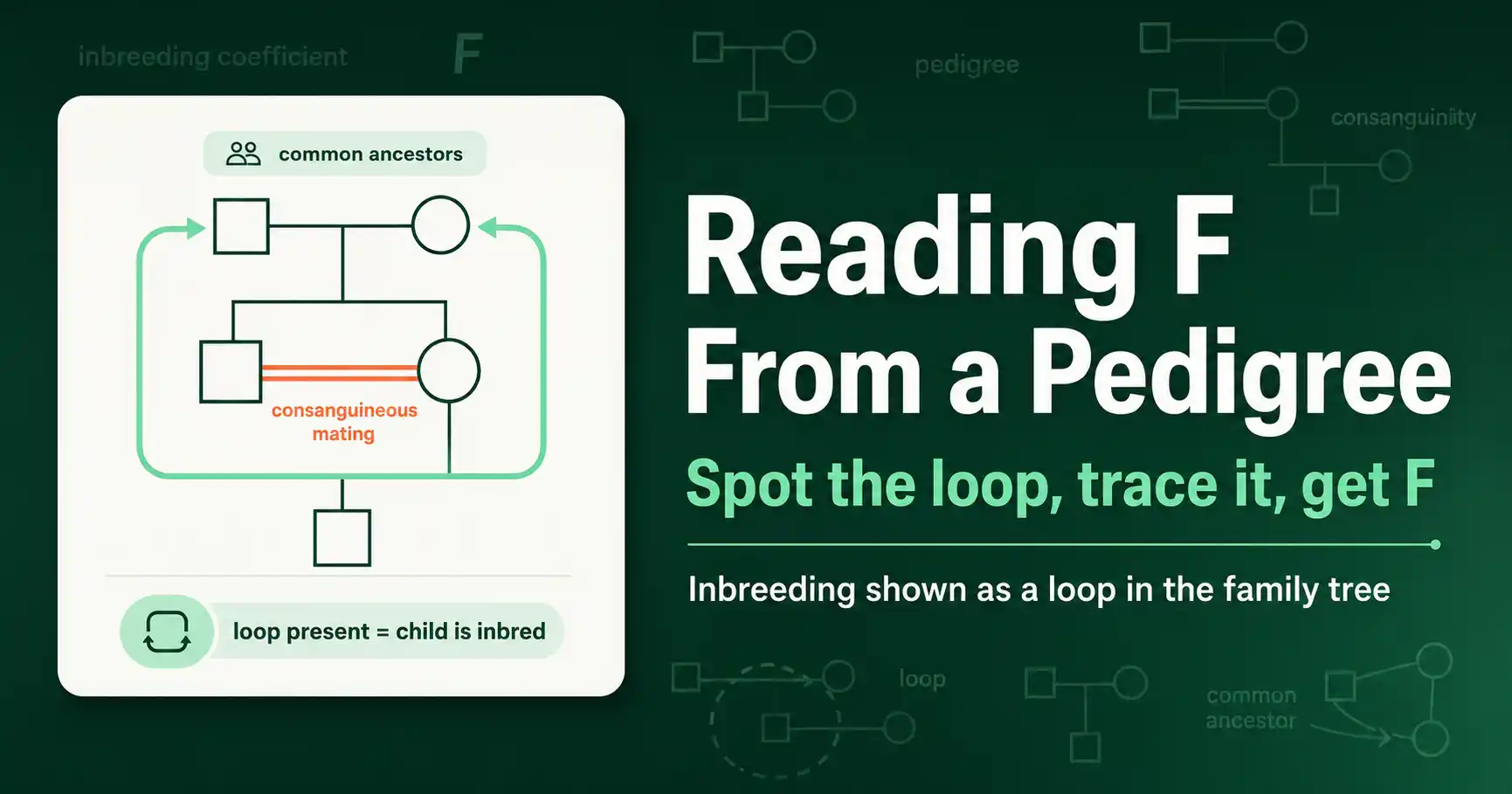
A pedigree shows inbreeding as a loop. Whenever a family tree contains a closed loop, the path that runs up from one parent to a shared ancestor and back down to the other parent, the offspring at the bottom is inbred. No loop means no inbreeding. Reading the inbreeding coefficient F from a pedigree is mostly the skill of spotting that loop and tracing it.
This guide shows how to read F directly off a family tree. It covers the pedigree symbols that flag inbreeding, how to find the loop, how to turn the loop into a number, and what the resulting F means for real families. The arithmetic itself follows Wright's path method, applied here straight to the chart.
The Symbol That Signals Inbreeding
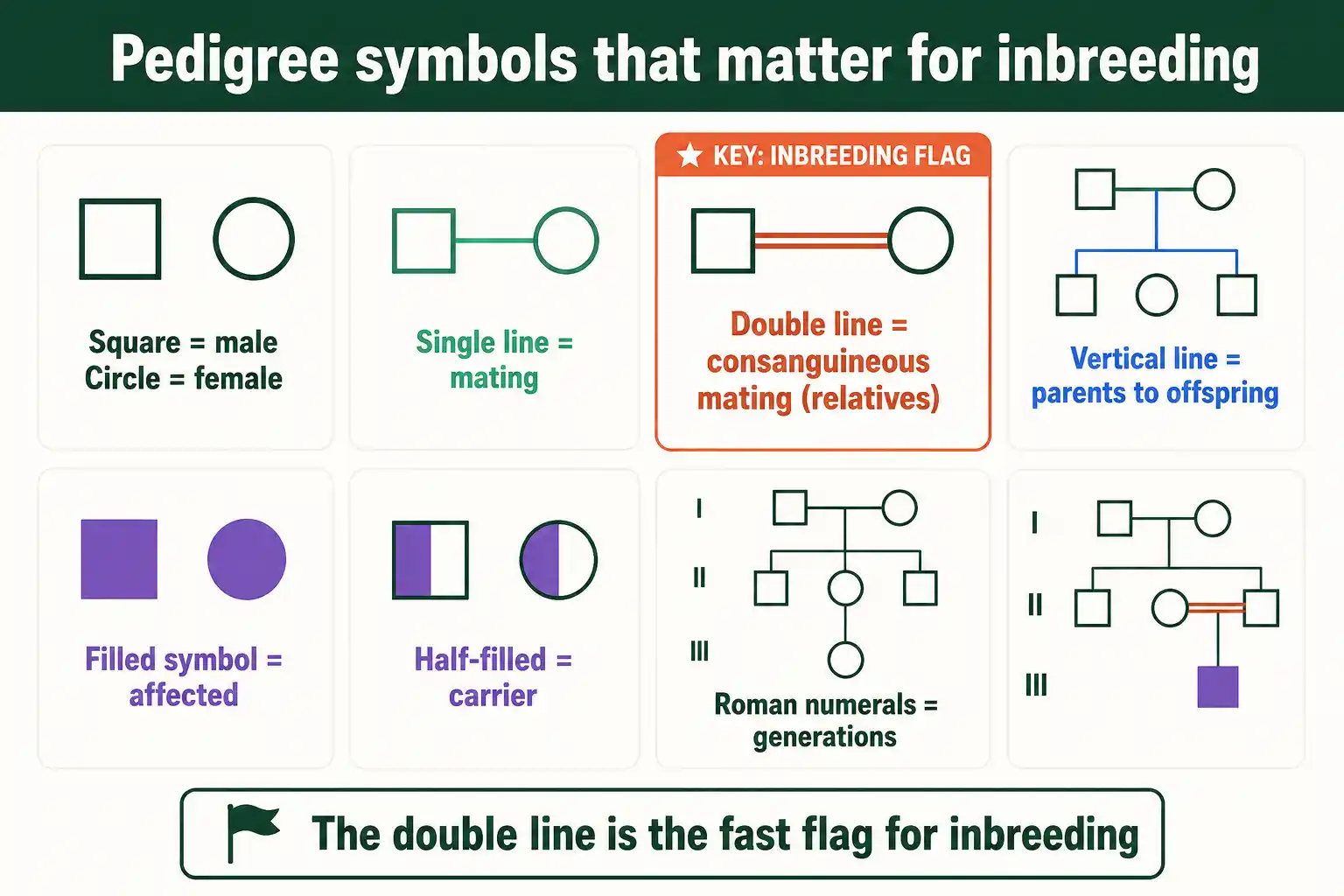
One pedigree symbol announces inbreeding before you trace anything: the double line. A standard mating between two individuals is drawn as a single horizontal line connecting them. A mating between relatives, a consanguineous mating, is drawn as a double horizontal line.
So the fastest scan of any pedigree is to look for double lines. Each one marks a couple who share ancestry, which means their children carry some inbreeding. If the degree of relationship is not obvious from the chart, it is usually written above the line, such as "first cousins" or "second cousins."
The rest of the symbols set the stage. Squares are males, circles are females, and a horizontal line joins mates. Vertical lines drop from a couple to their children, who are drawn left to right by birth order. Filled symbols mark individuals affected by the trait being studied, and half-filled symbols often mark known carriers. Generations are labeled with Roman numerals down the left edge. None of these create inbreeding on their own, but together they let you trace the ancestry that the double line flags. If you want the chart drawn and analyzed automatically, our pedigree analyzer handles the symbols and relationships for you.
Finding the Loop
The loop is the heart of reading F from a pedigree. A loop is a closed path: start at the inbred individual, go up through one parent to a common ancestor, then come back down through the other parent.
To find it, start at the individual whose F you want. Move up to their two parents. Then ask the key question: do these two parents connect back to any shared ancestor? Follow each parent's line upward. Wherever the two lines meet at the same individual, that individual is a common ancestor, and the closed path through them is a loop.
Two rules keep this accurate. First, never pass through the same individual twice within one loop. Second, the number of loops equals the number of common ancestors the parents share. Two shared ancestors, like the two grandparents that first cousins have in common, produce two loops. One shared ancestor, as with half siblings, produces one.
A loop is often written as a chain of initials. For the child of first cousins, a loop might read child–parent–grandparent–parent–child, naming each individual the path passes through from one parent up to the shared grandparent and back. Writing the loop out this way, rather than eyeballing it, is the single best habit for getting F right.
Turning the Loop Into a Number
Once you have the loop, the number follows a fixed rule. Count the links in the loop, the connecting lines from one parent up to the common ancestor and back down to the other parent. Raise one-half to that count. Do this for each loop and add the results.
For a child of first cousins, each of the two loops contributes (1/2) to the fifth power, or 1/32. Two loops sum to 1/16, which is 0.0625. For a child of half siblings, the single shorter loop gives 0.125. The closer the shared ancestor sits to the offspring, the shorter the loop and the larger its contribution.
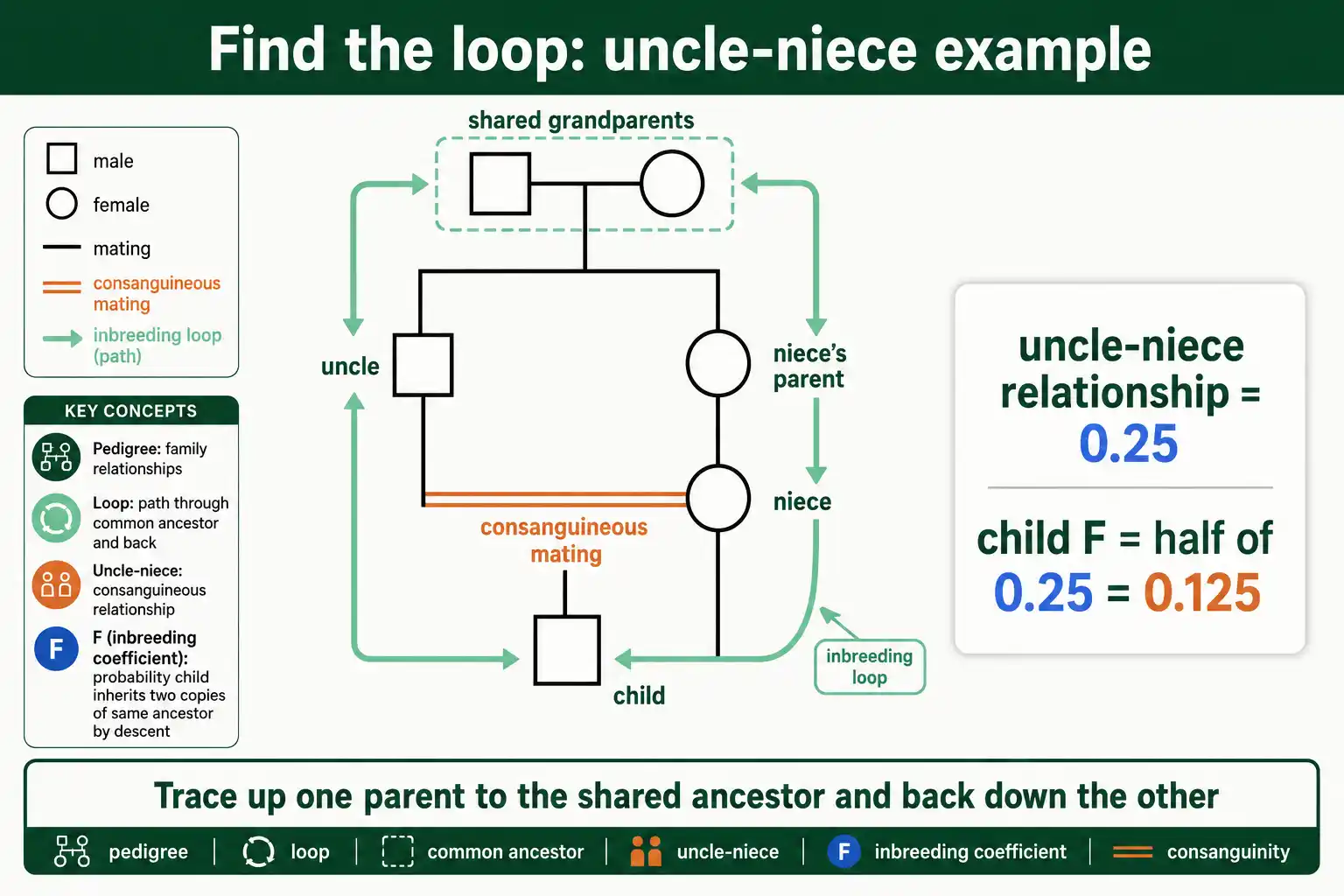
There is a useful shortcut that pedigrees make obvious. When the parents themselves are not inbred, the child's F equals exactly half the coefficient of relationship between the parents. Uncle and niece have a relationship of 0.25, so their child's F is 0.125. Full siblings have a relationship of 0.5, so their child's F is 0.25. If you already know how related the parents are, you can halve it and skip the loop tracing entirely. To check any pedigree against the exact figure, you can run the relationship through an F calculator and compare.
Reading a Worked Pedigree
Put it together on a concrete chart: an uncle-niece mating. This is a common consanguinity case and shows every step.
Draw it out. An uncle and his niece are connected by a double line, marking the consanguineous mating, and their child sits below. The uncle and niece share ancestors: the uncle's parents are also the niece's grandparents, since the niece's parent is the uncle's sibling. So the shared ancestors are that grandparental couple, giving the loops.
Trace from the child up through the uncle to a shared grandparent, then down through the niece's parent to the niece and back to the child. Count the links, apply one-half to that power for each shared grandparent, and sum. The result is 0.125, which matches the shortcut: an uncle-niece relationship of 0.25, halved, gives a child F of 0.125. Two routes, the full loop trace and the halve-the-relationship shortcut, agree, which is the confirmation you want. When they disagree, the trace is almost always where the slip happened, usually a loop that accidentally passed through someone twice or a missed second loop.
What the Number Means for a Family
F is not just an abstract figure on a chart. It maps onto real risk, which is why pedigrees with consanguinity loops matter in genetic counseling.
The higher the F, the more likely the child is to inherit two copies of the same recessive allele, including harmful ones. The real-world figures are concrete. According to data summarized by Britannica, the offspring of first-cousin marriages have roughly 3.5 to 4.5 percent higher mortality than the children of unrelated parents, along with about 2 to 3 percent additional birth defects. For first-degree matings, between full siblings or parent and child, excess mortality and serious childhood defects have been reported in 20 to 35 percent of offspring.
These numbers carry two messages at once. The added risk from cousin-level consanguinity is real but modest in absolute terms, which is why first-cousin marriage is common and accepted in many cultures. The risk from first-degree inbreeding is severe. The size of the loop in the pedigree, and the F it yields, is what separates these cases. A short, close loop means a high F and substantial risk; a long, distant loop means a low F and little added risk.
A Fast Way to Scan Any Pedigree
When you first look at an unfamiliar pedigree, a quick routine tells you whether inbreeding is present and roughly how much, before any calculation.
First, scan for double lines. If there are none, and no ancestor appears on both sides of any couple, there is no inbreeding to compute, and every individual's F is effectively 0. This single check settles most pedigrees in seconds.
Second, if a double line exists, find the couple it joins and look up to their ancestors. Trace each partner's lines upward until they meet. The generation where they meet tells you the closeness: meeting at a shared parent means a high F, meeting at shared grandparents means first-cousin-level F, and meeting only at great-grandparents or beyond means a low F.
Third, estimate before you calculate. Knowing the relationship, full sibs, half sibs, first cousins, lets you halve the relationship coefficient for an instant F. The formal loop trace then confirms it. This estimate-then-verify habit catches arithmetic slips, because a hand-traced answer that disagrees with the known relationship value signals an error in the tracing.
When Pedigrees Get Complicated
Real family trees are not always tidy, and a few situations need extra care when reading F.
Multiple loops appear when parents share more than two ancestors, or are related through several lines at once. Each loop is traced and summed separately, so missing one undercounts F. Double first cousins, who share all four grandparents, produce four loops and an F of 0.125, double the ordinary first-cousin value.
Inbred ancestors complicate the count. If a common ancestor in the loop was themselves the product of a consanguineous mating, shown by a double line higher up the chart, that ancestor's own F must be calculated first and folded in, which raises the descendant's F. A pedigree with double lines in more than one generation is the visual cue that this extra step is needed.
Incomplete pedigrees are the most common real limitation. A chart that stops a few generations back can hide shared ancestry further up, so the F read from a short pedigree is a floor, not a ceiling. The true value can be higher if the founders were related in ways the chart does not show.
Frequently Asked Questions
How do you know if a pedigree shows inbreeding?
Look for a double horizontal line between two mates, which marks a consanguineous mating, and look for any closed loop in the tree. A loop runs from an individual up through one parent to a shared ancestor and back down through the other parent. If a loop exists, the individual at the bottom is inbred.
How do you calculate F from a family tree?
Find the common ancestors of the individual's two parents, trace one loop through each without repeating anyone, count the links in each loop, raise one-half to that power, and sum across all loops. When the parents are not themselves inbred, you can shortcut this by halving the coefficient of relationship between the parents.
Reading the Tree at a Glance
Reading F from a pedigree comes down to three moves: spot the double line that flags a consanguineous mating, trace the loop from one parent up to the shared ancestor and back down to the other, and turn the loop into a number by summing one-half raised to each loop's length. The closer the shared ancestor, the shorter the loop and the higher the F.
The chart also tells you what the number means. A short loop signals high F and real recessive-disease risk; a distant loop signals low F and little added risk. Families with consanguinity in their history, especially first-degree or repeated cousin unions, benefit from speaking with a genetic counselor, who reads these pedigrees professionally and can assess risk for specific conditions. For the step-by-step arithmetic behind any loop, our guide on calculating the inbreeding coefficient lays out the full method.