Punnett Squares for GCSE Biology (AQA, Edexcel, OCR)
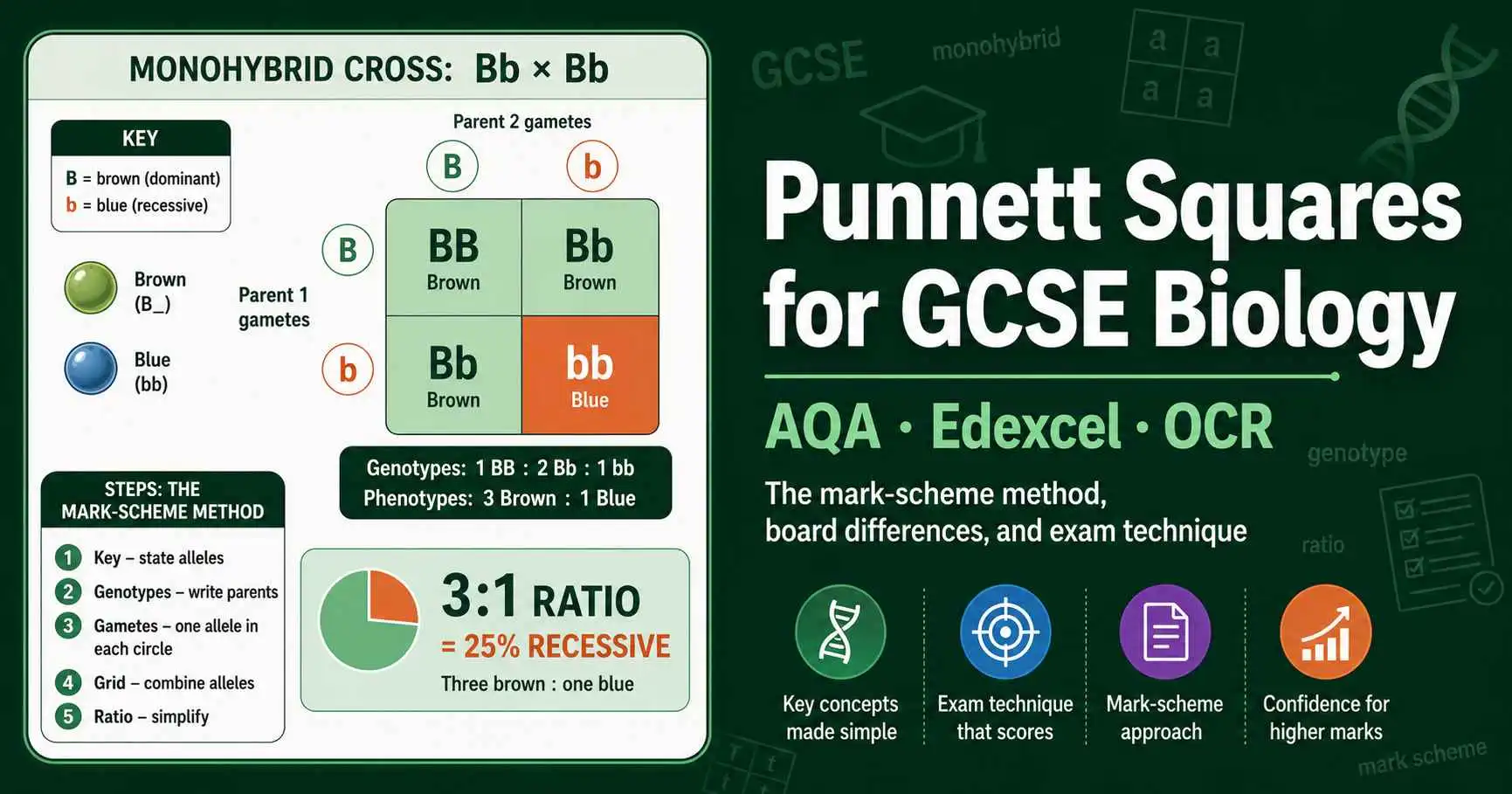
Punnett squares are a core part of GCSE Biology genetics, and exam boards expect you to use them to predict the genotypes, phenotypes, and probabilities of offspring from a genetic cross. On the higher tier, you must construct your own Punnett square from scratch, label it fully, and work out a ratio or probability. The method is the same across AQA, Edexcel, and OCR, though the exact requirements and examples differ slightly by board.
This guide is written for GCSE students who want to nail the Punnett square questions in their exam. It covers the precise method examiners reward, the differences between the major boards, the GCSE-specific examples that come up, and the common mistakes that lose marks. Master these and you can pick up the full marks these questions offer, which are some of the most reliable in the genetics topic. For a thorough grounding in the basics first, our guide on how a Punnett square works covers everything from the ground up.
What GCSE Biology Expects You to Know
At GCSE, a Punnett square is defined as a model used to predict the inheritance of alleles from parents to offspring. Examiners expect you to understand that it shows the possible combinations of alleles in the offspring, and that you can read both genotypes and phenotypes from it. This is single-gene, or monohybrid, inheritance for most boards, which keeps the maths manageable.
You need to be confident with the core vocabulary, because exam questions use these terms precisely and often award marks for using them correctly. An allele is a version of a gene. A dominant allele is always expressed, even with only one copy, and is written with a capital letter. A recessive allele is only expressed when two copies are present, written with a lowercase letter. Homozygous means two identical alleles, like BB or bb, and heterozygous means two different alleles, like Bb. Getting these two terms the right way round is essential, since questions often hinge on them, and our guide on homozygous vs heterozygous explains the distinction with clear examples. Genotype is the combination of alleles, and phenotype is the physical characteristic that results.
There is one more idea GCSE examiners emphasise: probability. A Punnett square predicts the proportion or probability of each outcome, not a guarantee. A common exam point is that each instance of fertilisation is independent, just like tossing a coin, so a 3:1 ratio does not mean exactly three of every four offspring will show the dominant trait. Understanding that the square predicts likelihood rather than certainty is worth marks, and it prevents the classic error of assuming only four offspring are produced.
The Mark-Scheme Method: How to Set Out a Cross
Examiners reward a clear, structured layout, and following the mark-scheme order is the surest way to collect every available mark. Genetics questions are often worth four to six marks, and those marks are spread across the steps, so showing your working matters as much as the final answer.
Use this structure every time. First, define your allele symbols in a key, for example "B = brown, b = blue," so the examiner knows what your letters mean. Second, state the parental phenotypes and their genotypes. Third, show the gametes each parent produces, ideally circled, with one allele per gamete. Fourth, draw the Punnett square and combine the gametes to fill the boxes. Fifth, read off the offspring genotypes and phenotypes, then give the ratio or probability the question asks for.
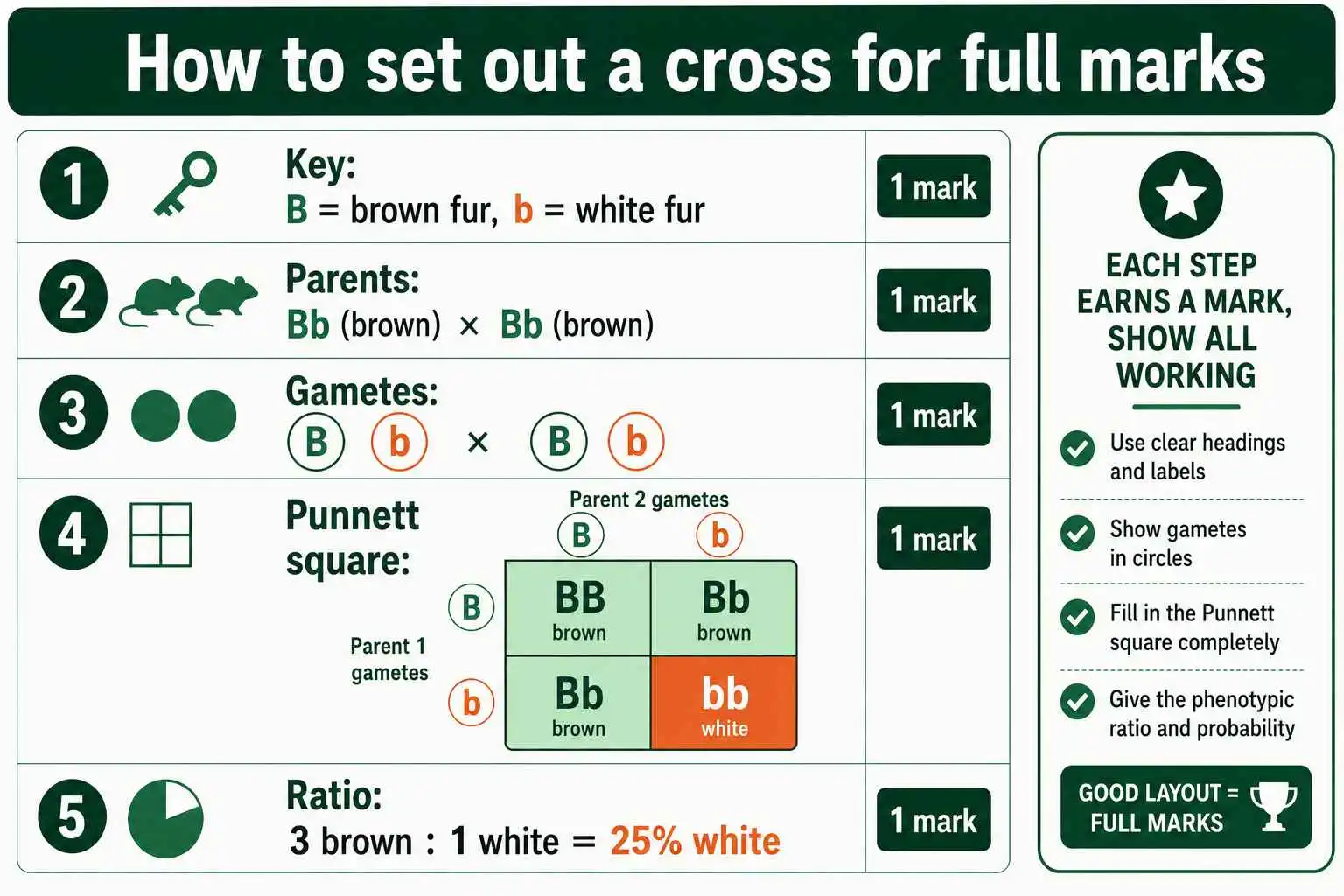
Each of these steps typically earns a mark, which is why skipping straight to the grid costs you. A question worth four marks might award one for the gametes, one for correctly filling the square, one for the genotypes, and one for the correct phenotypic ratio. Even if you make an arithmetic slip at the end, a clearly labelled square can still earn most of the marks through the method. Laying the cross out fully is not just good practice; it is how the marks are actually distributed, so it directly raises your score.
Board Differences: AQA, Edexcel and OCR
While the core method is identical across boards, the specifications differ in important ways, and knowing your board saves you from revising material you do not need or missing material you do. Always check your own specification, but the broad differences are worth understanding.
AQA and OCR both require Punnett squares for single-gene inheritance, and both treat the higher tier as requiring you to construct your own square rather than just complete a partly filled one. OCR A at A-level extends into dihybrid crosses and even epistasis, though at GCSE the focus stays on monohybrid crosses. Edexcel also requires Punnett squares for monohybrid inheritance, with exam questions frequently using examples like pea plants and inherited conditions. The foundation tier across boards may give you a partly completed square to finish, while the higher tier expects full construction.
The most important practical difference is between foundation and higher tier within each board. On foundation papers, you are more likely to be asked to complete a Punnett square that is already partly drawn, or to read genotypes and phenotypes from a finished one. On higher papers, you must build the whole thing yourself, define the alleles, work out the gametes, and calculate the probability. Knowing which tier you are sitting tells you how much you need to be able to do unaided, and the higher-tier skill of full construction is the one most worth practising. For extra practice across boards, the BBC Bitesize genetics pages align closely with what each specification expects.
Worked Exam Question: A Monohybrid Cross
Exam questions usually frame the cross around a real organism, so let us work through a typical one. In guinea pigs, the allele for rough fur (R) is dominant to the allele for smooth fur (r). Two heterozygous rough-furred guinea pigs are crossed. Predict the probability of a smooth-furred offspring. This is a classic four-mark question.
Follow the method. Start with the key: R is rough fur, r is smooth fur. Both parents are heterozygous rough-furred, so their genotype is Rr. Each Rr parent produces two gametes, one carrying R and one carrying r. Now draw the square, placing the gametes on the axes and combining them. The four boxes come out as RR, Rr, Rr, and rr.
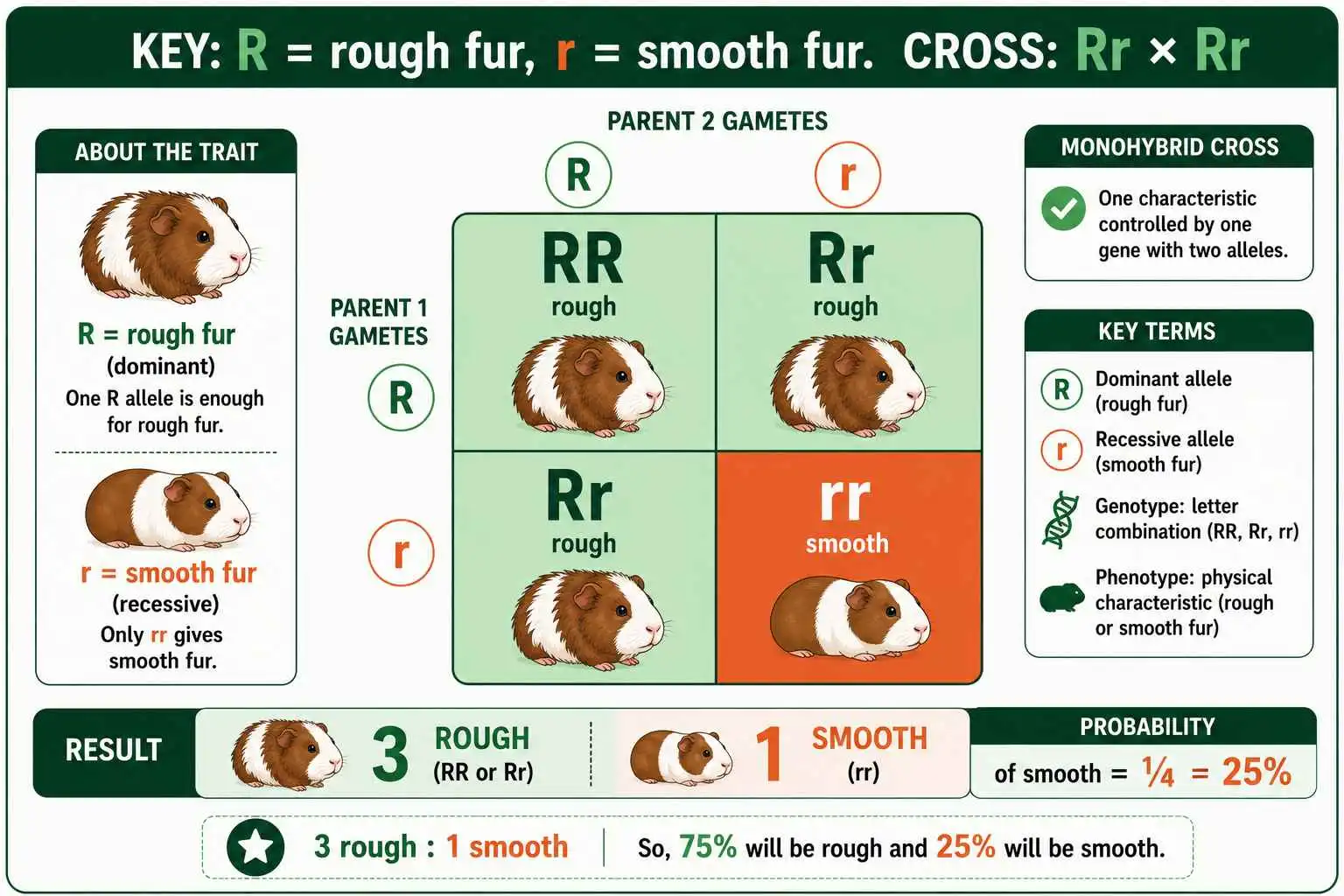
Reading the result, three boxes contain at least one R and are rough-furred, while one box is rr and smooth-furred. So the phenotypic ratio is 3 rough to 1 smooth, and the probability of a smooth-furred offspring is one in four, which you can write as 1/4, 0.25, or 25 percent. A useful exam tip: always check how the question wants the answer expressed, since it may specifically ask for a fraction, a decimal, or a percentage, and giving the wrong format can cost a mark.
GCSE Genetic Disorders: Cystic Fibrosis and Polydactyly
GCSE specifications require you to apply Punnett squares to inherited disorders, and two come up repeatedly: cystic fibrosis and polydactyly. These are worth knowing well, because disorder questions often carry extended marks and test whether you understand recessive versus dominant inheritance.
Cystic fibrosis is the standard recessive disorder example. It is caused by a recessive allele, so a person needs two copies to have the condition, while someone with one copy is a healthy carrier. The classic exam cross is between two carriers, which gives a 25 percent chance of an affected child, a 50 percent chance of a carrier child, and a 25 percent chance of an unaffected child. Being able to explain why two healthy parents can have an affected child, through the carrier concept, is frequently tested and shows real understanding.
Polydactyly, having extra fingers or toes, is the standard dominant disorder example at GCSE. Because it is caused by a dominant allele, only one copy is needed to have the condition, so an affected parent has a 50 percent chance of passing it to each child, and there are no carriers. Contrasting these two disorders, recessive cystic fibrosis with its carriers and 25 percent risk, against dominant polydactyly with its 50 percent risk and no carriers, is a common exam theme.
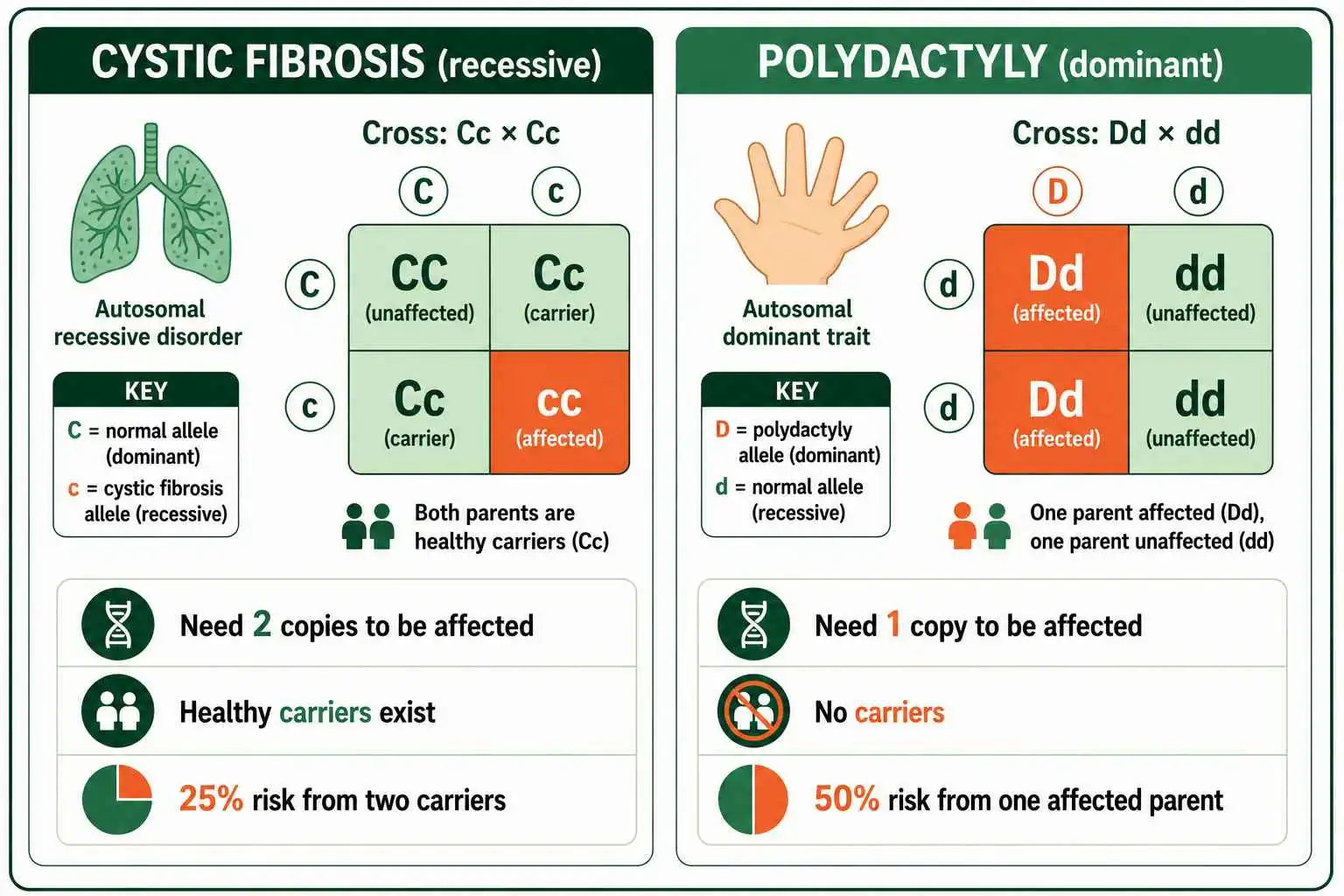
Our guide to genetic disorders and Punnett squares explores these patterns in more depth if you want extra background.
Reading Genotypes and Phenotypes From a Square
A skill examiners test directly is reading information out of a completed Punnett square, so it is worth practising separately from constructing one. Foundation papers in particular often hand you a finished square and ask you to interpret it.
The key is to read the square in two ways. To find genotypes, you simply list the allele combinations in the boxes, such as one BB, two Bb, and one bb. To find phenotypes, you apply the dominance rule: any box with at least one dominant allele shows the dominant trait, and only the homozygous recessive boxes show the recessive trait. So a square with one BB, two Bb, and one bb gives a 3:1 phenotypic ratio but a 1:2:1 genotypic ratio. Knowing which ratio the question wants is essential, since these are different numbers from the same square.
Probability questions are a variation on the same skill. To find the probability of a specific outcome, count the boxes showing that outcome and express it as a fraction of the total four boxes. One smooth-furred box out of four is a probability of 1/4. Examiners may then ask you to convert this to a percentage or decimal, so practise switching between 1/4, 25 percent, and 0.25 fluently. These reading skills are reliable mark-earners because they test understanding rather than memory, and they appear on nearly every genetics paper.
Foundation vs Higher Tier: What Each Demands
The single biggest factor in how Punnett square questions appear is whether you are sitting the foundation or higher tier, so it pays to know exactly what your tier expects. The genetics content overlaps, but the difficulty and the amount you do unaided differ sharply.
On the foundation tier, questions tend to scaffold the work for you. You might be given a Punnett square with some boxes already filled and asked to complete it, or handed a finished square and asked to read off a genotype, phenotype, or simple probability. The emphasis is on understanding and interpreting the model rather than building it from nothing. You still need the core vocabulary and the dominance rule, but the heavy lifting of construction is often done for you.
On the higher tier, you are expected to do everything yourself. A typical higher question gives you only the parental phenotypes and the allele information, then asks you to define the alleles, determine the parental genotypes, work out the gametes, draw and complete the square, and calculate a probability, sometimes as a percentage. Higher questions also more often combine the Punnett square with extended reasoning, asking you to explain why an outcome occurs rather than just state it. If you are on the higher tier, practising full unaided construction until it is second nature is the most valuable preparation you can do, because that construction skill is where the marks concentrate.
Tackling Extended 6-Mark Genetics Questions
Longer six-mark questions in the genetics topic intimidate many students, but they follow a predictable pattern, and a clear strategy turns them into reliable marks. These questions usually ask you to combine a Punnett square with an explanation, often around an inherited disorder or genetic screening.
The key to a six-mark answer is to show both the genetic working and the reasoning in clear, linked steps. A question about cystic fibrosis screening, for example, might ask you to explain how two unaffected parents could have an affected child and to discuss the probability. A strong answer would define the alleles, identify both parents as carriers, draw the Punnett square showing the 25 percent risk, and then explain in words why carriers are unaffected while their child can be affected. Marks are awarded across the genetic working, the correct probability, and the quality of the explanation.
Examiners reward answers that connect ideas logically rather than listing facts. Use linking phrases that show cause and effect, such as explaining that because both parents carry one recessive allele, each can pass it on, so there is a one in four chance the child inherits two copies and has the condition. Including the Punnett square as evidence and then interpreting it in words covers both the calculation and the reasoning the mark scheme wants. Planning a six-mark answer for a few seconds before writing, to make sure you address every part of the question, is the habit that separates full marks from partial ones.
Common GCSE Mistakes That Lose Marks
Certain errors cost GCSE students marks again and again, and all of them are avoidable once you know to watch for them. Examiners see these so often that fixing them is one of the fastest ways to improve your genetics score.
The single most common mistake is writing a whole genotype as a gamete. A gamete carries only one allele per gene, so a Bb parent produces B and b gametes, never "Bb." Writing "Bb" as a gamete shows a fundamental misunderstanding and loses marks immediately. A related error is putting too many alleles in the gametes, which examiners specifically flag. The second frequent mistake is confusing the genotypic ratio with the phenotypic ratio. A monohybrid cross of two heterozygotes gives a 1:2:1 genotype ratio and a 3:1 phenotype ratio, and you must give whichever the question asks for.
Other costly errors include forgetting to define your allele key, which can lose an easy mark, and not labelling the square with parental and offspring information on higher tier. Students also sometimes claim that exactly four offspring are produced, or that the ratio is a certainty rather than a probability, both of which examiners penalise. Finally, giving the answer in the wrong format, a ratio when a percentage was asked for, is a needless loss. Slowing down to lay out the full method and check the question wording prevents nearly all of these mistakes, which is why method marks are so valuable.
Frequently Asked Questions
Do I have to draw a Punnett square in the GCSE exam?
On the higher tier, yes, you usually need to construct your own Punnett square, label it, and work out a ratio or probability. On the foundation tier, you are more often given a partly completed square to finish or asked to read one, though you should still know the method.
What is the difference between a genotype and a phenotype at GCSE?
The genotype is the combination of alleles an organism has, like Bb. The phenotype is the physical characteristic that results, like brown eyes. A Punnett square shows both, and you read them differently from the same grid.
How do I show gametes in a Punnett square?
Each gamete carries only one allele per gene, so split each parent's genotype into single alleles. A Bb parent produces a B gamete and a b gamete. Circling the gametes makes your working clear and can earn a method mark.
Why can two unaffected parents have a child with cystic fibrosis?
Because cystic fibrosis is recessive, both parents can be healthy carriers with one copy of the allele each. If both pass the recessive allele, the child inherits two copies and has the condition, with a 25 percent chance per child.
Family Trees and Genetic Diagrams at GCSE
Alongside Punnett squares, GCSE papers sometimes present a family tree, also called a pedigree or family pedigree diagram, and ask you to interpret it. This is a closely related skill, and the same understanding of dominant and recessive inheritance lets you read one confidently.
In a family tree, circles usually represent females and squares represent males, with shaded shapes showing individuals affected by a trait or condition and unshaded shapes showing unaffected individuals. Lines connect partners and link parents to their children. Your task is often to work out an unknown person's genotype, or to explain how a condition was inherited, using the clues the diagram provides. For example, if two unaffected parents have an affected child, you can deduce the condition is recessive and that both parents must be carriers, which is exactly the cystic fibrosis logic in a different format.
The two diagrams work together. A family tree shows how a trait has actually moved through real generations, while a Punnett square predicts the probabilities for a specific cross. A question might give you a family tree, ask you to determine the parents' genotypes from it, and then ask you to draw a Punnett square predicting the chance their next child is affected. Being comfortable switching between the two is a higher-tier skill that examiners value, and it rewards the same core understanding of how alleles pass from parents to offspring. Practising both diagram types together is good preparation, since exam questions increasingly combine them.
Revision Checklist
Punnett squares are among the most predictable mark-earners in GCSE Biology genetics, as long as you follow the method examiners reward. Define your allele key, state the parental genotypes, show the gametes with one allele each, fill the square, and read off the ratio or probability in the format requested. Know your board's requirements, especially whether you are on foundation or higher tier, and be ready to apply the method to inherited disorders like cystic fibrosis and polydactyly.
Practise until the five-step method is automatic, watch for the classic gamete and ratio mistakes, and you will collect these marks reliably on exam day. You can build and check any cross while you revise with the Punnett Square Calculator, which is a quick way to confirm your answers and spot errors in your method. For curriculum-aligned revision notes that match your specification, the Oak National Academy biology lessons are a trustworthy free resource to work through.