Hardy-Weinberg for AP Biology: Exam Guide
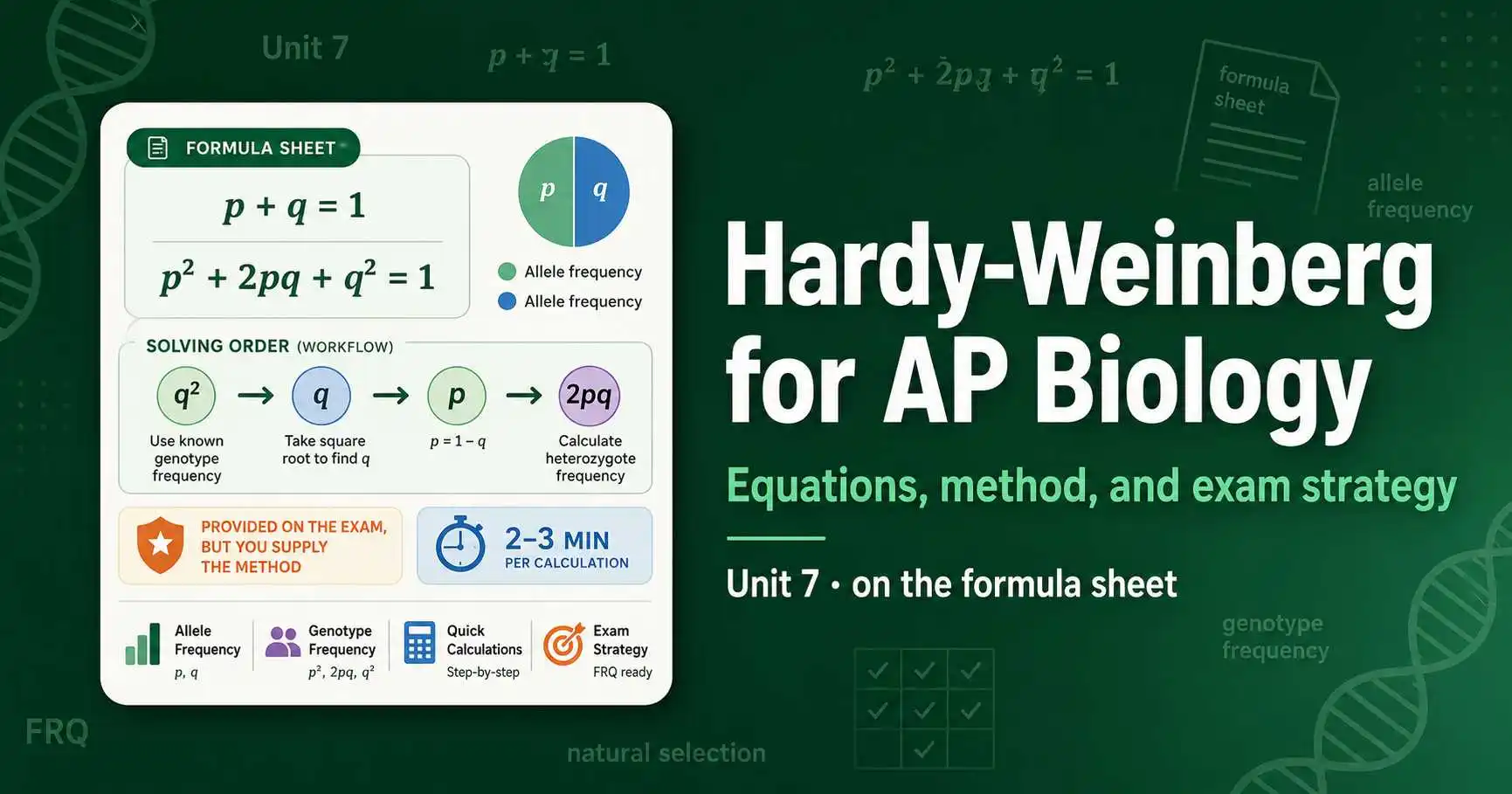
Hardy-Weinberg equilibrium is a required topic in AP Biology, appearing in Unit 7 on natural selection, and both of its equations are printed on the formula sheet you receive during the exam. The sheet gives you p + q = 1 and p² + 2pq + q² = 1, but it does not tell you how to use them, so the points come from knowing the method. AP questions test whether you can calculate allele and genotype frequencies and, just as often, explain why a population deviates from equilibrium, a connection between evolution and heredity that exam writers favor.
This guide covers everything an AP Biology student needs for Hardy-Weinberg: what the formula sheet provides, the step-by-step solving method, how the topic appears in both multiple-choice and free-response questions, the five conditions, and the specific mistakes that cost points. The calculations are straightforward once you know the sequence, and they are among the most reliable points on the exam. The calculations can be practised with a calculator while you study, but you should confirm you can do them by hand for test day.
Where Hardy-Weinberg Fits in the AP Curriculum
Hardy-Weinberg lives in Unit 7 of the AP Biology course, the unit on natural selection, which together with the rest of evolution makes up a substantial portion of the exam. The College Board treats evolution as the unifying theme of biology, so this material carries real weight and rewards solid preparation.
The placement in the natural selection unit is meaningful, because it frames how the topic is tested. Hardy-Weinberg is presented as the null model for evolution: the description of a population that is not evolving, against which real, evolving populations are compared. This means AP questions rarely treat the equation as pure math divorced from biology. Instead, they connect the calculation to evolutionary concepts, asking you to interpret what a result means or to explain why a population might not be in equilibrium.
A particularly important feature of the AP exam is its love of cross-unit connections, and Hardy-Weinberg is a prime example. The topic bridges Unit 7 on natural selection and Unit 5 on heredity, since it applies the allele and genotype logic of inheritance to whole populations. Exam writers frequently design questions that require you to combine these areas, for instance by using a genetic cross or pedigree concept alongside a population-level calculation. Recognizing that Hardy-Weinberg sits at this intersection helps you anticipate the kind of integrated reasoning the exam expects.
It is also worth knowing how heavily this content is weighted. Evolution and natural selection together account for a large share of the exam, and the College Board's chief reader reports repeatedly flag heredity and population-level reasoning as areas where students lose points. That makes Hardy-Weinberg a high-value topic to master: it appears reliably, the points are accessible, and many students underperform on it simply because they have not drilled the method. Putting in the preparation here yields a better return than almost any equally sized topic on the exam.
What the Formula Sheet Gives You
On exam day, the AP Biology formula sheet provides both Hardy-Weinberg equations, which removes any need to memorize them. The sheet lists p + q = 1 and p² + 2pq + q² = 1, along with the definitions that p is the frequency of one allele and q is the frequency of the other allele in a population.
This is genuinely helpful, but it has an important limitation: the formula sheet gives you the equations, not the method. It does not tell you that p² is the homozygous dominant frequency, that 2pq is the heterozygous frequency, or that q² is the homozygous recessive frequency. It does not tell you to start from the recessive phenotype, take a square root, and work toward the other values. All of that procedural knowledge is what you must bring yourself, and it is where the actual exam points are won or lost.
So the right way to think about the formula sheet is as a memory aid for the equations, freeing you to focus on understanding what each term means and how to move between them. Spend your preparation time not on memorizing the equations, which are provided, but on mastering the solving sequence and the meaning of each variable. A student who knows that q² is the observable recessive phenotype frequency, and who can chain from there to q, p, p², and 2pq, has everything needed, since the equations themselves are handed to them. The deeper mechanics of this sequence are laid out in our guide on using the Hardy-Weinberg equation.
The Solving Method for AP Problems
Nearly every AP Hardy-Weinberg calculation follows the same sequence, and committing it to memory makes these problems fast and reliable. The method starts from the one quantity you can usually observe and works systematically to everything else.
Begin with q², the frequency of the homozygous recessive individuals, which is the proportion showing the recessive phenotype. This is the standard entry point because the recessive phenotype maps to a single genotype, unlike the dominant phenotype. Take the square root of q² to get q, the recessive allele frequency. Use p + q = 1 to find p, the dominant allele frequency, by subtracting q from 1. Then square p to find p², the homozygous dominant frequency, and calculate 2pq for the heterozygous frequency. Finally, verify that p² + 2pq + q² sums to 1, allowing for slight rounding.
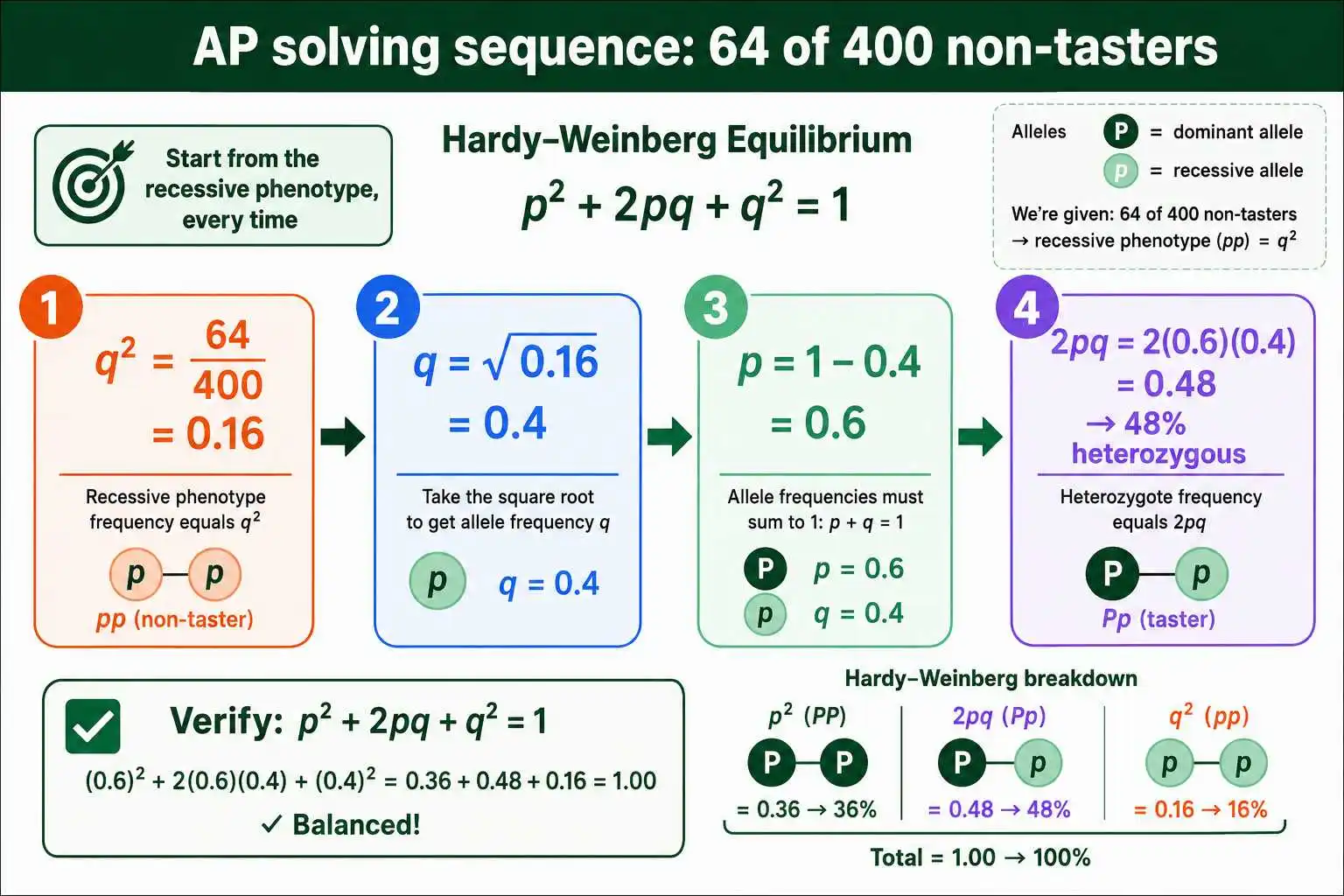
Consider a classic AP-style example: in a population, 64 out of 400 students cannot taste a particular chemical, a recessive trait, and you are asked for the percentage of heterozygous tasters. Start with q², which is 64 divided by 400, giving 0.16. The square root gives q equals 0.4. Then p equals 1 minus 0.4, which is 0.6. The heterozygous frequency 2pq is 2 times 0.6 times 0.4, which is 0.48, so 48 percent of the students are heterozygous. This sequence, recessive phenotype to q² to q to p to the target genotype, handles the overwhelming majority of AP questions. A time-management note worth internalizing: a Hardy-Weinberg calculation should take only two to three minutes, so do not let it eat into time for longer free-response sections.
How It Appears in Multiple-Choice Questions
In the multiple-choice section, Hardy-Weinberg questions tend to test either a quick calculation or a conceptual understanding of the principle. Knowing both flavors helps you move efficiently through these items.
Calculation-based multiple-choice questions give you a starting value, often the frequency of affected individuals or an allele frequency, and ask for a genotype or allele frequency. Because you cannot show work for partial credit here, accuracy and speed matter, and the answer choices are usually spaced far enough apart that a correctly executed calculation lands cleanly on one option. Watch for the common trap where one wrong answer choice is the value you would get by forgetting to take the square root, a deliberate distractor. Doing the full sequence carefully avoids it.
Conceptual multiple-choice questions test whether you understand what Hardy-Weinberg means rather than asking you to compute. These might ask which condition is being violated in a described scenario, what a deviation from equilibrium indicates, or why a dominant allele does not automatically increase in frequency. For these, the key is understanding that equilibrium represents a non-evolving population and that deviations signal evolutionary forces at work. A solid grasp of the five conditions and their connection to the forces of evolution answers most conceptual questions without any calculation at all.
How It Appears in Free-Response Questions
Free-response questions are where Hardy-Weinberg points are most often won or lost, because they require showing your method and explaining your reasoning. The good news is that the rubric rewards clear, step-by-step work, so a disciplined approach scores well.
A typical free-response part asks you to calculate one or more frequencies from given data. Here, showing each step is essential, because AP readers award points for the correct setup and intermediate steps, not just the final number. Write out q², the square root to get q, the use of p + q = 1, and the target calculation, labeling each. Even if you make a small arithmetic slip, clearly shown correct method can still earn most of the points. Always label which equation you are using and what each value represents, since unlabeled numbers are harder for readers to credit.
The second common free-response task is explanatory: you may be asked why a population deviates from Hardy-Weinberg equilibrium, or to identify which condition is violated in a given scenario. This is where the cross-connection to evolution pays off. Use the five conditions as a checklist, identify which assumption the scenario breaks, and name the evolutionary mechanism responsible, whether natural selection, genetic drift, gene flow, mutation, or non-random mating. A strong answer both names the violated condition and explains the mechanism in a sentence. This kind of integrated question, linking calculation to evolutionary reasoning, is exactly what the cross-unit design of the exam favors, and it also connects to the chi-square analysis used in AP Biology for testing deviations statistically.
The Five Conditions for AP
The AP exam expects you to know the five conditions for Hardy-Weinberg equilibrium, both to answer conceptual questions and to explain deviations. These conditions describe a population that is not evolving, and each corresponds to an evolutionary force that is absent.
The five conditions are a large population size, random mating, no mutation, no migration or gene flow, and no natural selection. A large population rules out genetic drift, the random change in allele frequencies in small populations. Random mating ensures alleles combine by chance, producing the predicted genotype ratios. No mutation means no new alleles are introduced. No migration means no alleles enter or leave through movement between populations. No natural selection means all genotypes survive and reproduce equally, so no allele is favored.
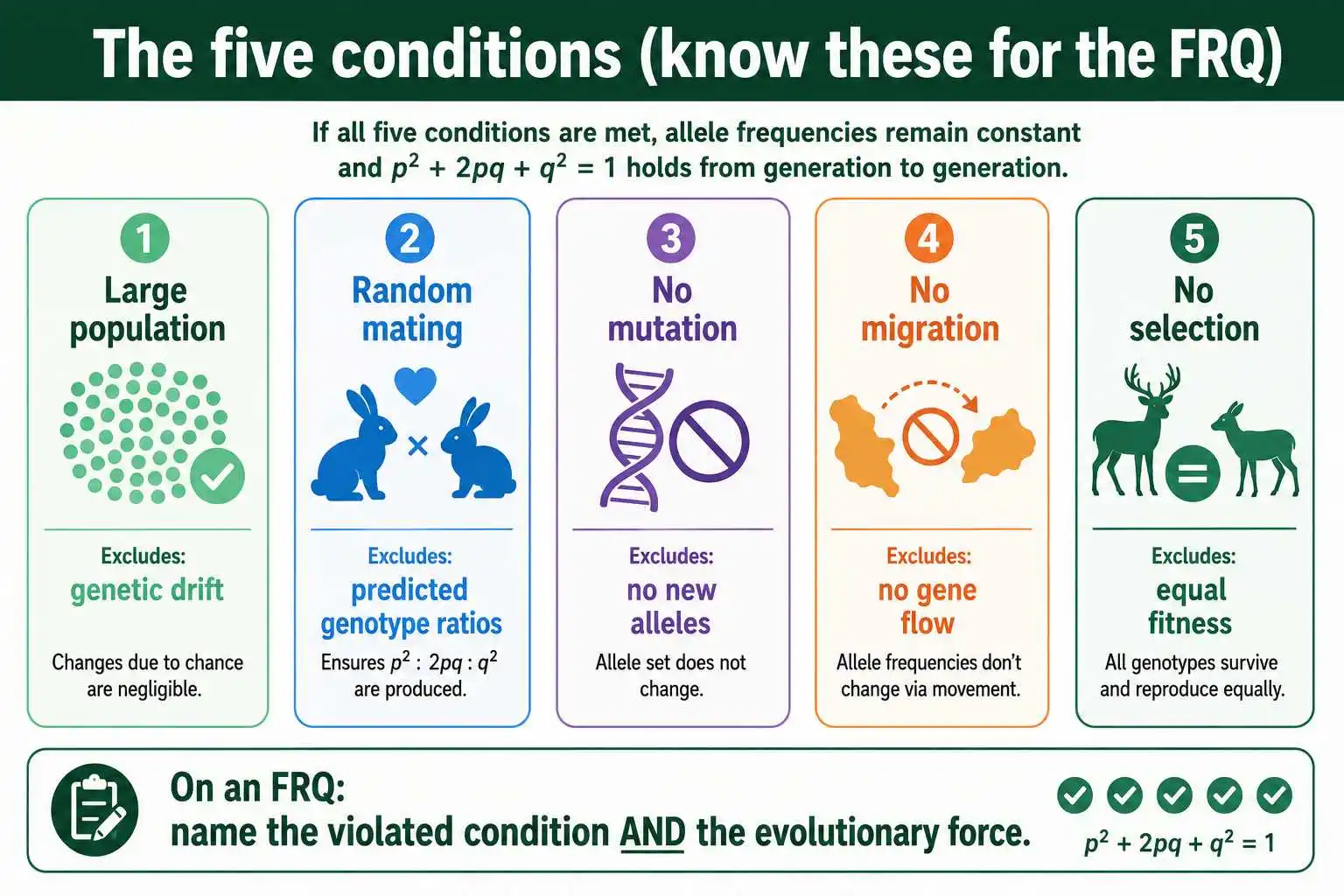
Many AP students use a mnemonic to recall the five, and any device that works for you is fine, since the exam simply expects you to produce and apply them. More important than rote recall is understanding that each condition, when violated, allows a specific evolutionary force to change allele frequencies, except non-random mating, which changes only genotype frequencies. When a free-response question describes a scenario, your task is to match the described situation to the violated condition and the corresponding force. The detailed treatment of each condition is covered in our guide to the assumptions of Hardy-Weinberg, which is worth reviewing before the exam.
Common AP Mistakes to Avoid
A handful of errors account for most lost Hardy-Weinberg points on the AP exam, and they are entirely avoidable with awareness. Each one is a predictable trap that exam writers know students fall into.
The most common mistake is forgetting to take the square root of q². The recessive phenotype frequency gives you q², not q, so you must take the square root before using the value as an allele frequency in 2pq or p + q = 1. A closely related error is confusing q, the allele frequency, with q², the genotype frequency; these are different quantities, and mixing them up derails the whole problem. A third frequent error is confusing the two equations, applying p + q = 1 when the genotype equation is needed or vice versa. Remember that p + q = 1 deals with alleles, while p² + 2pq + q² = 1 deals with genotypes.
Other avoidable mistakes include forgetting the factor of 2 in the heterozygous term, writing pq instead of 2pq, and failing to show work on free-response questions, which forfeits the partial credit that clear steps earn. A subtle conceptual error is assuming that a dominant allele or trait should be more common than a recessive one; dominance describes expression, not frequency. Guarding against these specific mistakes, especially the square-root step and the allele-versus-genotype distinction, protects the points that careless errors would otherwise cost. The habit of verifying that your three genotype frequencies sum to 1 catches many of these slips before you finalize an answer.
A Full Worked Free-Response Example
To see how the pieces come together under exam conditions, work through a complete free-response style problem with the kind of layout that earns full marks. The key is to show every step clearly and label your values.
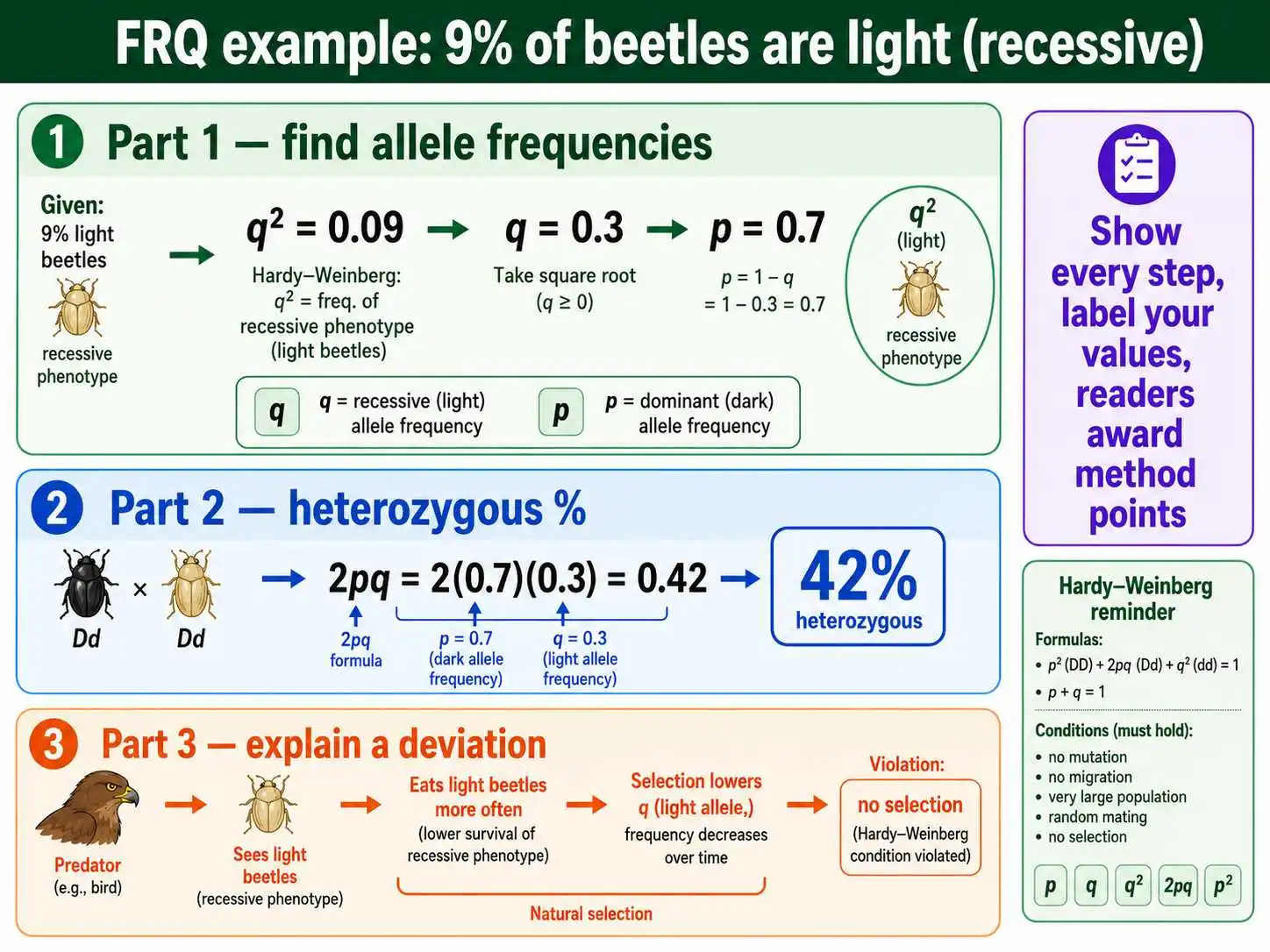
Suppose a question states that in a population of beetles, body color follows a single gene where dark (D) is dominant to light (d), and 9 percent of the beetles are light-colored. Part one asks for the frequency of the dark allele. Part two asks what percentage of the population is heterozygous. Part three asks you to explain one reason the population might not remain in Hardy-Weinberg equilibrium.
For part one, begin with the recessive phenotype. Light beetles are homozygous recessive, so q² equals 0.09. Take the square root: q equals 0.3. Then the dark allele frequency p equals 1 minus 0.3, which is 0.7. Write each of these steps explicitly, labeling q² as the recessive phenotype frequency and noting the use of p + q = 1, because the readers award points for the method. For part two, the heterozygous frequency is 2pq, which is 2 times 0.7 times 0.3, equaling 0.42, so 42 percent of the beetles are heterozygous. Show the substitution, not just the answer. For part three, choose any one condition and link it to a mechanism: for example, if a predator can see light beetles more easily, natural selection would reduce the d allele frequency, violating the no-selection condition and pushing the population out of equilibrium. A complete answer names the condition and explains the mechanism in one clear sentence. This three-part structure, two calculations and one explanation, is a very common AP free-response pattern for this topic.
A Study Strategy for the Exam
Preparing Hardy-Weinberg for the AP exam is efficient if you focus on the right things, since the equations are given and the method is fixed. A targeted study plan turns this into reliable points rather than a source of anxiety.
Start by drilling the solving sequence until it is automatic, using a variety of starting points. Most problems give you the recessive phenotype frequency, but some give an allele frequency or a dominant phenotype frequency, so practise recognizing the entry point and routing to q² when needed. Work enough problems that the steps, square-root, subtract from 1, square, double, become muscle memory you can execute in two to three minutes. Then practise the explanatory side separately: given a scenario, name the violated condition and the evolutionary force. These two skills, calculating and explaining, are tested in different question types and both need rehearsal.
In the final review before the exam, concentrate on the high-yield points. Confirm you know what each term in p² + 2pq + q² means, that you reliably take the square root of q², and that you can distinguish the allele equation from the genotype equation. Review the five conditions and a one-sentence mechanism for each. Practise showing clean, labeled work so free-response readers can award every available point. As one AP review resource emphasizes, fluency with both the equations and the five conditions is exactly what the College Board expects for this high-frequency topic. With the equations provided and the method rehearsed, Hardy-Weinberg becomes one of the most secure and predictable scoring opportunities in the entire exam.
Frequently Asked Questions
Is Hardy-Weinberg on the AP Biology formula sheet?
Yes. The AP Biology formula sheet provides both equations, p + q = 1 and p² + 2pq + q² = 1, along with the definitions of p and q. However, it does not give the method for using them, so you must know the solving sequence and what each term represents.
What unit is Hardy-Weinberg in for AP Biology?
Hardy-Weinberg is part of Unit 7, natural selection, within the broader evolution content. It is presented as the null model for a non-evolving population, and exam questions often connect it to evolutionary mechanisms and to the heredity material in Unit 5.
How do you solve an AP Hardy-Weinberg problem?
Start with q², the recessive phenotype frequency, take its square root to find q, use p + q = 1 to find p, then square p for p² and calculate 2pq for heterozygotes. Show every step on free-response questions, and verify the genotype frequencies sum to 1.
What is the most common Hardy-Weinberg mistake on the AP exam?
Forgetting to take the square root of q². The recessive phenotype frequency is q², not q, so you must square-root it before using it as an allele frequency. Confusing q with q², and mixing up the two equations, are the next most common errors.
Scoring the Points on Test Day
Hardy-Weinberg is one of the more dependable sources of points on the AP Biology exam, because the equations are provided and the method is fixed. Master the solving sequence, start with q² from the recessive phenotype, square-root to q, find p, then compute the target frequency, and you can handle nearly any calculation the exam presents. The formula sheet covers the equations, so your preparation should focus on the method and the meaning of each term.
Equally important is the conceptual side: knowing the five conditions and being able to explain which one a scenario violates, naming the evolutionary force responsible. That cross-connection between calculation and evolution is exactly what the AP exam's integrated questions reward. Watch for the predictable mistakes, especially the square-root step, and show your work on free-response parts to capture partial credit. You can drill the calculations with the allele frequency calculator until the sequence is automatic. For the official equation reference as it appears on the exam, the College Board AP Biology free-response materials show the exact formula sheet you will be given on test day.