What Is Mutation Rate? (Explained)
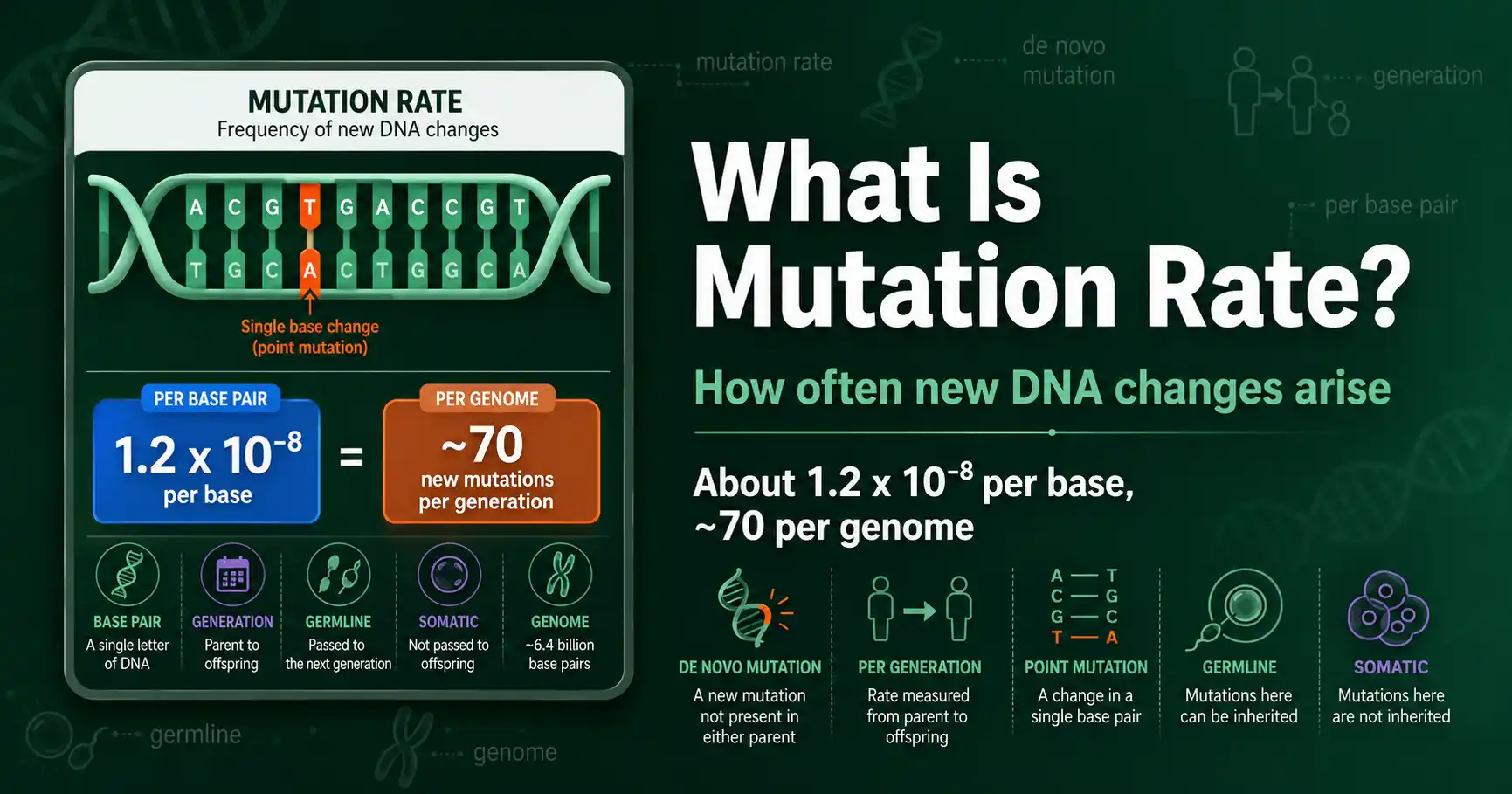
Mutation rate is how often new genetic changes arise in DNA, usually expressed per base pair per generation. In humans, the germline mutation rate is about 1.2 x 10^-8 per base pair per generation, which works out to roughly 70 new mutations in each person's genome that neither parent carried. That number is the raw input to evolution and a direct contributor to genetic disease.
This guide explains what mutation rate means, the different units it comes in, how germline and somatic rates differ, and why the rate matters. It is the starting point for everything mutation does in genetics, including its role as one of the forces that change allele frequencies, covered in our guide on Hardy-Weinberg equilibrium.
The Core Definition
Mutation rate is the frequency at which new mutations occur per unit of DNA per unit of time. The most common unit is per base pair per generation: the chance that any single position in the genome is altered when copied from parent to offspring.
For humans, that per-base rate is about 1.2 x 10^-8, meaning roughly one change for every 83 million bases copied. That sounds vanishingly small, and per base it is. But the genome is huge, so the small per-base rate adds up. With about 6.4 billion base pairs in a diploid genome, the per-base rate multiplies out to dozens of new mutations per person.
So mutation rate has two faces. Per base, it is tiny, which is why DNA copying is remarkably faithful. Per genome, it is substantial, which is why every individual carries new genetic variation their parents did not have. Both views are correct; they just describe the same rate at different scales. This dual nature is why mutation can be both rare enough to make inheritance reliable and common enough to drive evolution.
New Mutations in Every Genome
The clearest way to grasp the human mutation rate is through de novo mutations: the genetic changes present in a child but in neither parent. Every person carries a handful of them.
Studies that sequence parents and their children directly count these new mutations. The consistent finding is that each person carries on the order of 70 de novo single-nucleotide changes across their genome, with most studies landing in the range of about 45 to 70 depending on parental age and method. These are brand-new mutations, arising during the formation of the egg or sperm, or shortly after fertilization.
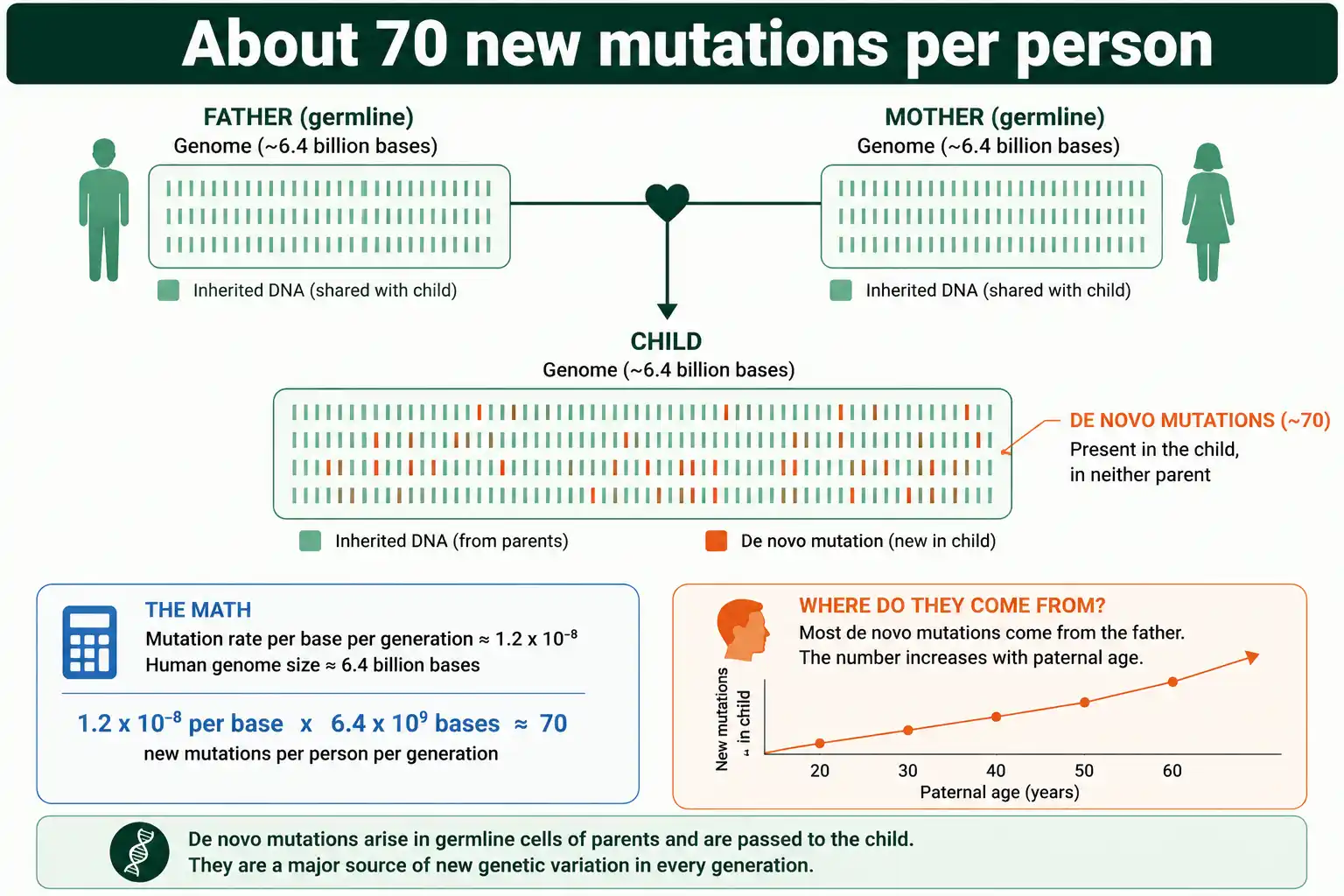
This is the mutation rate made concrete. The abstract figure of 1.2 x 10^-8 per base is the same thing as "about 70 new mutations per person," just expressed per base rather than per genome. Multiply the per-base rate by the genome size and you recover the per-genome count. The number was pinned down by large family-sequencing studies, including influential work led by Augustine Kong and colleagues in 2012, which also revealed how strongly the rate depends on the father's age.
The Units of Mutation Rate
Mutation rate is reported in several units, and they answer different questions. Confusing them is a common source of error, so it helps to keep them straight.
Per base pair per generation is the standard for germline mutation in multicellular organisms, the 1.2 x 10^-8 figure for humans. Per genome per generation expresses the same rate as a whole-genome count, the roughly 70 mutations per person. Per cell division is used for organisms or contexts where generations are not the natural unit, such as bacteria or somatic cell lineages. Per year is used in molecular evolution, where calibrating to absolute time matters more than to generations.
Converting between them requires knowing the relevant scale: genome size to go from per-base to per-genome, the number of cell divisions per generation to go from per-division to per-generation, and generation time to go from per-generation to per-year. You can move between per-base and per-genome figures for any genome size with a mutation rate calculator. The key point is that a single biological reality, how often DNA changes, can look very different depending on which unit you choose, so always check which one a source is using. A per-base rate of 10^-8 and a per-genome rate of 70 can describe the exact same organism, and quoting one when you mean the other is a frequent and avoidable mistake.
Germline Versus Somatic Mutations
Mutations fall into two categories with very different consequences: germline and somatic. The distinction is about which cells carry the mutation.
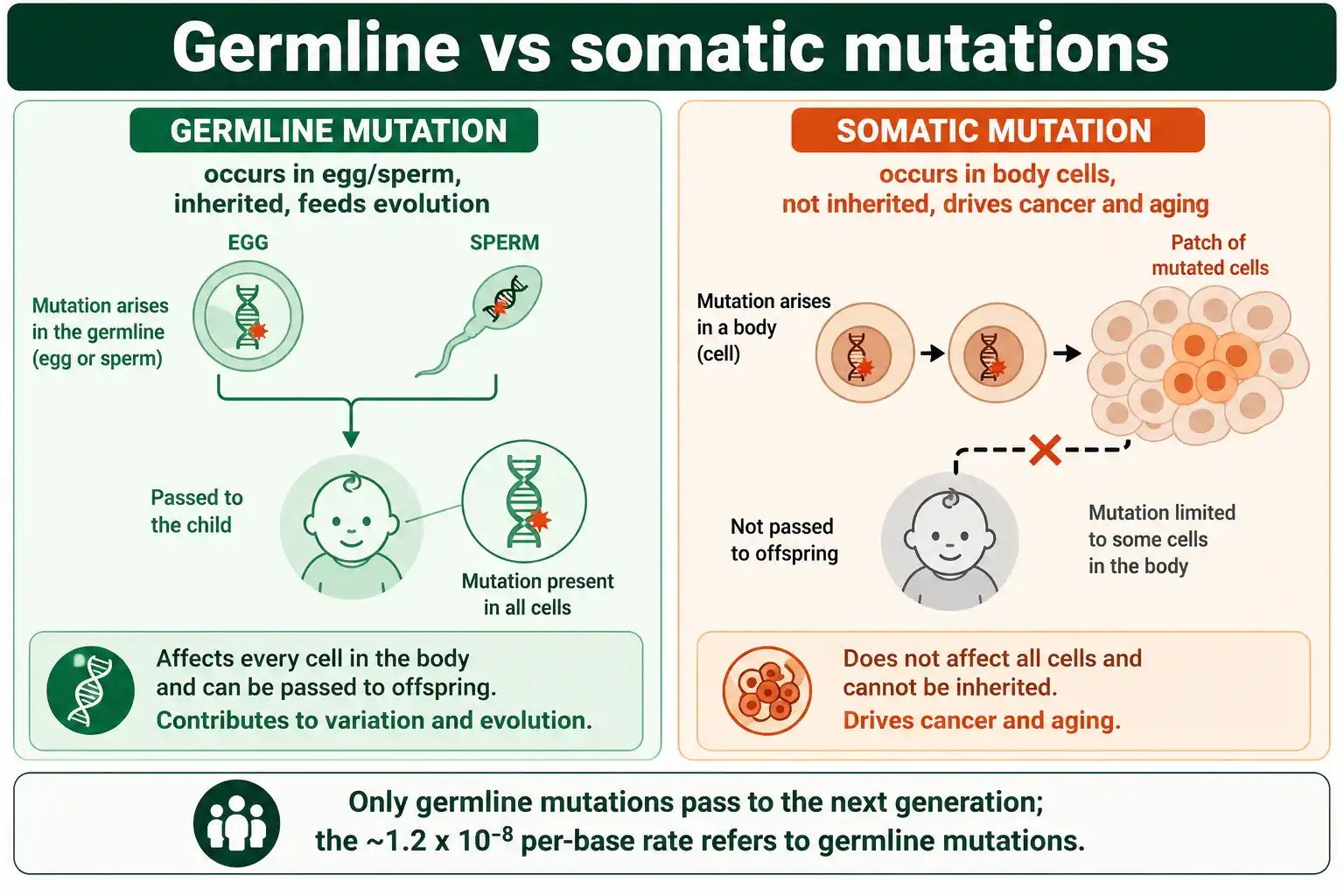
Germline mutations occur in the cells that produce eggs and sperm, so they can be passed to offspring. These are the mutations that matter for inheritance and evolution, because they enter the next generation. The 1.2 x 10^-8 per-base rate and the 70-mutations-per-person figure refer to germline mutations.
Somatic mutations occur in the body's other cells, the non-reproductive ones, so they are not inherited. A somatic mutation affects only the individual and the cellular descendants of the mutated cell. Somatic mutations matter enormously for the individual, since they drive cancer and contribute to aging, but they do not pass to children. Somatic mutation rates are generally higher than germline rates, partly because somatic cells lack the extra protective mechanisms that guard the germline. Keeping the two apart is essential: only germline mutations feed evolution, while somatic mutations shape an individual's own health.
How Rates Vary Across Species
The per-base mutation rate is not the same in every organism, and the pattern of variation is itself revealing. Comparing species shows what shapes the rate.
Per base pair per generation, humans sit around 1.2 x 10^-8. Mice are lower, around 3.5 to 5.4 x 10^-9. Invertebrates like the fruit fly Drosophila and the nematode C. elegans are lower still, near 2.8 x 10^-9 and 2.7 x 10^-9. Broadly, organisms with larger genomes and longer generations tend to have lower per-base rates, which keeps the per-genome burden of new mutations from spiraling out of control.
A classic observation, often called Drake's rule after John Drake and colleagues in 1998, is that across microbes with DNA genomes the mutation rate per genome per replication is roughly constant, even though per-base rates vary enormously with genome size. Larger genomes evolved lower per-base rates, holding the whole-genome total steady. The pattern does not hold perfectly across all life, but it captures a real force: selection tunes the per-base rate so the total mutational load stays tolerable. The mutation rate, in other words, is itself an evolved trait, not a fixed constant of chemistry.
Why Mutation Rate Matters
Mutation rate matters because mutation is the ultimate source of all genetic variation. Without it, there would be nothing for evolution to act on. Three roles stand out.
The first is fueling evolution. Every allele that natural selection or genetic drift ever acts on began as a mutation. The mutation rate sets the pace at which new variation appears, which influences how fast populations can adapt. Too low a rate starves evolution of raw material; too high a rate floods the genome with harmful changes.
The second is causing genetic disease. Many genetic disorders arise from de novo mutations, new changes in a child not inherited from either parent. Because each person carries dozens of new mutations, a few will occasionally land in important genes, which is why some genetic conditions appear with no family history. This connects the mutation rate directly to human health.
The paternal age effect sharpens this link. Because sperm-producing cells keep dividing throughout a man's life, while egg cells do not, most new mutations come from the father, and the number rises with his age at conception. Each additional year of paternal age adds roughly one to two more de novo mutations to the child, which is part of why the children of older fathers carry a modestly higher risk of certain genetic conditions. The mutation rate is therefore not a single fixed number even within humans; it varies with age, sex, and individual, around the 1.2 x 10^-8 average.
The third is timing evolutionary history. Because mutations accumulate at a roughly steady rate over long periods, the number of genetic differences between two species estimates how long ago they shared a common ancestor. This molecular clock, built on the mutation rate, is one of the main tools for dating the tree of life.
How the Rate Is Estimated
Mutation rates are measured two main ways, which our methods guide covers in full. Both are worth knowing in outline.
The direct method sequences parents and their offspring and counts the new mutations present in the child but absent in both parents. This became possible only with cheap whole-genome sequencing, and it gives the most direct estimate of the current per-generation rate. It is how the 70-mutations-per-person figure was established.
The indirect method compares DNA sequences between species and uses the number of differences, together with the time since they diverged, to infer the rate at which mutations have accumulated. This was the only option before modern sequencing and is still used for species that cannot be bred and sequenced in families. The two methods can disagree, and reconciling them is an active area of research. The full procedures, including the per-site math and a worked example, are covered separately in the calculation walkthrough.
Frequently Asked Questions
What is the human mutation rate?
The human germline mutation rate is about 1.2 x 10^-8 per base pair per generation. Across the whole diploid genome of roughly 6.4 billion base pairs, that amounts to approximately 70 new mutations per person that neither parent carried, with estimates ranging from about 45 to 70 depending on parental age and study method.
What is the difference between germline and somatic mutations?
Germline mutations occur in egg and sperm cells and can be passed to offspring, so they matter for inheritance and evolution. Somatic mutations occur in the body's other cells and are not inherited, affecting only the individual. Somatic mutations drive cancer and aging, while germline mutations feed the next generation.
The Short Version
Mutation rate is how often new genetic changes arise, usually given per base pair per generation. The human germline rate is about 1.2 x 10^-8 per base, which adds up to roughly 70 new mutations in each person's genome. The same rate can be expressed per base, per genome, per cell division, or per year, so the unit always matters.
Germline mutations, the inherited ones, are the rate that feeds evolution and contributes to genetic disease, while somatic mutations affect only the individual. Mutation rate is the raw material of evolution, a source of genetic disorders, and the basis of the molecular clock. To see how the figure is actually measured from real data, the next step is our guide on how to calculate mutation rate.